

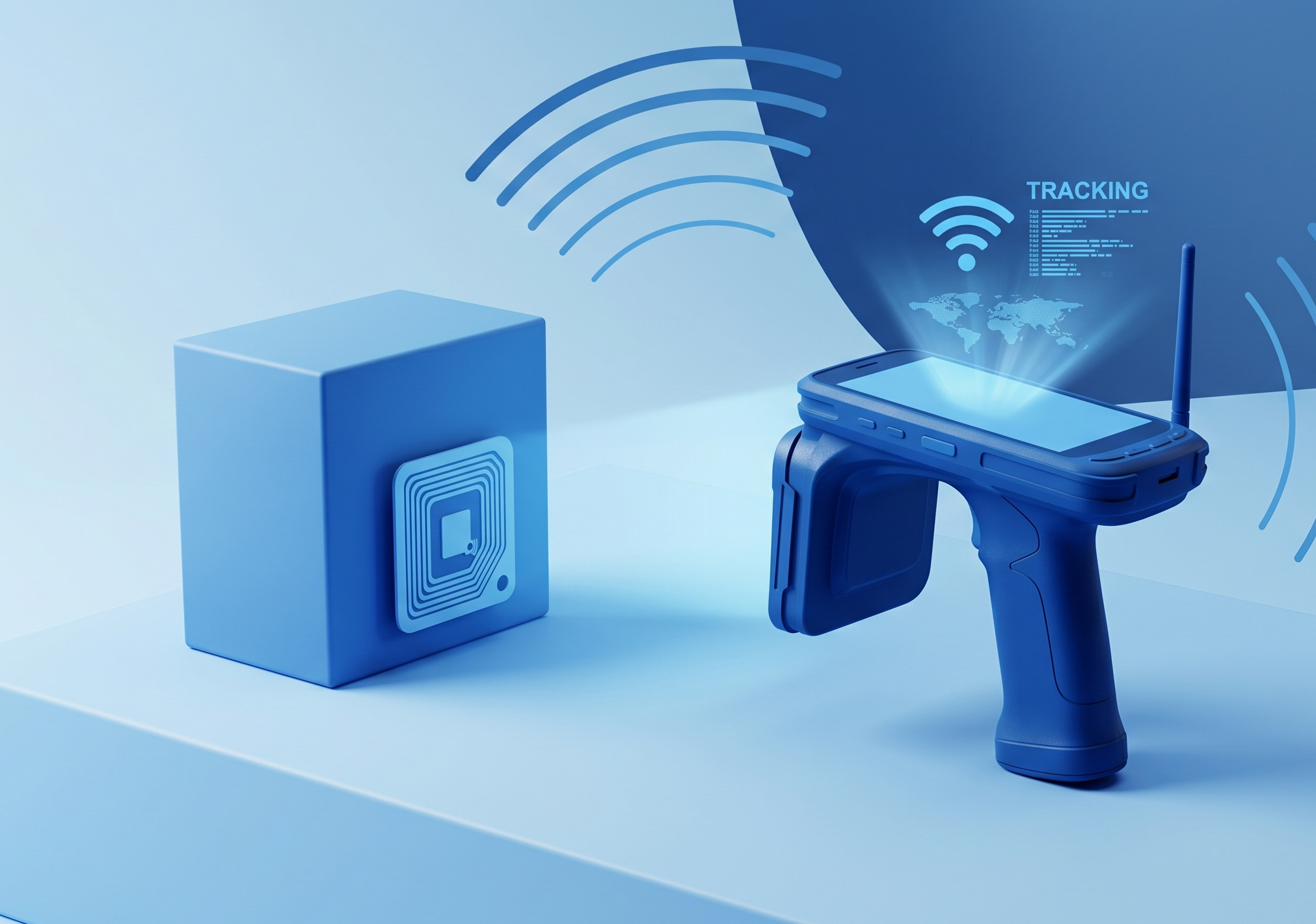
Congratulations on your purchase of a “smart” RFID pallet! With your purchase, you get two things: an alert when your pallet leaves one site, and an alert when it arrives at another.
Disappointed?
You should be. What’s being packaged and sold as smart pallet technology is, in most cases, a ten-cent sticker slapped onto a rickety wooden pallet. The “real-time tracking” in the marketing materials refers to a handful of timestamps per leg of a journey. Everything that happens to your product in between, the “visibility” which you so desire? Nowhere to be seen.
That’s not a tracking system. That’s a low effort way to confirm that your pallet moved.
What RFID Pallet Tracking Actually Does
Passive RFID tags have no onboard power; instead, they respond when a fixed reader scans them at close range (about 30 feet, maximum), usually at the dock doors or conveyor gates. You get a tag ID and a timestamp, and that’s the complete data record for that event. Between those fixed read points, there is no data. On the truck: nothing. At the third-party cross-dock: nothing. Staged at the customer site before unloading: nothing. These gaps aren’t a limitation you can engineer around but rather are truly structural to how the technology works.
That isn't to say RFID is all bad, or even bad at all. It’s great when your favorite department store is trying to catch shoplifting or when a library wants to know which books are on which shelves. APS pallets include RFID tags for exactly this reason, supporting in-DC and in-warehouse scanning workflows alongside the embedded cellular hardware.
The problem is the claim. When a pallet pooler tells you their product offers real-time tracking, they’re applying a technology designed for fixed-point scanning to a problem that requires continuous, in-transit visibility. Those are vastly different problems.
Why RFID Pallet Tracking Isn’t Real-Time
Real-time means continuous. It means you can pull up an asset’s location and condition at any moment and get a current answer. If you only have an RFID scanner at your DC in Kansas City and another at the client’s location in St. Louis, you have no way of knowing if your pallet is en-route or lost in the Florida Everglades.
What RFID does is log discrete events at predetermined checkpoints. Calling that real-time tracking is like calling a timecard real-time employee monitoring. You know when someone clocked in, but you have no idea if they’ve been kicking it in the break room all day.
For most supply chain operations, the things that go wrong happen in between.
What Real Real-Time Pallet Tracking Looks Like
If you’re moving temperature-sensitive goods, you need to know the full thermal history of a shipment, not just that it arrived. If you’re managing damage claims, you need time-stamped shock data, not a dock-door timestamp from 36 hours prior. If you're building a compliance record, you need continuous, sensor-generated data, not inferred events from infrastructure you don’t control at every node.
And if you’re moving any type of goods at all, you probably want to know they’re safe and accounted for en-route, rather than sitting on the side of a highway or speeding away in a cargo thief’s truck.
GPS and cellular IoT solve these problems: the sensor travels with the pallet because the sensor is part of the pallet. There’s no fixed infrastructure to depend on, no read-point gaps, no missing hours. Location updates periodically over cellular networks, while temperature, humidity, shock, and load state log exception events. The data is primary source: generated by the pallet, not inferred from a gate event.
RFID vs. Pulse at a Glance
Questions to Ask Before You Trust a Pallet Tracking Vendor
If you’re evaluating pallet tracking technology, ask the vendor where location data updates. If the answer involves dock doors, gateways, or reader infrastructure, you’re looking at a scanning system. Ask what environmental parameters are logged, and whether that data is sensor-generated or estimated. Ask what the data looks like for a pallet that spent six hours on a truck between two facilities with no fixed readers.
The answers will tell you whether you’re buying true visibility into your supply chain, or a system that goes dark between the dock doors.
The Bottom Line on RFID Pallet Tracking
RFID isn't a bad technology; it's just the wrong tool for a job it was never built to do. If your pallets are carrying anything time-sensitive, high-value, or compliance-critical, the six hours between dock doors are exactly the hours you can't afford to lose visibility on.