
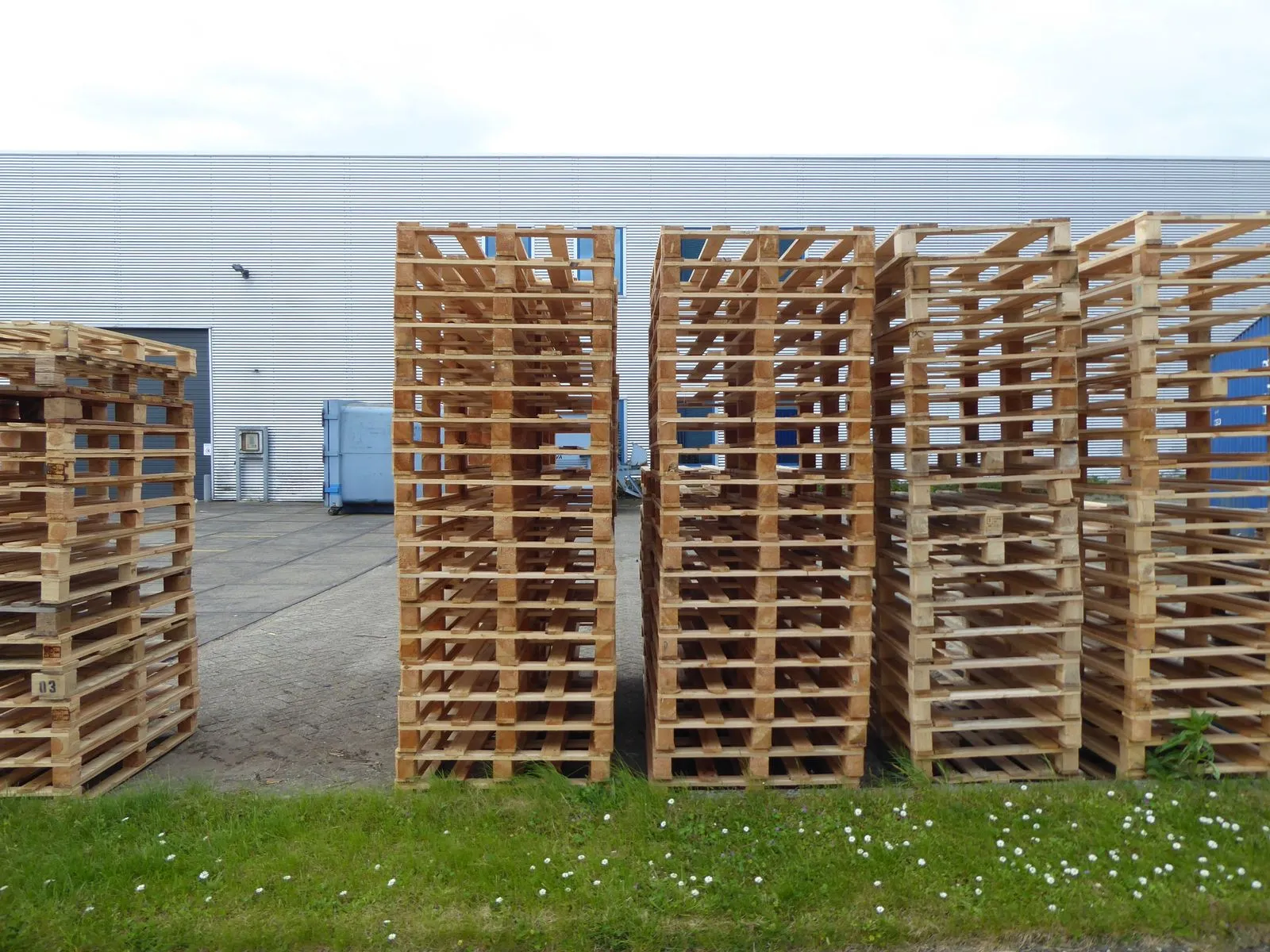
U.S. pallet makers built an estimated 919 million new wood pallets in 2021 and produced another 280 million repaired or remanufactured ones, according to a 2024 Virginia Tech survey of the industry. By the same study's count, wood pallets carry about 80 percent of all products shipped domestically. So when a supplier calls a pallet sustainable, the useful question is how many loads it carries, whether it comes back, and where it goes when it is done.
We lease Smart Pallets made from 100% recycled HDPE, with a sensor built in and one monthly lease that covers the pallet, the sensor and the software, with retrieval, repair and recycling handled by us. So we have a stake in this list, and we say so. Where our own figures appear, they are labeled as ours. Everything else comes from public sources you can check, listed at the end.
Key Takeaways
- Judge a pallet per trip. A 2019 review of 16 pallet life cycle studies found a trip-based unit the most appropriate way to measure what a pallet does.
- Wood's recovery record is real. Virginia Tech found 95 to 97 percent of U.S. wood pallets are repaired, reused in repairs or turned into by-products.
- Recyclable is not the same as recycled. The FTC's Green Guides tie a recyclable claim to an established recycling program, so ask who takes the pallet back.
- Presswood and corrugated pallets sit outside ISPM 15 treatment rules and are sold for one-way or limited reuse, which makes them export tools more than loop assets.
- Under an APS lease the pallet comes back to us at end of life, and the recovery and recycling data is available for your Scope 3 reporting.
How to Measure Sustainable Pallets
Sustainable pallets carry more loads for each pound of new material and finish their working life as high as possible on the EPA waste management hierarchy. From most to least preferred, the EPA ranks them: source reduction and reuse, recycling and composting, energy recovery, and treatment and disposal. A pallet that keeps getting reused sits at the top. A pallet ground into boiler fuel sits two rungs down.
Material is the claim most suppliers lead with, and on its own it proves the least. Our sustainability page puts the test this way: "Plastic pallets can be more sustainable when they are made from recycled material, used repeatedly, recovered at end of life, and kept in a closed loop." All four conditions have to hold. It works for reusable pallets of any material, wood included. Five questions turn it into something you can score.
- Trips Per Pallet Count the loads a pallet carries over its life and spread its footprint across them. A 2019 review of 16 pallet life cycle studies in the journal Sustainability concluded that a trip-based functional unit "seems the most appropriate" way to account for what a pallet does.
- Recovery Rate A reusable pallet that never comes back is a single-use pallet that cost more. Loss rates swing widely by program, as our reusable packaging recovery statistics show.
- Material Source Ask how much of the pallet is recycled content, and where that content came from.
- End-of-Life Route Ask where the pallet goes when it can no longer carry a load: into a new pallet, into mulch or fuel, or into a landfill. Each step down the EPA's list is a weaker claim.
- Proof Ask whether you can show the first four answers in a report. A program with no record of where its pallets went leaves you estimating.
Key Takeaway
Score a pallet on trips, recovery and end of life together. Recycled material without a route back is half a claim.
Sustainable Pallet Options Compared
Seven options come up when shippers look for a greener pallet. Three are plastic or plastic programs, two are wood systems, and two are one-way materials that exporters favor. Below, each one is scored against the questions above, then given its own section.
| Option | Made From | How It Is Reused | End of Life | ISPM 15 |
|---|---|---|---|---|
| Recycled plastic | Recycled plastic resin | Many trips if recovered | Regrind, if returned | Outside its scope |
| Closed-loop plastic | Plastic, often recycled | Returns to origin | Up to the owner | Outside its scope |
| Leased with take-back | Recycled HDPE at APS | Lessor runs returns | Lessor takes it back | Outside its scope |
| Pooled wood | Wood, owned by a pooler | Pooler handles returns | Repair, mulch or fuel | Treatment and mark |
| Recycled wood | Recovered wood boards | Repaired or rebuilt | Repair, mulch or fuel | Mark, re-treat if rebuilt |
| Presswood | Pressed wood waste | Limited reuse | Not reparable | Exempt |
| Corrugated | Corrugated paperboard | Mostly one way | Paper recycling | Outside its scope |
No option wins every column. Plastic and leased options win on trips and on a defined route back. Wood wins on a recovery industry that already exists in every region. Presswood and corrugated win where the pallet is never coming home.
Recycled Plastic Pallets
Recycled plastic pallets are molded from resin that already had a first life. Ours come from bottles, containers and industrial scrap, as we explained in our post on pallets made from milk jugs. For recycled plastic pallets, the case starts at the resin. A Franklin Associates study the Association of Plastic Recyclers published in January 2019 found that producing post-consumer recycled HDPE resin took 88 percent less total energy and cut greenhouse gas emissions by 71 percent compared with virgin HDPE resin, as Waste Dive reported. That is a resin figure, not a pallet life cycle study.
APS Smart Pallets are made from 100% recycled HDPE, post-consumer and post-industrial, and the spec sheet for the APS 48 x 40 reads "Pallets & Technology Made In The U.S.A." Our sustainability page lists 60 million pounds of plastic recycled and reprocessed a year, 240,000 pounds in 24 hours, and 88.5% of our manufacturing powered by renewable energy. Those are our figures, for APS and its manufacturing partner.
Recycled content starts the claim. It does not finish it. A recycled plastic pallet that leaves your network after a few loads has spent its head start on someone else's dock, which is why the next two options matter more than the resin.
Reusable Plastic Pallets in a Closed Loop
Reusable plastic pallets earn their footprint back through trips, and trips depend on the loop. The Reusable Packaging Association calls closed-loop systems ideal for reusable transport packaging and describes them this way: "Reusable containers and pallets flow through the system and return empty to their original starting point."
A closed loop is your own plants, DCs, co-packers and the customers who send pallets back. The tighter the loop, the higher the trip count. Our spec sheet for the APS 48 x 40 lists a 10x longer lifespan than wood, and our sustainability page estimates roughly 100 to 200+ trips before recycling. That is our estimate, and it assumes the pallet keeps coming back.
Durability also changes what happens between trips. Our sustainability page says: "APS plastic pallets will not absorb water, rot, or harbor bacteria under normal use." They can be washed and sent back out, so a dirty pallet is a cleaning job rather than a replacement.
The weak point is the one that sinks every reusable program: recovery. When an owned pallet goes missing, the owner buys another, and the footprint of the lost one is spread over fewer trips. Reusable plastic pallets reward the shippers who can see where their pallets are.
Leased Pallets With End of Life Take-Back
A lease hands the recovery problem to the company that owns the pallets. That is how we run APS. One flat monthly lease covers the pallet, the sensor, and Pulse, the platform that reads it. As our sector pages put it: "Retrieval, repair and recycling stay on our side of the fence, including at sites you do not operate directly."
End of life is written into the deal. The Closed-Loop Guarantee on our Why Plastic page reads: "When a pallet reaches end of life, we take it back. That is not a sustainability claim. It is a contractual commitment baked into how we operate." The pallet goes back into the APS HDPE stream, where it is recovered and recycled again.
What makes recovery measurable is the sensor.
Most programs start with four readings, location, temperature, humidity and shock, and the pallet reports when something changes or crosses a threshold. If a pallet goes quiet, our technology page is direct about it: "A missing report is itself a signal." Pulse flags the gap so someone investigates, instead of the pallet quietly dropping out of the fleet.
Our all-inclusive lease is designed to price at or below what companies are already paying for traditional wood pallet programs, and the fleet stays an operating cost. Most partners start with a single lane or a defined pallet count before scaling.
A lease fits closed loops at volume. It is not built for one-off export loads or for a buyer who wants to own the pallets outright.
Pooled Wood Pallets
Pooled wood pallets are owned by a pooling company and rented to the shippers who use them. The Reusable Packaging Association describes the model in one line: "With pallet and container pooling, companies outsource the logistics of pallet and/or container management." The pooling company sets up a network to handle the return of the empties.
That network is the real strength of pooling.
An open loop is one where pallets scatter to receivers who will never ship them back to you, and the same RPA guide notes that open-loop systems often need a third-party pooling company to handle the return. If that describes your network, a pool is built for it, and every pallet it reissues is one nobody had to build.
Pooling has trade-offs too, and they come with the material and the model. A pooled pallet is still solid wood, so it shares wood's end-of-life routes, from repair to mulch or fuel, and it needs ISPM 15 treatment and marking for most international lanes. It also leaves your control at the dock, so the trip and recovery numbers in your sustainability report come from the pooler, not from your own lanes.
Recycled Wood Pallets
Recycled wood pallets are used pallets that have been repaired, or taken apart and rebuilt from recovered boards. It is a large, working market. Sean Hobbs's 2024 Virginia Tech study found that U.S. companies produced 280 million repaired and remanufactured pallets in 2021, against 919 million new ones, and that about 89 percent of recovered wood pallets were converted back into repaired or remanufactured pallets.
Every repaired pallet puts recovered wood back to work, and that matters, because the same study found the pallet industry used 38.6 percent of all the sawn softwood lumber produced in the U.S. in 2021.
The trade-off is consistency. Our Director of Customer Engagement, Terry Crew, has a name for the worst of them, "Frankenstein Pallets," which our earlier post described as pallets cobbled together from old, mismatched boards that have no business being anywhere near an automated line. Rebuilt pallets also carry an export catch. Under ISPM 15, a pallet with more than about one third of its components replaced counts as remanufactured, and it must be re-treated and marked again before it ships abroad.
Presswood Pallets
Presswood pallets, also called pressed or molded wood pallets, start as old pallets, sawmill chips and other wood fiber. A presswood pallet maker told Modern Materials Handling in November 2026 that the fiber is ground, dried and placed in a mold, where high heat and several hundred tons of pressure compress it into a one-piece pallet. Their export advantage is written into the standard. ISPM 15 exempts packaging made wholly of processed wood material, such as plywood, particle board or oriented strand board, that has been "created using glue, heat or pressure, or a combination thereof." A 2019 Future Market Insights study, reported by Modern Materials Handling, said molded wood pallets meet ISPM 15 for export.
The same study described presswood pallets as nestable, which saves space when empties travel, and as "designed for limited reuse and are not reparable." That makes them a strong fit for one-way export loads that will not come back. Used that way, their sustainability case rests on the material, since a pallet built for few trips has few loads to spread its footprint across.
Corrugated Pallets
Corrugated pallets are built from corrugated paperboard. ISPM 15 covers wood packaging made from raw wood, so a paper pallet sits outside its treatment and marking rules. Importing countries can set rules on top of the standard, so confirm with yours.
Their end-of-life route is the most familiar on this list. The EPA put the 2018 recycling rate for corrugated boxes at 96.5 percent, and one corrugated pallet maker told Modern Materials Handling in 2019 that its receivers can recycle the pallet. Its maker also described the pallet as intended for one-way use and rated it up to 2,000 pounds. Those figures come from the maker, not an independent test, and the maker offers an optional water-retardant coating, so ask about humidity and check the rating against your heaviest load before you switch.
Pallet Recycling & End of Life
Pallet recycling means something different for each material. For wood, it mostly means repair and remanufacture, then grinding into mulch or fuel. For corrugated, it means the paper stream. For HDPE, it means grinding the pallet down and molding the material again. An APS pallet at end of life goes back into the APS HDPE stream.
Wood's numbers depend on who is counting. The EPA estimated 11.5 million tons of wood pallets and other wood packaging in 2018, with 3.1 million tons recycled and 58.8 percent landfilled. Yash Mansharamani's 2024 Virginia Tech survey of landfill operators found that 76.8 million pallets, 8.4 percent of new pallets in 2021, reached a landfill, that only 4.4 percent of new pallets were buried, and that 95 to 97 percent of U.S. wood pallets are repaired, used to repair other pallets or converted into by-products. The EPA figure is estimated tonnage. The Virginia Tech figure is a pallet count from a survey. If your report quotes one, say which.
Plastic's question is a different one. HDPE is recyclable, but recyclable describes the material and recycled describes what actually happened. Across all plastic containers and packaging, a category that runs from PET bottles and HDPE jugs to bags, sacks, clamshells and trays, the EPA counted 13.6 percent recycled in 2018. The FTC's Green Guides say a product should not be marketed as recyclable unless it can be collected, separated or otherwise recovered through an established recycling program (16 CFR 260.12). For recyclable pallets, the program is the claim.
That is why we wrote the route into the lease. An APS pallet at end of life comes back to us and goes back into the APS HDPE stream, with the recovery and recycling data available for your Scope 3 reporting. You can check the figures behind it in our APS sustainability & recovery data.
The Short Version
Recyclable is a property. Recycled is an outcome. Ask every supplier who takes the pallet back, and where it goes next.
Emissions Reporting & Pallet Recovery Data
Pallets show up in Scope 3 emissions in more than one place. Under the GHG Protocol's Corporate Value Chain (Scope 3) Standard, value chain emissions fall into 15 categories, and our Scope 3 Exposure Calculator maps pallets to three of them, using the factors below.
- Category 1, Purchased Goods & Services Every new pallet you buy. Our calculator uses 4.009 kg CO2e per softwood pallet, 7.29 for hardwood and 4.507 for an industry mix.
- Category 5, Waste Generated in Operations Every pallet you throw out. Our calculator uses 0.3676 kg CO2e per pallet on the industry end-of-life mix.
- Category 9, Downstream Transportation & Distribution The fuel burned hauling the pallets themselves on outbound trucks.
Reporting rules are moving. California's SB 253 Scope 1 and 2 reports stayed due on November 10, 2026, the deadline CARB set. On November 9, 2026, in Chamber of Commerce v. Sanchez (No. 25-5327), the Ninth Circuit held that SB 253's Scope 3 requirement and SB 261 likely violate the First Amendment, and it sent the case back for the district court to decide whether Scope 3 can be severed from the rest of the law. It left the Scope 1 and 2 requirement in place. It is a preliminary-injunction ruling, not a final judgment.
Whatever the court decides, the categories stay the same, and so does the gap between an estimate and a measured number. A sustainable supply chain is one you can measure. Our own calculator is candid about its limits: "Treat the output as a floor, not a forecast." A measured pallet program replaces industry averages with your own counts of pallets bought, lost, recovered and recycled.
Under the APS lease, the recovery and recycling data is available for your Scope 3 reporting, and our calculator methodology states: "Under the lease, manufacturing sits on APS's Category 13 rather than your Category 1." Confirm that treatment with whoever signs off on your inventory. For the wider numbers on packaging, Scope 3 and circularity, see our supply chain sustainability statistics.
Choosing Pallet Alternatives for a Closed Loop
The right pallet alternatives depend on one question before any other: do your pallets come back? Sort your lanes by the answer.
- Loads That Never Return One-way export and shipments to receivers you will never see again. Presswood or corrugated, chosen against your heaviest load and the importing country's rules.
- Open Networks With Many Receivers Pallets that scatter across hundreds of docks. A pooled program, whose network handles the returns you cannot.
- Closed Loops You Control Your own sites, plus partners who send pallets back. This is where reusable plastic pays off, because the trips keep adding up.
- Closed Loops Without the Recovery Work The same loop, with someone else owning the fleet, running retrieval and repair, and taking the pallet back at end of life. That is a lease with take-back.
For closed loops, we built APS around the last option: Smart Pallets made from 100% recycled HDPE, a sensor built into the pallet rather than bolted on, and one monthly lease for the pallet, the sensor and Pulse, with retrieval, repair and recycling handled by us. You can read why APS chose recycled plastic pallets, and run your own pallet emissions numbers in the Scope 3 Exposure Calculator on our Savings page.
A pallet is only as sustainable as its next trip.
If you run a closed loop, send us the lanes, the volumes and the compliance regime you answer to. An APS expert will come back with a program scoped to your operation, and a clear view of what your pallets would report.
Sustainable Pallets FAQ
Is Wood a Sustainable Material?
Wood is renewable, and most U.S. wood pallets are recovered: a 2024 Virginia Tech study found 95 to 97 percent are repaired, used to repair other pallets or converted into by-products. Whether a wood pallet is sustainable depends on how many loads it carries and where it ends up, since reuse ranks above mulch or fuel on the EPA's waste hierarchy.
What Are Some Alternatives to Wooden Pallets?
Alternatives to wooden pallets include recycled plastic pallets, reusable plastic pallets in a closed loop, leased pallets with end-of-life take-back, presswood pallets and corrugated pallets. Plastic suits closed loops where pallets make many trips. Presswood and corrugated suit one-way export, because they sit outside ISPM 15 treatment rules. APS leases recycled HDPE Smart Pallets for closed loops.
How Do You Dispose of Pallets?
Reuse or repair first, then recycling, following the EPA's waste hierarchy. Wood pallets can go to pallet recyclers for repair, or be ground into mulch or fuel. Corrugated pallets go into the paper recycling stream. Plastic pallets should go back to their owner or a plastics recycler, and leased APS pallets come back to us at end of life.
Sources
- Mansharamani, Y., Virginia Tech, Investigation into the Landfilling and Recovery of Wood and Wooden Pallets at U.S. Landfills in 2021, 2024
- Hobbs, S. P., Virginia Tech, Investigation of New and Recovered Wood Shipping Platforms in the United States, 2024
- U.S. EPA, Containers and Packaging: Product-Specific Data (2018 data), updated October 19, 2026
- U.S. EPA, Sustainable Materials Management: Non-Hazardous Materials and Waste Management Hierarchy, updated December 19, 2025
- IPPC, ISPM 15, Regulation of Wood Packaging Material in International Trade (2013, with 2018 Annex 1)
- Deviatkin, Khan, Ernst and Horttanainen, Wooden and Plastic Pallets: A Review of Life Cycle Assessment (LCA) Studies, Sustainability 11(20), 2019
- Waste Dive, APR: Recycled Plastics Reduce Energy Consumption, GHG Emissions (Franklin Associates study), January 29, 2019
- Reusable Packaging Association, Reusables 101: Defining Reusable Transport Packaging and Its Applications, 2010
- Modern Materials Handling, Report: Molded Wood Pallets Sales on an Upswing (Future Market Insights study), July 18, 2019
- Modern Materials Handling, Packaging Corner: Turning Wood Waste into Shipping Workhorses, November 2, 2026
- Modern Materials Handling, Seven Alternative Pallets for Greener Operations, June 11, 2019
- Federal Trade Commission, Guides for the Use of Environmental Marketing Claims, 16 CFR 260.12, Recyclable Claims (eCFR)
- GHG Protocol, Corporate Value Chain (Scope 3) Accounting and Reporting Standard, 2011
- U.S. Court of Appeals for the Ninth Circuit, Chamber of Commerce of the USA v. Sanchez, No. 25-5327, opinion filed November 9, 2026
- California Air Resources Board, Corporate Disclosure of Climate Data
- Crowell & Moring, Ninth Circuit Declines to Halt CARB's Scope 1 and 2 Disclosure Requirements, Finds Scope 3 and SB 261 Likely Unconstitutional, November 9, 2026
- Adaptive Pallet Solutions, The Adaptive Pallet Model 48x40 Spec Sheet, 2026
- Adaptive Pallet Solutions, Sustainability
- Adaptive Pallet Solutions, Why Plastic
- Adaptive Pallet Solutions, Savings (Scope 3 Exposure Calculator methodology)
- Adaptive Pallet Solutions, Smart Pallet Technology
- Adaptive Pallet Solutions, The Pallet Is Costing You More Than You Think
Featured Posts From the APS Blog

Milk Jugs, Snowboards, and Shampoo Bottles: Your Next Pallet Has Had a Past Life
Every APS pallet is 100% recycled HDPE, sourced from across the recovery stream. Bottles, containers, industrial scrap, melted down into a platform that survives a decade of forklifts.
 Rodrigo CastroCo-Founder & President3 min read

California Just Changed the Rules. Is Your Supply Chain Ready?
Thirty-seven countries already require large companies to disclose their carbon footprints. The United States has been the holdout, and that is changing fast.
Rodrigo CastroCo-Founder & President4 min read
The Pallet Is Costing You More Than You Think
You have invested millions in automation and you track labor, freight and energy to the decimal. Somewhere on your dock, a wooden pallet is about to stop the line.
Rodrigo CastroCo-Founder & President10 min read