
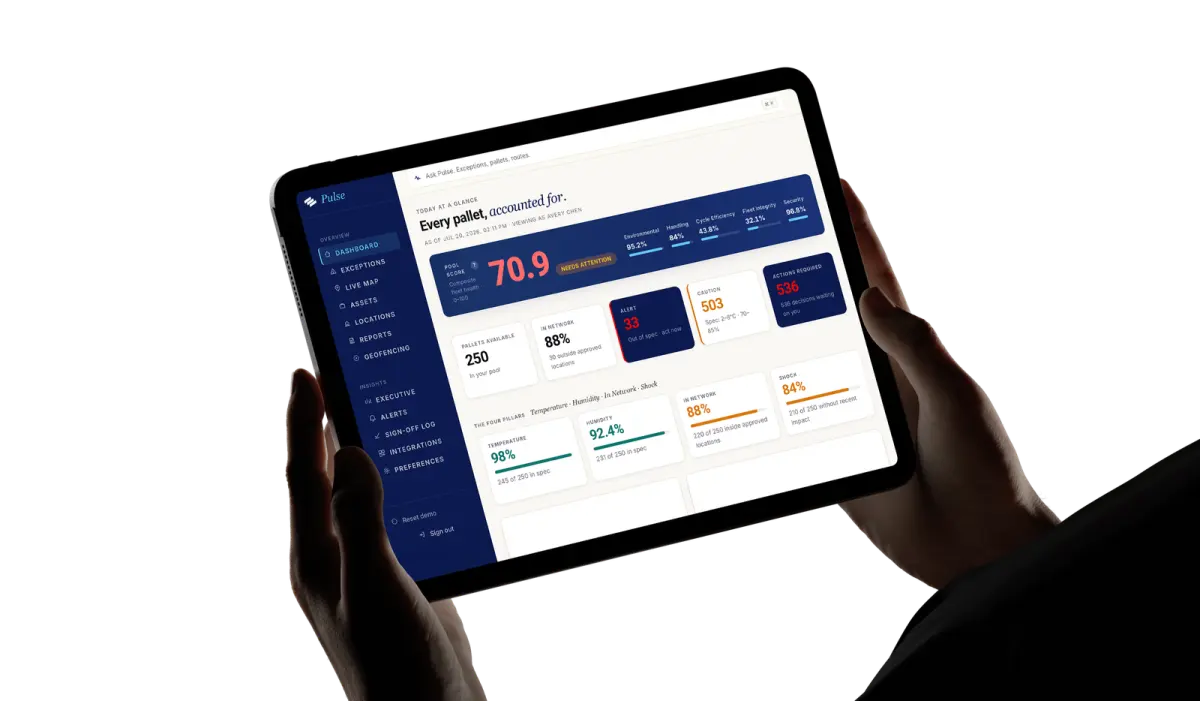
Ask a plastic pallet supplier about sustainability and the first word you will hear is recycled. Cabka has a long claim on that word. It was founded in Germany in 1994 as a recycler of mixed plastic waste, and it opened a recycling and production plant near St. Louis in 2005. Our Smart Pallets are 100 percent recycled HDPE too. So the two pallets part ways at the sale, not the resin. Cabka sells you the pallet. We lease you a program, with a sensor in every pallet as standard.
APS vs Cabka Verdict
Same Recycled Start, Two Different Deals
Cabka, listed on Euronext Amsterdam since 2022, says it makes most of its pallets from recycled plastic and sells them by quotation. Once you buy, the fleet is yours to run, with tracking as an option and a buyback program at end of life.
APS designs and manages custom pallet leasing programs for closed-loop partners. Every Smart Pallet is 100 percent recycled HDPE with a sensor module built in, and the whole program is one flat monthly cost designed to price at or below what you pay for wood.
Choose APS If
- You Would Rather Not Buy a FleetOne all-inclusive monthly lease covers the pallet, sensors, exception reporting and visibility, with no capital purchase and no replacement cost.
- Your Lanes Run Between Sites You ControlA closed-loop program with 100 percent retrieval capability keeps the same pallets cycling between your plants and DCs.
- The Load Needs a Witness in TransitEvery pallet logs location, temperature, humidity and shock on its own, with no scanning or readers.
- You Want 100 Percent Recycled HDPEEvery APS pallet is recycled HDPE, and a retired one is shredded back into the APS HDPE stream.
Choose Cabka If
- You Ship One Way or for ExportCabka sells one-way and export nestable pallets, exempt from ISPM 15, for freight that never comes back.
- You Want to Own a Catalog PalletCabka lists more than 150 pallets and large containers, including 48 by 40 nestable and rackable models you can buy outright.
Our verdict turns on where the pallet goes after your dock. If your pallets cycle between facilities you can name and the freight on them matters, lease the program. For export, one-way freight or retail nesting, a Cabka pallet is a sensible purchase.
In a closed loop where someone will eventually ask what happened to the load, a pallet that reports back beats a pallet you have to count.
Cabka Recycled Plastic Pallets vs APS Smart Pallets
Two Recycled Pallets, Traced to the Source
Both companies sell recycled plastic pallets as the answer to wood, and both can show their work. Recycled covers more than one kind of material, though. The FTC's Green Guides count material diverted from the waste stream during manufacturing (pre-consumer) or after consumer use (post-consumer).
Where Cabka's Recycled Plastic Comes From
Mixed Plastic Waste, Recycled In-House
Cabka was founded in 1994 in Weira, Germany, and credits itself with pioneering the recycling of post-consumer and post-industrial mixed-plastic waste. In 1998 it began selling what it calls the first lightweight, nestable plastic pallets made from recycled materials. Its 2025 annual report lists its feedstock as post-consumer and post-industrial plastic waste, end-of-life products bought back from customers, and already recycled material sourced from supply chain partners.
The figures are Cabka's own. In 2025 it processed 121 kilotons of plastic waste at a recycled raw material inflow rate of 86 percent. It uses primary material where customers need stringent hygienic standards, a small portion of production by its account, and its Hygienic pallets are food grade virgin plastic, with recycled versions for non-food use.
For U.S. buyers, the name that matters is Cabka North America, Inc., in Hazelwood, Missouri, outside St. Louis. Cabka opened its first full-service recycling and production plant near St. Louis in 2005, and its 2025 annual report lists St. Louis as its one U.S. factory. The 48 by 40 Nest US5 and NestRack pages list their pallet weights in polypropylene.
Where APS's HDPE Comes From
Bottles, Containers & Industrial Scrap
Every APS Smart Pallet is 100 percent recycled HDPE, post-consumer and post-industrial, sourced from across the recovery stream and not just from worn-out pallets. Bottles, containers and industrial scrap all go in. HDPE is the plastic in milk jugs, bleach bottles and cutting boards.
Our manufacturing partner processes roughly 60 million pounds of recycled plastic a year and can grind 240,000 pounds in a single 24-hour period. Our post on where pallet plastic comes from traces the bottles and scrap behind a pallet.
The sheet below scores three groups out of ten: material and sourcing, data, and program and ownership.
Material comes out even, because both companies use post-consumer and post-industrial plastic and both take pallets back at end of life. The gap opens on what each pallet reports and on whether you buy it or lease it.
| Criterion | APS | Cabka |
|---|---|---|
| Material & Sourcing | 10/10 | 10/10 |
| Recycled content | Yes100% recycled HDPE | Yes86% recycled inflow in 2025 |
| Post-consumer & post-industrial | YesBoth, across the stream | YesBoth, plus bought-back pallets |
| Published recycling volume | YesPartner: about 60M lbs a year | Yes121 kt processed in 2025 |
| ISPM 15 exempt | YesNo heat treatment needed | YesExempt, per Cabka |
| End-of-life take-back | YesShredded into the APS stream | YesBuyback program |
| Data | 10/10 | 6/10 |
| Sensor standard on every pallet | YesEmbedded cellular module | NoTracking is an option |
| Location without readers | YesCellular GPS | YesIoT option reports position |
| Temperature logging | YesStandard on every pallet | YesOptional, per product pages |
| Humidity & shock logging | YesStandard on every pallet | NoNot among listed options |
| RFID for in-DC scans | YesRFID tags | YesRFID & barcode options |
| Program & Ownership | 6/10 | 4/10 |
| No capital purchase | YesMonthly lease | NoBought by quotation |
| One flat monthly cost | YesPallet, sensors, reporting | NoPurchase, priced per quote |
| No replacement cost | YesNot charged in the lease | NoYou buy the replacement |
| Works without a closed loop | NoNeeds a closed loop | YesOne-way & export models |
| Standard catalog to buy from | NoCustom lease programs | Yes150+ pallets & containers |
Two points per Yes and none per No, five rows per group, so each group is out of 10. Recycled-content and volume figures are each company's own published numbers. Cabka's data marks follow the tracking options listed on its product and Track & Trace pages.
Bottom Line
The plastic is a tie. The program is not. Only the APS pallet carries a sensor as standard, and only the APS deal has no capital purchase and no replacement cost.
Post Consumer Recycled Plastic & Pallet Durability
Does Recycled Plastic Hold Up Under Load?
Buyers ask us whether a pallet made from post consumer recycled plastic will carry the same load, for as many trips, as one molded from new resin. The research gives a qualified yes.
A 2023 study in Resources, Conservation and Recycling melt-extruded HDPE 10, 20 and 50 times in the lab, then made blends that were half virgin HDPE. The blends tested close to virgin in tensile properties, while HDPE extruded 50 times on its own came out 13 percent lower in stiffness and strength. A 2020 study of extruded hollow sections found recycled HDPE less stiff and lower in tensile yield strength, with no significant difference in ultimate tensile strength and higher flexural strength. Neither study tested a pallet.
That is why both companies talk about trips, not resin. Cabka's 2025 annual report says plastic pallets have been proven to endure an average of 200 or more logistic trips, against about 5 for wooden pallets, and its site calls ISO 8611 a seal of quality for pallets it subjects to regular product tests. APS Smart Pallets are built for roughly 100 to 200+ trips before recycling, 10 times the service life of wood. Our plastic pallet durability statistics post walks through the sources behind numbers like these.
Durable plastic pallets also hold their shape. An APS pallet is dimensionally consistent to under 1 percent, against 8 to 10 percent variance for wood, and matches wood in load-bearing capacity at up to 30 percent less weight. Judged on the pallet and not the resin, a recycled plastic pallet from either company is a long way from the wood it replaces.
Bottom Line
Recycled holds up when the pallet is tested as a pallet. Ask either supplier for trip counts and tolerances. On those terms both beat wood, and an APS pallet also logs its own movements.
Nestable Plastic Pallets vs Rackable Lease Pallets
Built to Stack Empty, or Built to Stay in the Loop
Cabka has sold recycled nestable pallets since 1998. Nestable plastic pallets have hollow legs that drop into one another when empty, so a stack of returns takes less trailer and floor space. Cabka says its Nest pallets need up to 4 times less space in storage and transport, and that nestable models typically carry medium to light loads of around 3,000 kg static.
In the 48 by 40 size it sells the Nest US5, a nine-foot pallet rated 3,000 kg static and 1,400 kg dynamic, about 6,600 and 3,100 pounds by our conversion. For racking it offers the NestRack, a nestable pallet on runners rated 1,000 kg in the rack, about 2,200 pounds.
A closed-loop lease pallet is chosen for a different job. It carries loads between sites you control, rides conveyors and feeds automated lines, then cycles back through the same loop. APS Smart Pallets match wood in load-bearing capacity, stay consistent to under 1 percent, and are automation ready.
| Operation | APS | Cabka |
|---|---|---|
| Closed-Loop Plant & DC Lanes | Best fit | Best fit |
| Cold Chain & Pharma Lanes | Best fit | Workable |
| High-Value & Theft-Exposed Freight | Best fit | Workable |
| Retail Display & Store Delivery | Workable | Best fit |
| Export & One-Way Shipments | Poor fit | Best fit |
The ratings are our editorial read of the evidence in this post: what each pallet is built for, what it records on its own, and whether it is expected back. Cabka takes retail display and export outright, with nestable and one-way designs made for those jobs.
Bottom Line
Nest the pallets that leave. Lease the ones that come back. One-way and store-floor pallets suit a nestable Cabka design. Pallets that cycle between your own plants and DCs suit a lease pallet that reports its trips.
Buying vs Leasing Sustainable Pallets
A Quote for the Fleet, or One Monthly Number
Search for recycled plastic pallets for sale and you will land on manufacturers like Cabka, which sell by quotation. Its product pages carry no prices, and its Total Cost of Ownership calculator builds what Cabka calls the 5-year financial case for switching to its plastic solutions.
That is the purchase model. You buy a fleet, book it as capital and spread the cost over every trip it survives. A bought pallet that goes missing is a new purchase, and tracking is something you add. At end of life Cabka runs a buyback program, and its 2025 annual report says a buyback clause can now be written into supply contracts. All of it is yours to manage.
Sustainable pallets on a lease work from the other end. APS charges one all-inclusive monthly cost covering the pallet, the embedded sensor module, exception reporting and visibility. There is no capital purchase and no replacement cost, and the lease is designed to price at or below what you pay for wood pallet programs.
| Cost Line | APS | Cabka |
|---|---|---|
| The pallets | In the monthly lease | Bought by quotation |
| Sensors & data | In the monthly lease | Optional Track & Trace |
| A pallet that never returns | No replacement cost | Another purchase |
| End of life | Shredded back into APS HDPE | Buyback program |
What each model includes, from APS's lease terms and Cabka's product, Track & Trace and annual report pages. Neither company publishes a price.
Bottom Line
Buy when you want the asset. Lease when you want the outcome. Cabka's calculator makes the case for owning plastic over five years. An APS lease makes the case for never owning the fleet, with the sensor and reporting in one monthly number.
Tracking, Recovery & End of Life
Where the Pallet Is, Then Where It Goes
A recycled pallet only stays out of a landfill if it comes home. Cabka's Track & Trace page opens on that problem: reusable packaging disappears into the supply chain every day. The service tracks Cabka products with IoT, RFID, BLE or barcode technology, from simple checkpoint scans to assets that report their own position. Its product pages list tracking for location and temperature as optional.
An APS Smart Pallet has its tracking built in. The embedded sensor module reports cellular GPS location plus temperature, humidity and shock. It stays quiet while conditions are normal, and when the pallet moves or a threshold is crossed it logs a timestamped, geolocated event and Pulse routes the exception to the right person. Every program is a closed loop with 100 percent retrieval capability, and every handoff adds to an independent chain of custody.
Then comes the last trip. Plastic pallet recycling works best when the material stays in one stream. Cabka's buyback program returns end-of-life products to its own recycling process. A retired APS pallet is shredded and goes back into the APS HDPE stream, and our APS sustainability program page explains how that loop runs.
The national numbers show why the loop matters. The EPA plastics recycling figures put the 2018 U.S. plastics recycling rate at 8.7 percent, with 27 million tons of plastic sent to landfill that year. HDPE recycling does better. The EPA puts the 2018 rate for HDPE natural bottles at 29.3 percent, which still leaves most of them unrecycled. A pallet tracked, retrieved and shredded back into its own HDPE stream skips those odds.
Bottom Line
Recovery is a tracking problem before it is a recycling problem. Cabka offers tracking you can add to a purchase, plus a buyback program. Every APS Smart Pallet carries its sensor from the first trip, inside a closed loop built for retrieval.
Best Recycled Pallet Option for Your Operation
Pick by Where Your Pallets Go
Either supplier gets you out of wood. Our page on why plastic pallets win covers that half of the decision. The other half is how you want to hold plastic pallets: as an asset you buy and manage, or as a program that reports back.
If your pallets leave for good or stand nested on a store floor, the Cabka card fits. If they cycle between sites you control and carry something worth watching, the APS card does.
Who APS Is Best For
Closed Loops With a Record to Keep
- Cold Chain, Pharma & Food LanesTemperature, humidity and shock logged on the pallet, with a timestamped chain of custody for GDP and FSMA records.
- Plant-to-DC & Automated LoopsRepeating lanes between your own facilities, feeding automated lines that need a consistent pallet.
- Recycled Goals Without a Fleet PurchaseRecycled HDPE pallets with no capital purchase, no replacement cost and one monthly cost designed to price at or below wood.
Who Cabka Is Best For
Exporters, Retailers & Fleet Owners
- Export & One-Way ShippersCabka's nestable pallets are ISPM 15 exempt and come in one-way versions for freight that is not coming back.
- Retail & Display ProgramsCabka says its nestable pallets are popular in retail for display and space optimization.
- Buyers Who Want to Own the PalletCabka's 48 by 40 Nest, Eco and Endur models suit a team that wants to buy a standard design.
Cabka's strengths are real. It has made pallets from recycled plastic since 1998, publishes load ratings model by model and, by its own account, has supplied pooling operators in Europe and North America for more than 15 years.
Our side has two honest cons. A lease is a monthly commitment, and it needs a closed loop to work. Owning a Cabka fleet trades those for capital up front, losses you replace and tracking you add.
APS
Pros
- A Sensor in Every PalletLocation, temperature, humidity and shock are logged on the pallet itself, with no readers to install.
- One All-Inclusive Monthly CostPallet, sensors, exception reporting and visibility in one number, designed to price at or below wood.
- 100 Percent Recycled HDPEPost-consumer and post-industrial HDPE, shredded back into the APS stream at end of life.
- Built for RetrievalEvery program is a closed loop with 100 percent retrieval capability, and the lease carries no replacement cost.
Cons
- Needs a Closed LoopThe program is designed for pallets that cycle between facilities, so it does not suit one-way freight.
- A Monthly CommitmentA lease is an ongoing cost rather than a one-time purchase you can depreciate and forget.
Cabka
Pros
- Three Decades of RecyclingFounded in 1994, it calls itself a pioneer in recycling mixed post-consumer and post-industrial plastic, and it still recycles in-house.
- A Deep CatalogMore than 150 pallets and large containers, with nestable, rackable, hygienic and export designs.
- Published Load RatingsStatic, dynamic and racking ratings are listed model by model on its product pages.
- Tracking & Buyback OptionsTrack & Trace by IoT, RFID, BLE or barcode, and a buyback program.
Cons
- Capital Up FrontPallets are bought by quotation, so the fleet is a capital purchase.
- Data Is an Add-OnIts product pages list location and temperature tracking as optional, not standard on every pallet.
- Losses Are YoursA bought pallet that does not come back is replaced with another purchase.
APS vs Cabka FAQ
Short Answers Before You Request a Quote
Three questions come up whenever Cabka is on a shortlist. Each answer stands on its own, and the sources list carries the figures behind it.
Where Does Cabka Operate?
Cabka has six production sites in Germany, Belgium, Spain and the United States, plus an Innovation Center in Valencia, Spain, and says its products are available in more than 80 countries. In North America it operates as Cabka North America, Inc., based in Hazelwood, Missouri. Cabka opened a recycling and production plant near St. Louis in 2005. The parent company, Cabka N.V., has been listed on Euronext Amsterdam since March 1, 2022.
Are Recycled Plastic Pallets as Strong as Virgin Plastic?
Recycled resin can come close, but the finished pallet matters more than the resin's history. A 2023 lab study found that blends of half virgin HDPE and half repeatedly reprocessed HDPE tested close to virgin in tensile properties, while HDPE reprocessed 50 times on its own came out 13 percent lower. APS Smart Pallets are 100 percent recycled HDPE and match wood in load-bearing capacity.
Can Recycled Plastic Pallets Be Recycled Again?
Yes. Cabka describes its pallets as 100 percent recyclable and runs a buyback program that feeds end-of-life products back into its recycling. A retired APS pallet is shredded back into the APS HDPE stream. HDPE doesn't really retire. It just changes jobs.
Sources
- Cabka, "About Cabka," 2026
- Cabka, "Worldwide Presence," 2026
- Cabka N.V., "Annual Report 2025" (ESEF filing), 2026
- Cabka, "Nestable Pallets," 2026
- Cabka, "Rackable Pallets," 2026
- Cabka, "1219x1016 Plastic Pallets," 2026
- Cabka, "Nest US5 (OD-9F)," 2026
- Cabka, "NestRack US (OD-4R)," 2026
- Cabka, "Nest US1.1 (OD-9F)," 2026
- Cabka, "Hygienic Pallets," 2026
- Cabka, "Track & Trace," 2026
- Cabka, "Pooling," 2026
- Cabka, "Total Cost of Ownership Calculator," 2026
- Federal Trade Commission, "Guides for the Use of Environmental Marketing Claims, 16 CFR 260.13 Recycled Content Claims"
- Gaduan et al., "Simulating the Recycling of Milk Bottles in the UK: Influence of Blending Virgin and Repeatedly Melt-Extruded High-Density Polyethylene," Resources, Conservation and Recycling, 2023
- Wheatley and Rendage, "Mechanical Testing of Recycled HDPE Extruded Hollow Section," Annual Journal of Technical University of Varna, 2020
- U.S. EPA, "Plastics: Material-Specific Data," 2018 data
Pallet Comparison Articles
Featured Posts From the APS Blog

Milk Jugs, Snowboards, and Shampoo Bottles: Your Next Pallet Has Had a Past Life
Every APS pallet is 100% recycled HDPE, sourced from across the recovery stream. Bottles, containers, industrial scrap, melted down into a platform that survives a decade of forklifts.
 Rodrigo CastroCo-Founder & President3 min read
The Pallet Is Costing You More Than You Think
You have invested millions in automation and you track labor, freight and energy to the decimal. Somewhere on your dock, a wooden pallet is about to stop the line.
Rodrigo CastroCo-Founder & President10 min read
California Just Changed the Rules. Is Your Supply Chain Ready?
Thirty-seven countries already require large companies to disclose their carbon footprints. The United States has been the holdout, and that is changing fast.
Rodrigo CastroCo-Founder & President4 min read