
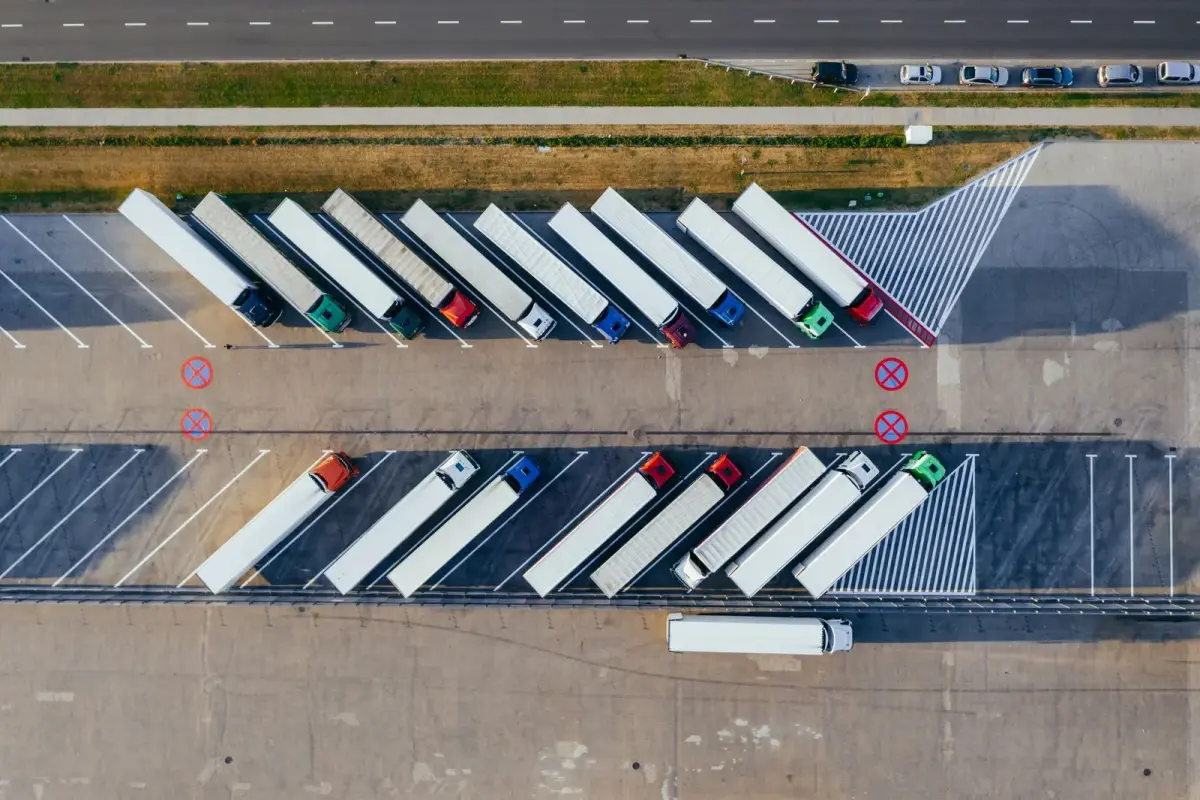
Stand at the receiving doors of a big grocery distribution center for an hour and the argument rolls past on forklifts. Blue CHEP pallets. Red PECO pallets. White wood strays nobody will claim. And sometimes, pallets that belong to one shipper and are going straight back to it.
Most comparisons of CHEP pallets and PECO pallets stop at the color. That misses the decision. CHEP vs PECO is a choice between two pallet pooling companies with similar mechanics and different billing. The bigger choice is whether your freight belongs in a shared pool at all, or in a closed loop supply chain of returnable transport items that cycle between sites you know.
If you want the primer on pooling, exchange, rental, leasing and ownership as categories, we wrote it in our guide to closed-loop pallet programs. This post is the head to head. We run a closed-loop program, so we will tell you where we win, and where we don't.
Key Takeaways
- On repeating lanes between your plants, DCs and known customers, a dedicated closed-loop lease wins on accountability, condition and location data, hygiene and cost predictability.
- For one-way shipping to thousands of retail receivers, CHEP's pool of 352 million shared assets is the strongest option, and PECO's roughly 23 million red pallets are a credible second source.
- Pooled pallets bill on activity: Brambles lists issue, transfer, transport and daily hire fees, and received US$202.0 million in compensation for lost pooling equipment in FY26.
- Neither pooler's published pallet specification lists a sensor. CHEP's serialization program is in operational testing in North America, with a rollout decision expected between January and March 2027.
- A closed-loop lease puts the pallet, the embedded sensor and exception reporting in one flat monthly cost, so loss and dwell show up as events, not statement surprises.
CHEP vs PECO vs a Closed-Loop Program: Our Verdict
Our Verdict
If your pallets go one way to thousands of retail receivers, rent from a pooler: CHEP for reach, PECO for a food and grocery second source priced per turn. If most of your volume runs on repeating lanes between your own plants, DCs and key customers, a dedicated closed-loop lease beats both on accountability, data, hygiene and cost predictability.
The poolers are very good at what they were built to do: put a standard, repaired pallet on your dock within days and collect it from places you will never visit. Brambles, CHEP's parent, reported US$7,042.9 million in sales revenue for the year to June 2026, US$3,867.1 million of it in CHEP Americas, and 352 million shared pallets, crates and containers worldwide. PECO manages about 23 million red pallets through more than 90 depots and sort facilities. Nobody else offers that reach.
What a pool cannot give one shipper is control. The pallet belongs to the pooler, the fees follow activity, and the record of where it went is a set of declarations, scans and audits. When your lanes close, you are paying a network to solve a recovery problem you do not have.
CHEP vs PECO at a Glance, With a Closed-Loop Lease Alongside
CHEP and PECO cells come from their published specifications, Brambles' FY26 filings and the trade press; the closed-loop column describes the APS program.
| Attribute | CHEP | PECO | Closed Loop (APS) |
|---|---|---|---|
| Owner | Brambles, listed in Australia | Private; sold to Alinda and USS in 2020 | APS owns, you lease |
| Pallet | Blue painted wood, mostly Southern Yellow Pine | Red nine-block wood | 100% recycled HDPE |
| Rated load | 2,800 lbs, 48 x 40 block | 2,800 lbs, 48 x 40 block | Matches wood |
| Network | 352M assets, about 60 countries | About 23M pallets, 90+ depots | Your plants, DCs and customers |
| How you pay | Issue, transfer, transport, daily hire | Per-turn rate plus surcharges | One flat monthly lease |
| Who recovers | Customer arranges return or transfer | PECO, from retailers and distributors | APS, 100% retrieval capability |
| What the pallet reports | Scans and declarations; serialization in testing | Transactions in its portal | GPS, temperature, humidity, shock |
In 2010 Logistics Management put PECO's pool at 5 million pallets, against a share of pooling that CHEP itself estimated at 90 percent. The red pool is now about four and a half times that size, so CHEP vs PECO is a genuine choice.
The Scorecard: Six Criteria That Decide the Choice
| Criterion | CHEP | PECO | Closed Loop (APS) | Edge |
|---|---|---|---|---|
| Network reach for one-way shipping | 10/10 | 8/10 | 4/10 | CHEP |
| Cost predictability | 5/10 | 7/10 | 9/10 | APS |
| Accountability and chain of custody | 5/10 | 5/10 | 9/10 | APS |
| Condition and location data in transit | 4/10 | 3/10 | 10/10 | APS |
| Hygiene and washability | 6/10 | 7/10 | 10/10 | APS |
| Automation fit and consistency | 7/10 | 7/10 | 9/10 | APS |
We set the scores from the evidence below: Brambles' FY26 filings, the poolers' published specifications and the trade press, and for APS only the program facts on our own site. Reach is scored on network size, so CHEP takes it outright and a dedicated loop scores low by design. Cost predictability rewards fewer variable charges, accountability an independent record of each handoff and data what the pallet reports without a scanner, while hygiene and automation fit reward washability and consistency. If reach is the only row that matters to you, rent.
How CHEP and PECO Charge, and Why the Invoice Moves
CHEP: Activity Fees on a Shared Asset
Brambles' FY26 annual report is unusually plain about the model: "Several fees are charged to customers including issue, transfer, transport and daily hire." The predominant billing structure is "either a bundled upfront fee upon issue of pooling equipment to customers, or a daily hire fee based on the number of days the pooling equipment is used in the field," and transfer fees are billed when the activity occurs. Brambles also lists surcharge income tied to lumber, fuel and transport costs in North America among the drivers of its profit.
None of that is hidden; Brambles publishes it. But each fee moves with something you do not fully control: how long a receiver holds the pallet, whether a transfer was declared on time, what diesel and lumber did this quarter. In FY26 the average capital cost of a new Brambles pallet rose 4 percent, and higher US labor rates were reflected in pricing for renewals and new business.
PECO: One Rate per Trip, Plus Surcharges
PECO built its pitch on simpler billing. In 2010 Logistics Management reported that PECO "bills customers one flat rate per pallet, rather than an issue fee and a rental rate," with the rental period running from delivery to the manufacturer until the manufacturer reports the pallets shipped. PECO's chief executive has since described rental pricing as "typically done on a per-turn basis," with variable costs for fuel and trucking plus lumber surcharges.
Simpler is not the same as fixed. When a distributor joins PECO's Participating Distributor network, PECO's own site tells renters it means "no NPD charges and reduced complexity for you." Heat-treated pallets for export come at an extra charge and take up to five business days to deliver.
The Closed Loop: One Monthly Number
An APS lease is one flat monthly cost covering the pallet, the embedded sensors, exception reporting and visibility, with no capital purchase and no replacement cost, designed to price at or below what companies already pay for wood pallet programs. There are no issue, transfer or daily hire events to reconcile.
A Worked Illustration: What Dwell Does to Daily Hire
This illustration uses round, hypothetical volumes. It is not a CHEP or PECO price, and it is not an APS quote.
| Assumption or Result | Plan | Reality |
|---|---|---|
| Pallets shipped per week | 1,000 | 1,000 |
| Days on hire per trip, dock to declared transfer | 7 | 12 |
| Pallet-days on hire per week of shipments | 7,000 | 12,000 |
| Change in daily hire exposure | Baseline | +71% |
| Trips per year | 52,000 | 52,000 |
| Pallets unreconciled at audit, at 1% | 0 | 520 |
Five extra days at a receiver, or a declaration that slips most of a week, adds 71 percent to the hire days on the same freight. On a per-trip contract the invoice may not move, but the pool does: PECO's chief executive wrote in Transport Topics in 2022 that pallets held longer get fewer turns and the available pool shrinks. Someone always pays for the time a pallet sits. In a closed loop that dwell shows up in Pulse by facility and lane, and you fix it with the customer who caused it.
Watch Out
Ask every provider what happens when a receiver holds pallets twice as long as planned. A daily hire contract bills it, a per-trip pool feels it in availability, and a closed-loop lease shows it to you by facility.
Accountability: Who Proves Where the Pallet Went
In a pool, you are responsible for the pallet until the system says you are not. A former CHEP USA inventory project manager put it bluntly in Pallet Enterprise in 2009: "all rental pallet programs are self-managed with emphasis on the self," and "it is up to the shipper to report as they are responsible for the pallet until it is received and transmitted to the end user." Missing blue pallets arrived as Lost Equipment Notices.
Seventeen years later, Brambles is candid about the same friction. Its FY26 annual report says that in Chile, its pilot market, an offer to all customers "has eliminated the need for declarations and physical audits of pallets" and "significantly reduces the administrative effort associated with a traditional pooling model." Elsewhere, the same report says Brambles "conducts audits continually" at its plants, customer sites and other locations to confirm its pallets exist and to validate customer hire records.
Those numbers describe a pool working hard to control a shared asset. Brambles' irrecoverable pooling equipment provision (IPEP) expense, which reflects uncompensated pooling equipment lost, rose US$23.4 million to US$116.9 million in FY26, about 1.7 percent of sales by our arithmetic. Its auditor's procedures covered provision estimates for significant customers "where the Group has no access to physically count the pooling equipment."
PECO is just as clear that its red pallets remain its property at all times, and it asks anyone who finds them "in the wild" to call for pickup. That is the honest shape of pooling: the asset travels through hands that have no contract with you.
What Accountability Looks Like in a Closed Loop
In a dedicated loop the pallet keeps its own record. Every APS pallet carries an embedded sensor module with cellular GPS that logs timestamped, geolocated events at each handoff, so the chain of custody is independent of anyone's paperwork. A pallet that stops moving in a customer's yard becomes an exception routed to a named person, not a line on next quarter's statement. We wrote about why that record matters when risk changes hands in Pallets, Paperwork, and Proof.
Key Takeaway
Pooling turns loss into a billing event discovered after the fact. A closed loop turns it into an exception you see while the pallet is still where it stopped.
Condition and Location Data: Scans and Transactions vs Telemetry
Both poolers are investing in data, and it is fair to say so. Brambles has instrumented 80 North American service centers with reading capabilities in operational testing of its Serialisation+ program, and expects to announce a decision on a potential North American rollout in the third quarter of its 2027 fiscal year, January to March 2027. PECO's RED<>LINK portal lets customers place orders, view invoices, enter transactions and track pallet flows, and PECO said in 2023 that its Vision X system inspects a returned pallet within six seconds.
Look at what those tools record. Serialized reads happen where the readers are, at service centers. Portal data centers on orders, invoices and transactions. Inspection data describes the pallet when it comes home. None of it tells you where a loaded pallet is on a Tuesday afternoon, how warm it got in a trailer, or whether it was dropped at a cross-dock. As we said in our post on RFID pallet tracking, that only confirms your pallet moved.
What Each Pallet Tells You on the Road
- CHEP Issue, transfer and return events from declarations and its systems, with serialized reads at instrumented service centers still in testing. The pallet specification lists no sensors.
- PECO Orders, invoices and customer-entered transactions in RED<>LINK, plus depot inspection data. The pallet specification lists no sensors.
- Closed Loop (APS) Cellular GPS location plus temperature, humidity and shock from a sensor built into the pallet, reported by exception, with RFID tags for in-DC scanning. No scanning, facility infrastructure or carrier cooperation needed.
Our technology page shows how Pulse stays quiet while conditions are normal and wakes when the pallet moves or crosses a threshold, logging the event and routing it to the right person. You get dwell time by facility and lane without asking anyone to scan anything. The silence is data too.
Hygiene, Quality and Automation Fit
All three options start with a decent pallet. CHEP's North American block pallet is 48 x 40 inches, built primarily from kiln-dried Southern Yellow Pine, finished in water-based paint, nailed and rated for 2,800 lbs. PECO's is 48 x 40 inches, kiln-dried and rated for 2,800 lbs, and in 2023 PECO described a typical pallet as 65 pounds of 26 boards, 9 blocks and 138 nails. PECO keeps its pallets out of chemical and hazardous service, a real advantage for food shippers.
With any pooled wood pallet, quality is maintained through repair. PECO has identified more than 500 defects that can occur with a pallet. Brambles' FY26 results show what happens when repair capacity tightens. From April 2026, a sharper than expected rise in demand, labor availability challenges, subcontractor turnover and planned quality initiatives aimed at repair consistency for automation combined to constrain pallet availability in parts of its US network. Brambles bought 1.3 million new pallets in the fourth quarter, held 3.4 million unrepaired excess pallets at 30 June 2026, and reported that the constraints and its response reduced Underlying Profit by about US$90 million. It says it is on track to resolve them by the end of December 2026. The goal is right, and it shows that on wood, consistency is restored by repair every cycle.
A recycled HDPE pallet starts somewhere else. APS pallets are non-porous, moisture and pest resistant and pressure-washable, with no nails or splinters, and dimensionally consistent to under 1 percent against 8 to 10 percent for wood. They are ISPM 15 exempt and up to 30 percent lighter. Our Why Plastic page has the detail, and the industries we serve are the ones where washability and consistency are audited, not assumed.
Best For: Which Pallet Supply Model Fits Which Network
The right answer follows your lanes, including the cases where we would tell you to rent.
- CHEP Is Best For Open-loop retail distribution: shipping one way to many retailers and distributors, where a pool of 352 million shared assets does recovery work no single shipper can. If you cannot name where your pallets end up, rent from the biggest pool.
- PECO Is Best For Food, grocery and consumer goods shippers that want per-trip pricing, pallets kept out of chemical service and acceptance at retailers PECO lists as including Walmart, Costco and Sam's Club. It is also the natural second supplier if you already run CHEP.
- A Dedicated Closed Loop Is Best For Repeating lanes between your plants, DCs, co-packers and major customers, especially in pharma, cold chain, food and beverage, automotive and aerospace, where you must prove condition and custody, wash the pallet, feed automation and know your pallet cost a year out.
- A Split Network Is Best For Shippers with both kinds of volume. Put the closed lanes on a dedicated fleet and leave one-way retail deliveries with a pooler.
Why It Matters
Pooling is the right tool for open distribution. Paying a pooler to recover pallets from your own DCs, on trucks you already run, is paying for a network you are not using.
How the APS Closed-Loop Program Works for This Decision
Adaptive Pallet Solutions designs and manages custom pallet leasing programs for closed-loop partners. We start where this post starts: your lanes, your volumes and the compliance regime you answer to. An APS expert comes back with a program scoped to your operation, not a generic deck.
- Map the Loop Separate the lanes where pallets come back to you from the one-way volume that belongs with a pooler.
- Size the Fleet Cycle time by lane sets how many pallets the loop needs, and Pulse dwell data keeps that number honest.
- Run on One Monthly Cost Pallet, sensor, exception reporting and visibility in one flat lease, with no capital purchase and no replacement cost.
- Close the Loop at End of Life Retired pallets are shredded back into the APS HDPE stream and become raw material for the next one.
Our savings calculators will size the hidden costs in your current program in a few inputs. When you have lanes that close, Let's Talk.
Blue and red pallets will keep moving the country's groceries. The real question is whether your freight should ride on someone else's asset when it is coming back to you anyway.
Sources
- Brambles Limited, “2026 Annual Report” (ASX lodgement with Appendix 4E), 2026
- Brambles Limited, “FY26 Result: ASX & Media Release,” 2026
- CHEP USA, “Pooled Wood Block Pallet, North American Standard (48 x 40 inches),” 2026
- AJOT, “PECO Pallet Recognizes Top Performing Carriers in Annual Awards Program,” 2026
- DC Velocity, “PECO Pallet Completes Rollout of Vision X System for Automated Pallet Inspection,” 2023
- DC Velocity, “Peco Pallet to Be Acquired by Pair of Investment Firms,” 2020
- Logistics Management (Bob Trebilcock), “Pallets: Pallet Pooling for the Other Guys,” 2010
- Transport Topics (Joe Dagnese), “Perspective: Flexibility Helps With Supply Chain Delays,” 2022
- PECO Pallet (Joe Dagnese), “How Pallet Return Delays Ripple Through Supply Chains,” 2022
- PECO Pallet, “Specifications,” 2026
- PECO Pallet, “Pooled Pallet Network” home page and RED<>LINK page, 2026
- Pallet Enterprise (Andrew Mosqueda), “Smart Management Techniques to Avoid Lost Pallet Charges,” 2009
FAQ
What Is the Difference Between CHEP and PECO Pallets?
Both are pooled 48 x 40 wood block pallets rated for 2,800 lbs, rented rather than sold and recovered by the pooler. CHEP's are blue, owned by Australian-listed Brambles and billed through fees that include issue, transfer, transport and daily hire. PECO's are red nine-block pallets, privately owned, about 23 million strong and, per its chief executive, typically priced per turn with surcharges. CHEP has the larger network.
Can You Keep or Sell CHEP and PECO Pallets?
Not as your own. PECO states that its red pallets remain its property at all times, and Brambles describes CHEP pallets as its own pooling equipment, which customers return to it or transfer to another participant. If pooled pallets land on your dock without a contract, contact the pooler for pickup.
Who Are CHEP's Main Competitors in North America?
PECO, which describes itself as North America's second largest pallet rental network, is the main pooled alternative. Outside pooling, shippers can buy white wood, own a reusable fleet or lease a dedicated closed-loop fleet such as the APS program.
Is a Closed-Loop Pallet Program Cheaper Than Pallet Pooling?
It depends on your lanes. Pooling earns its fees when the pooler recovers pallets from receivers you could never reach. On repeating lanes you already run, a closed loop stops you paying for that network, and the APS lease is designed to price at or below what companies pay for wood pallet programs, in one flat monthly cost. Our savings calculators help size your hidden costs first.
Are CHEP Pallets Wood or Plastic?
In North America the standard CHEP pallet is a blue painted 48 x 40 wood block pallet built mostly from kiln-dried Southern Yellow Pine, according to CHEP's own specification. PECO's pallets are wood too. If you need a non-porous, washable pallet with no nails, that means a plastic program, which is what APS leases.
Featured Posts From the APS Blog

What RFID Pallet Tracking Actually Tells You (And What It Doesn't)
What gets packaged and sold as smart pallet technology is, in most cases, a ten-cent sticker on a rickety wooden pallet. Here is what passive RFID can and cannot see.
 Rodrigo CastroCo-Founder & President5 min read
Pallets, Paperwork, and Proof: How Two of the Least Sexy Industries Finally Found Each Other
Incoterms decide the exact point where risk transfers from seller to buyer. Almost nobody has the data to enforce what they are supposed to guarantee.
Rodrigo CastroCo-Founder & President6 min read
The Pallet Is Costing You More Than You Think
You have invested millions in automation and you track labor, freight and energy to the decimal. Somewhere on your dock, a wooden pallet is about to stop the line.
Rodrigo CastroCo-Founder & President10 min read