
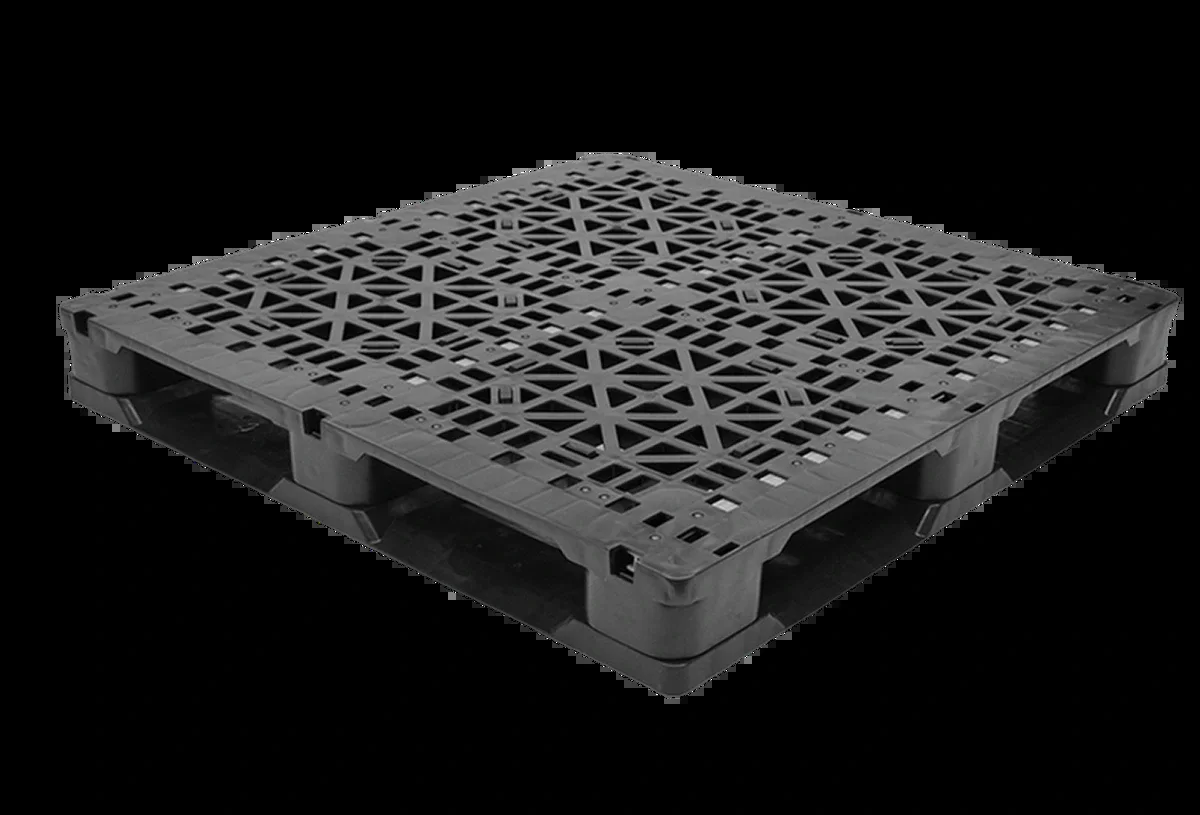
Pull up any plastic pallet spec sheet and you'll find the same three numbers near the top: static, dynamic and racking. We've watched buyers compare the static number on one pallet against the dynamic number on another and conclude the first pallet is five times stronger. It isn't. It's rated for a different job.
The confusion is understandable. Plastic shipping pallets come in more varieties than wood ever did: nestable, stackable, rackable, open or solid deck, hygienic, export, HDPE or polypropylene, virgin or recycled, fire retardant. Each choice moves the weight, the price and the load rating. This guide covers the types, the materials, how load ratings and testing really work, what the pallets weigh, how to match one to an application, and when leasing beats buying.
We'll be honest about where wood still wins, and where our own recycled HDPE Smart Pallets fit.
Key Takeaways
- Every plastic pallet carries three capacities, static, dynamic and racking, and the racking number is almost always the smallest. Never spec a pallet against the biggest number on the sheet.
- HDPE and polypropylene part ways in the cold: HDPE stays tough far below freezing while many generic PP grades turn brittle around 32°F, so freezer and cold chain programs lean HDPE.
- ISO 8611 and ASTM D1185 are the test methods behind every honest load rating, and ISO 8611 itself says lab capacities do not replace field tests on your own unit load.
- Weight is a design choice, not a material constant: a 48x40 nestable can weigh 18 lbs and a heavy rackable 59 lbs, against roughly 32 to 45 lbs for a wood GMA pallet.
- Unlisted plastic pallets can raise the sprinkler design class of your building. Pallets listed to UL 2335 or FM 4996 are treated as wood under the International Fire Code.
Plastic Pallet Types: Nestable, Stackable, Rackable and More
Wood pallets are described by size and class. Plastic pallets are described by what they do when empty and where they may sit when full, which sorts almost every industrial plastic pallet into three structural families.
The Three Structural Families
- Nestable Pallets Hollow cone legs let empty pallets nest, cutting return freight and storage space. They are the lightest and cheapest plastic pallets, which is why Grand View Research found nestables made up 43.7 percent of the global plastic pallet market by value in 2022. Most are meant for floor stacking, conveyors and one-way export, and most carry no racking rating.
- Stackable Pallets Bottom runners or a full picture-frame base let loaded pallets stack squarely and ride conveyors cleanly. Many are rated for supported racking (beams plus decking under the whole pallet) but not for open beams.
- Rackable Pallets The heavy duty plastic pallets of the family, with reinforced decks and often steel or fiberglass rods in the runners so a loaded pallet can bridge an open span between beams. Heaviest, most expensive, and the only type that belongs in open racking.
Deck Styles and Special Purpose Designs
- Open (Lattice) Deck The grid on most plastic pallets, including the one above. It saves resin and weight, drains washdown water and lets air through a load in a blast freezer. Small-footprint goods such as pails need enough deck contact so they do not sink into the openings.
- Solid Deck A closed top surface. Solid deck plastic pallets stop debris and liquids falling onto the pallet below, sanitize more easily and present a flat face to automated layer pickers. They weigh and cost more.
- Hygienic Pallets Solid deck, closed structure with no hollow legs or water traps, smooth edges, usually virgin resin suitable for direct food contact. Built for pharma, food and cleanrooms where the pallet is washed as part of the process.
| Type (48x40 examples) | Weight | Static / Dynamic / Racking | Best For |
|---|---|---|---|
| Economy nestable (ORBIS XpressPal) | Within 20 to 55 lbs (48x40 range) | 15,000 / 2,750 / none listed | One-way export, floor stacking |
| Rackable nestable (Nelson NPP-4840-N) | 18 lbs | 10,500 / 3,100 / 2,700 | Light racking, air freight, automation |
| Heavy duty nestable | Within 20 to 55 lbs (48x40 range) | 30,000 / 4,000 / none listed | Closed loops with floor storage |
| Rackable, solid wall (ORBIS RII STR) | 55 lbs | 30,000 / 6,000 / 3,000 edge, 6,000 supported | Selective racking, heavy loads |
| Rackable, picture frame (ORBIS RII PC FRM) | 59 lbs | 30,000 / 6,000 / 3,000 edge, 6,000 supported | Drive-in racking, automated systems |
Materials: HDPE vs PP, Virgin vs Recycled, and Additives
Two resins account for nearly the whole market. High-density polyethylene held 68.2 percent of the global plastic pallet market in 2022 according to Grand View Research, and Global Market Insights valued the polyethylene segment at $4.1 billion of an $8.3 billion market in 2024. Polypropylene takes most of the rest. They fail differently.
HDPE vs Polypropylene
| Property | HDPE | Polypropylene (homopolymer) |
|---|---|---|
| Density | 0.941 to 0.965 g/cm³ | 0.895 to 0.910 g/cm³ (5 to 7 percent lighter) |
| Flexural modulus (stiffness) | 1.0 to 1.5 GPa | 1.3 to 1.8 GPa |
| Cold impact | Keeps 70 to 80 percent of impact strength at -20°C | Ductile-to-brittle transition near 0°C; can lose 50 to 70 percent |
| Where it fits | Freezers, cold chain, rough handling, recycled content | Ambient and warm storage where stiffness matters most |
The cold numbers are the ones that bite. Nelson Company, a pallet distributor, puts it plainly: most plastic pallets handle temperatures below 32°F, but many generic PP grades will get brittle at around 32°F, while HDPE grades show brittle thresholds as low as -50°F. Their rule: any operation consistently below 0°F should be looking at true freezer grade pallets. PP wins on stiffness at room temperature. Neither resin is wrong. The mistake is buying on price and learning the material after the first winter.
Virgin vs Recycled Resin
- Virgin Resin Consistent lot to lot, available in colors, and the usual route to FDA-compliant material for direct food contact. It costs more and carries the full footprint of new polymer.
- Recycled Resin Post-consumer and post-industrial HDPE (milk jugs, detergent bottles, industrial scrap) reprocessed into pallet grade compound. Cheaper, circular and nearly always black. Ask whether the load ratings were tested on the recycled formulation you will receive. Our own pallets are 100 percent recycled HDPE, a past life we are happy to talk about.
Additives and Fire Performance
- UV Stabilizers and Impact Modifiers UV packages for pallets that live outdoors; rubber-phase modifiers for cold toughness; steel or fiberglass rods in the runners to turn a stackable into a rackable.
- Fire Retardants The additive your insurer cares about. Untreated plastic burns hotter and faster than wood, and melts and flows. The International Code Council notes that the International Fire Code lets pallets listed to FM 4996 or UL 2335 be treated as wood for sprinkler design, while under IFC 3203.10.2 unlisted plastic pallets raise the commodity class by one step for unreinforced pallets and two for reinforced ones; the ICC puts the one-step case at roughly 55 percent more sprinkler water. UL 2335 runs an idle pallet storage test and a commodity storage test; FM 4996 requires the fire to be controlled at 0.15 gpm per square foot within 10 minutes.
Why It Matters
Fire listing is a building question, not a pallet question. Before the first truckload arrives, ask your insurer and fire marshal whether your sprinkler design assumed wood pallets. The answer decides whether you need listed pallets, a sprinkler upgrade or a different storage plan.
How Plastic Pallet Load Ratings Work
Here is the part most buyers skip, and it is the part that keeps product on the floor instead of under it. A plastic pallet publishes three capacities because it has three jobs; the definitions below follow distributor Nelson Company's explainer.
- Static Load What the pallet holds at rest on a flat floor, or as the bottom pallet in a stack. Always the biggest number, which is why it is always the one in the headline.
- Dynamic Load What the pallet carries while moving on forks, a pallet jack or a conveyor. Always lower than static, because the deck is supported only where the forks or rollers touch it.
- Racking Load What the pallet carries while bridging an open span between two beams with nothing under the middle. Almost always the lowest number, and the one most often missing from the sheet.
Look at the ORBIS rackable in the types table: 30,000 lbs static, 6,000 dynamic, 3,000 on edge rack. The same pallet is rated for ten times as much on the floor as on beams. Spec against the first number and store against the second and you are off by a factor of ten.
Edge Racking, Supported Racking and Drive-In
Racking ratings split again by support. Edge racking: the pallet rests on two beams and spans the open middle; ORBIS publishes 3,000 lbs. Supported racking: decking or rails carry the deck, and the same pallets are rated for 6,000 lbs. Drive-in racking: rails support the long sides, so the load spans the other direction, and a pallet rated across 48 inches is not automatically rated across 40. Ask for the rating in the direction you will store.
Deflection, Not Just Breaking
Ralph Rupert, writing in Pallet Enterprise, separates three measures buyers blur. Strength is breaking capacity, and ratings carry a safety factor: a pallet that fails at 5,000 lbs under a 2.5x factor is rated at 2,000 lbs. Stiffness is how much it bends. Durability is how long it lasts. Under the ASTM protocol the deflection limit is 1.9 percent of the greatest span, just over three quarters of an inch on 44-inch rack supports. Deflection is what automated systems feel: a pallet that sags half an inch has not failed, but it can jam a shuttle or crush the bottom layer of cases. Rack beams themselves are limited to their length divided by 180 under ANSI MH16.1, as rack specialist Damotech summarizes it, about half an inch on an 8-foot beam. If your pallet bends more than your beam, your pallet is the weak link.
Temperature, Time and Creep
Plastics creep: under a sustained load they keep slowly deforming, and heat accelerates it. ISO/TS 8611-4:2013 exists specifically to predict creep in stiffness tests of plastic pallets, and it applies at ambient temperature only. Container Exchanger's buying guide says it plainly: extreme heat or cold makes plastic softer or more brittle and reduces the safe working load. Derate for hot warehouses and long rack dwell, and ask for ratings at your temperature and duration, not 73°F for 24 hours.
Your Unit Load Is Not the Test Load
Published ratings assume an evenly distributed load. Virginia Tech's Center for Packaging and Unit Load Design reported in 2021 that, on wood stringer pallets, replacing a flexible test load with rigid 5-gallon pails cut deflection by 56 to 61 percent in racking and 70 to 89 percent in a single floor stack, because the load travels down the pail rims to the stringers. Nelson's spec sheet is candid that its capacities come from box unit load testing at the same center. When the load matters, test your load.
Key Takeaway
Spec the racking number for anything that will sit on beams, the dynamic number for anything that will move, and the static number only for floor stacks. Then derate for temperature, dwell time and the shape of your actual unit load.
Testing Standards: ISO 8611, ASTM D1185 and ANSI MH1
A load rating is only as good as the test behind it. Three documents govern pallet testing.
| Standard | What It Covers | Why a Buyer Cares |
|---|---|---|
| ISO 8611-1:2025, Flat pallets, Part 1: Test methods | Tests for new flat pallets, grouped into nominal load, maximum working load and durability comparison | The international method; Europe and global poolers rate to it |
| ISO 8611-2:2025 (replaced the 2021 edition in February 2025), Part 2: Performance requirements and selection of tests | How to establish a nominal load and which tests apply to which handling environment | Which tests should have been run for your use |
| ISO/TS 8611-4:2013, Part 4 | Predicting creep in stiffness tests of plastic pallets, ambient only | The plastic-specific piece; ask whether creep was tested |
| ASTM D1185-98a (reapproved 2025) | Conditioning, static stiffness and strength tests, dynamic tests for wood, composite, fiberboard, plastic and metal pallets | The primary U.S. method for safe working loads |
| ANSI MH1, Pallets, Slip Sheets and Other Bases for Unit Loads | 700+ definitions, standard footprints, tolerances, markings, sampling, drop, impact, vibration and compression tests; any material | The shared vocabulary and the tolerances automation depends on |
ISO 8611-1 draws the line that matters most: its own scope says the load capacity tests do not replace field tests on specific pallet designs. ASTM D1185 is equally direct: static compression and bending tests estimate stiffness, strength and safe working loads under specified conditions; dynamic tests estimate durability in a specified handling environment. Change the conditions and the number changes.
Durability Testing
Durability is the number vendors love and standards bodies hedge on. Virginia Tech's center runs FasTrack, a repeated 10-step handling sequence with inspections between cycles. In a 2018 study commissioned by ORBIS, its RackoCell plastic pallet completed the sequence up to 200 times without failure while the whitewood stringer pallet failed after an average of 11 cycles; in 2021 the same lab ran ORBIS's Odyssey pallet to 400 cycles. Those are vendor-commissioned tests of specific products, and we cite them as such, but the gap is one every operator who has run both materials recognizes.
Plastic Pallet Weight: What the Numbers Mean for Freight
Plastic pallet weight varies more than most buyers expect. Container Exchanger, a used-packaging marketplace, puts most empty plastic pallets at 13 to 32 lbs against 32 to 44 lbs for wood, but the structural family decides it: Repackify's marketplace guide spans 20 to 55 lbs for a 48x40 depending on configuration, Nelson's rackable nestable weighs 18 lbs, and ORBIS's manufacturer sheets put its rackables at 55 and 59 lbs. On the wood side, Uline lists its recycled 48x40 at about 45 lbs and a new 48x48 at 58 lbs, noting species and moisture move the number.
Weight is dead freight you pay to move both ways in a closed loop. Our pallets are up to 30 percent lighter than wood, roughly 2,200 lbs less dead weight per truckload and 1 to 2 percent lower fuel use per trip; the math is on our Why Plastic page. The tradeoff is stiffness: the 18-lb nestable carries a 2,700-lb racking rating, the 59-lb rackable carries 3,000 lbs on edge and 6,000 supported.
How to Match a Plastic Pallet to the Application
With the vocabulary in place, selection is mostly a lookup: handling path first, then environment, then material and deck.
| Application | Type | Deck and Material | What to Check |
|---|---|---|---|
| One-way export | Light nestable | Open deck; HDPE or PP; recycled is fine | ISPM 15 exemption, air freight weight |
| Closed-loop distribution, floor storage | Heavy nestable or stackable | Open deck; recycled HDPE | Dynamic rating, conveyor fit, nesting ratio |
| Selective or drive-in racking | Rackable | Reinforced runners; HDPE or PP | Racking rating in your span direction, creep |
| Freezer and cold chain | Any family in HDPE | Open deck for airflow | Cold impact performance, true freezer grade below 0°F |
| Food and pharma contact | Hygienic stackable or rackable | Solid deck, closed structure, virgin FDA-compliant resin | Washdown, no water traps, audit documentation |
| Automation, AS/RS, robotic palletizers | Stackable or rackable | Solid or fine-grid deck; consistent dimensions | Dimensional tolerance, deflection, bottom deck pattern |
| Heavy industrial (automotive, aerospace) | Heavy duty rackable | Solid wall, rod reinforced | Static and edge-rack ratings, fire listing |
Where Wood Still Wins
We sell plastic pallets, so take this for what it is worth: wood is the right answer in some places. On a true one-way lane, a $15 white wood pallet beats a $60 plastic one that is lost on its first trip. Wood is also recycled far better than its reputation: Virginia Tech researchers found about 95 percent of wooden pallets are recycled, with pallets landfilled falling from 178.5 million in 1998 to 25.39 million in 2016, and a 2020 Penn State life cycle assessment found heat-treated wood ahead of plastic on carbon per trip, assuming 100 trips for plastic and 33 for pooled wood. The sustainability case for plastic is a closed-loop case, not an automatic one.
Where Plastic Wins
Plastic wins on automation, hygiene and export. In Logistics Management's survey of 259 pallet users, 53 percent said poor quality or bottom boards cause jams or faults in storage equipment daily or weekly; molded pallets do not shed boards, and ours hold dimensions to under 1 percent against 8 to 10 percent for wood (see The Pallet Is Costing You More Than You Think). In the National Consumers League's 2010 test of 70 wood and 70 plastic pallets, 10 percent of wood pallets carried E. coli and 2.9 percent Listeria, against 1.4 percent and none for plastic. And ISPM 15 requires solid wood packaging to be heat treated to 56°C at the core for 30 minutes or fumigated, then stamped; plastic is exempt.
A load rating tells you what the pallet can carry. It doesn't tell you where the pallet is.
The Plastic Pallet Buying Checklist
Run this list before you request a quote, and send the answers with the RFP.
- Define the Unit Load Heaviest gross weight, footprint, package type, rigid or flexible.
- Map the Handling Path Forks, hand jacks, conveyors, AS/RS shuttles, palletizers, and every rack type with its beam span and support style.
- Set the Environment Temperature extremes, washdown frequency and chemistry, outdoor exposure, rack dwell time.
- Pick the Structural Family Nestable for one-way and floor stacks, stackable for closed loops and conveyors, rackable for open beams. Never promote a nestable into a rack because it was cheaper.
- Pick Deck and Material Open or solid deck, HDPE or PP, virgin or recycled, plus any UV, impact or fire retardant additives.
- Verify the Ratings Which standard, support condition, load type, temperature, duration, safety factor and resin lot sit behind each number. Get the test report.
- Clear the Fire Code Confirm with your insurer and fire marshal whether UL 2335 or FM 4996 listing is required.
- Confirm Compliance Paperwork FDA-compliant resin documentation, ISPM 15 exemption for export, and whatever your FSMA, GDP or HACCP program needs in the audit binder.
- Plan for Loss and Return Decide how pallets come home, who pays when they do not, and how you will know where they are.
- Choose the Commercial Model Buy, pool or lease. The next chapter covers how each one charges you.
Watch Out
The most expensive plastic pallet is the one that never comes back. Before you compare unit prices, know your loss rate. A durable pallet with no return path is a very well-made one-way pallet.
Buy, Pool or Lease: Where APS Recycled HDPE Smart Pallets Fit
Plastic pallets cost more up front than wood and earn it back over trips, which makes the commercial model as important as the spec. There are three ways to put them in your network, and each moves risk to a different balance sheet.
| Model | Upfront Cost | Who Carries Loss and Damage | Visibility | Fits When |
|---|---|---|---|---|
| Buy | Full capital purchase | You, including repair, replacement and end of life | Only what you build yourself | Captive loops inside your own walls |
| Pool (rental per issue) | None | Shared; loss and damage fees charged back under the pool's terms | Scan points, RFID in some programs | Open retail networks with pool-accepting receivers |
| Lease (APS model) | None; one flat monthly cost | APS retrieves, recycles and replaces within the program | Embedded sensors on every pallet, exception reporting | Closed-loop partners who need proof, not just pallets |
Pooling works at enormous scale: Brambles reported about 348 million pallets, crates and containers across roughly 60 countries in FY25. It also shows what loss and damage cost even the best-run pool. Brambles' provision for uncompensated pallet losses ran at 4.7 percent of sales in FY23 before falling to 1.4 percent in FY25, and its pallet damage rate rose about 1.5 points against its FY21 baseline instead of falling the 3 points targeted. If the world's largest pooler cannot fully control where its pallets go, a buyer with no tracking should not expect to.
What an APS Program Includes
We design and manage custom pallet leasing programs for closed-loop partners. The pallet is 100 percent recycled HDPE, non-porous, pressure washable, with no nails and no splinters. It matches wood in load-bearing capacity, holds dimensions to under 1 percent, is ISPM 15 exempt and is built for the conveyors and robotic cells that wood jams. We rate it to last about 10 times as long as wood, roughly 100 to 200 or more trips before it is shredded back into our HDPE stream, against about 3 to 5 for white wood and about 15 for pooled hardwood; the comparison is on our Sustainability page.
What no spec sheet covers is what makes ours a Smart Pallet. Every APS pallet ships IoT ready, with a sensor module built into the pallet rather than bolted on: cellular GPS plus temperature, humidity and shock, plus RFID tags for in-DC scanning. Our Pulse platform runs on exception reporting: quiet when conditions are normal, and when the pallet moves, a temperature threshold is crossed or a shock exceeds its limit, it logs a timestamped, geolocated event and routes it to the person who can act. No scanning, no dock gateways, no cooperation from the carrier. As our team puts it, a GPS tracker has to be bolted on and set up to connect, and RFID gives you a ping at a reader; ours skips both because the sensor is part of the pallet.
Commercially, it is one all-inclusive monthly lease priced at or below what you already pay for a wood pallet program: no capital purchase, no replacement cost, and pallet, sensors, exception reporting and visibility in one line. Run your numbers on our Savings page, and see how we scope programs by sector on our Industries page.
So here is the honest summary. If you ship one way, buy wood. If you stay inside your own four walls, buy plastic and keep it there. If your pallets leave the building and you need them back, and you need to prove what happened to the product on top of them, lease the pallet that can tell you. We'd love to show you.
Sources
- ISO, “ISO 8611-1:2025 Pallets for materials handling, Flat pallets, Part 1: Test methods,” 2025 (EVS store listing)
- ISO, “ISO 8611-2 Flat pallets, Part 2: Performance requirements and selection of tests,” 2021 edition listing noting replacement by ISO 8611-2:2025 (EVS store)
- ISO, “ISO/TS 8611-4:2013 Procedure for predicting creep responses in stiffness tests for plastic pallets,” 2013 (SFS store listing)
- ASTM International, “ASTM D1185-98a(2025) Standard Test Methods for Pallets and Related Structures Employed in Materials Handling and Shipping,” 2025
- Pallet Enterprise, “MHIA Administers New MH1 Pallet Standards,” 2007
- Pallet Enterprise, Ralph Rupert, “Keys to Understanding Pallet Performance: Strength, Stiffness and Durability,” 2011
- Nelson Company, “Capacity Ratings for Plastic Pallets Explained”
- Nelson Company, “When Do I Need True Freezer Grade Plastic Pallets?”
- Nelson Company, “NPP-4840-N-RackNest 48x40 Plastic Pallet Spec Sheet”
- ORBIS Corporation, “40 x 48 RII PC FRM Plastic Pallet”
- ORBIS Corporation, “40 x 48 RII STR Plastic Pallet”
- Repackify, “Plastic Pallets Dimensions & Specifications”
- Container Exchanger, “How Much Weight Can a Plastic Pallet Hold? Load Capacity Explained”
- Uline, “Recycled Wood Pallet 48 x 40, H-750”
- Uline, “New Wood Pallet 48 x 48, H-1125”
- Boxu Mold, “HDPE vs PP for Impact Resistance”
- Damotech, “How to Deal with Pallet Rack Deflection” (ANSI MH16.1 L/180 rule)
- Virginia Tech Center for Packaging and Unit Load Design, “CPULD News, Spring 2021”
- International Code Council, Building Safety Journal, Robert Neale, “Cellulose or plastic? It's not just about shopping bags,” 2021
- DC Velocity, “Lots of smoke, not much fire” (UL 2335 and FM 4996 listings)
- Phytosanitary.info, “Alternative Non-Wood Packaging Options to Satisfy ISPM 15 Requirements”
- Wikipedia, “ISPM 15” (heat treatment and marking requirements)
- Grand View Research, “Plastic Pallets Market Worth $11.20 Billion By 2030,” 2023
- Global Market Insights, “Plastic Pallets Market Size, 2025-2034,” 2025
- Brambles Limited, “FY25 Annual Report,” 2025
- Brambles Limited, “Full-Year 2025 Results Presentation,” 2025
- Refrigerated & Frozen Foods, “Research reveals ORBIS plastic pallet can withstand up to 200 cycles,” 2018
- Powder & Bulk Solids, “Plastic Pallet Can Handle 400 Cycles,” 2021
- Logistics Management / Peerless Research Group, “The Pallet Report: State of the Pallet Industry,” 2019
- National Consumers League, “Unsanitary shipping pallets posing threats to food safety?,” 2010
- Penn State News, “Wooden or plastic pallets: which are more eco-friendly?,” 2020
- Pallet Enterprise, “Letter from Ed: Wood or Plastic? Which Pallet Is Better for the Environment?,” 2020 (trip assumptions of the Penn State LCA)
- DC Velocity, “Study: 95 percent of wooden pallets are recycled instead of landfilled,” 2018
FAQ
How Much Weight Can a Plastic Pallet Hold?
It depends on which of the three ratings you mean. Published 48x40 plastic pallets run from about 10,500 to 30,000 lbs static, 2,750 to 6,000 lbs dynamic and 2,700 to 3,000 lbs in edge racking, and many nestables carry no racking rating at all. Use the rating that matches how the pallet will be supported, and derate for cold, heat and long dwell times.
What Is the Difference Between Static, Dynamic and Racking Load?
Static load is what a pallet holds at rest on a flat floor, or as the bottom pallet in a stack. Dynamic load is what it carries while moving on forks, a pallet jack or a conveyor. Racking load is what it carries while bridging open rack beams with nothing under the middle, and it is almost always the lowest of the three.
Are HDPE or Polypropylene Pallets Better for Freezers?
HDPE. It keeps most of its impact strength well below freezing, with some grades staying tough to -50°F, while many generic polypropylene grades turn brittle near 32°F. Polypropylene is stiffer at room temperature, so it suits ambient and warm storage.
Do Plastic Pallets Need ISPM 15 Heat Treatment?
No. ISPM 15 applies to solid wood packaging, which must be heat treated to 56°C at the core for 30 minutes or fumigated, then stamped. Plastic pallets contain no wood, so they cross borders without treatment or marks. More on our Why Plastic page.
Are Plastic Pallets Better Than Wood Pallets?
For closed loops, automation, hygiene-sensitive products and export, usually yes: they hold dimensions, wash down, carry no nails and last many more trips. For true one-way lanes, wood is cheaper and is recycled at about 95 percent. The answer depends on whether your pallets come back.
Featured Posts From the APS Blog
The Pallet Is Costing You More Than You Think
You have invested millions in automation and you track labor, freight and energy to the decimal. Somewhere on your dock, a wooden pallet is about to stop the line.
 Rodrigo CastroCo-Founder & President10 min read
Milk Jugs, Snowboards, and Shampoo Bottles: Your Next Pallet Has Had a Past Life
Every APS pallet is 100% recycled HDPE, sourced from across the recovery stream. Bottles, containers, industrial scrap, melted down into a platform that survives a decade of forklifts.
Rodrigo CastroCo-Founder & President3 min read
Stuck in the 20th Century: Neil Armstrong, iPhones, and Pallets
80% of global goods touch a pallet at some point. How can an asset that fundamental to modern trade have changed so little since 1969?
Rodrigo CastroCo-Founder & President3 min read