
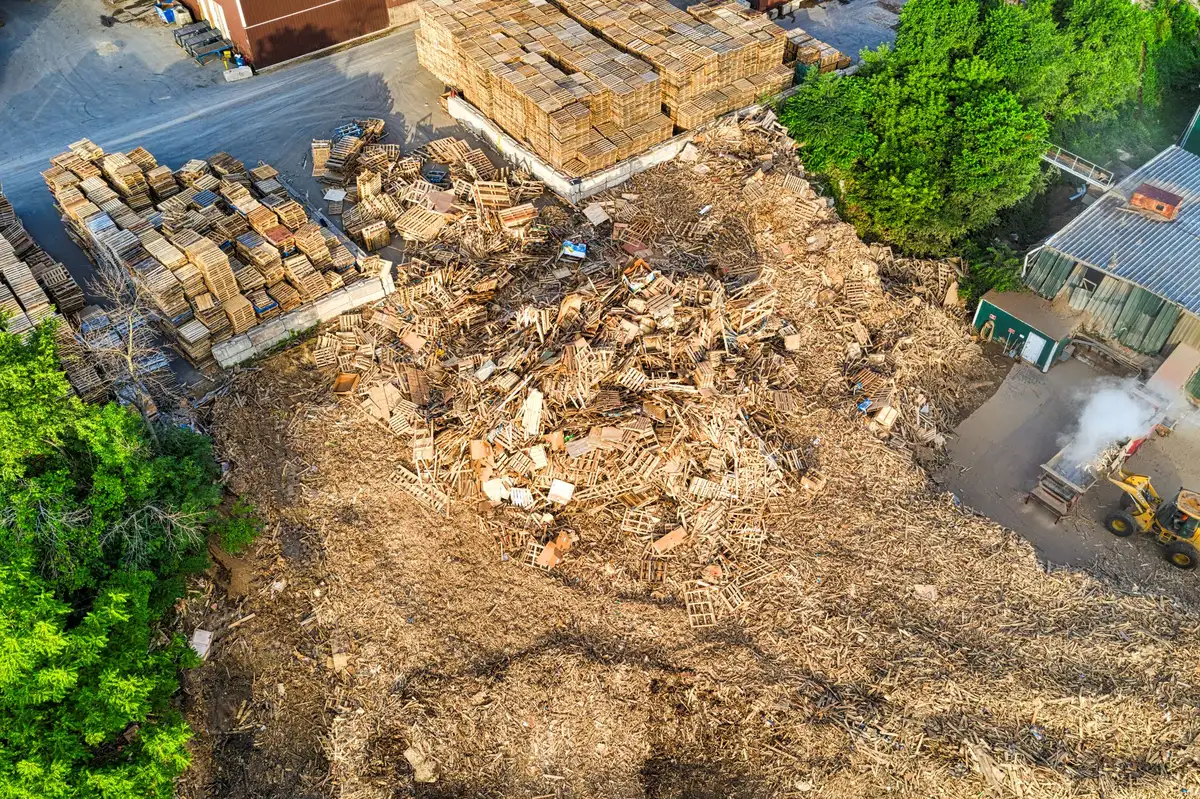
Every distribution center has a corner where pallets wait to find out what happens next. Some go back into service. Some go to the repair line. Some go to the grinder. Which pile a pallet lands in, and how many trips it made before it got there, is the real lifespan of a reusable pallet.
This guide follows a reusable pallet from its first trip to its last: how long each material lasts, what inspection and repair add, where washing fits, why recovery matters as much as durability, and what happens at end of life. Every outside number carries its source and year.
We lease Smart Pallets made from 100% recycled HDPE under one program that covers retrieval, repair and end-of-life recycling, so where our own figures appear, we say so.
Key Takeaways
- Published trip counts run from 3 to 5 for white wood to roughly 100 to 200+ for the APS recycled HDPE pallet, both by APS's estimates. Penn State's 2020 model assumed 33 trips for quality pooled wood and 100 for plastic.
- Loss caps lifespan. In our illustration, a fleet that loses 5% of its pallets per trip averages about 20 trips per pallet, whether their expected life is 100 trips or 200.
- Wood stays in service through repair: U.S. pallet makers produced 919 million new and 280 million repaired or remanufactured pallets in 2021 (BioResources, 2025).
- For food it covers, FDA's Sanitary Transportation rule lists pallets as transportation equipment that must be maintained in a sanitary condition for its intended use, and it sets no washing interval. The schedule is the operation's to write.
- End of life is a recovery question for every material: a 2024 Virginia Tech study puts wood at 95 to 97% repaired or turned into by-products, and plastic can be reground and molded again only if the pallet comes back.
What Makes Reusable Pallets Reusable
A pallet is not reusable because it survives one trip. Reusable pallets are built for many trips and run inside a system that brings them back. The Reusable Packaging Association, the trade association for reusable transport packaging, describes that packaging as designed for lasting use in "a system that ensures their effective recovery and return for continuous purpose." The RPA, of which APS is a member, lists four requirements reusable packaging generally meets:
- Designed for Reuse The pallet is built to do the same or a similar job again, trip after trip.
- Durable for Years It works in its original condition for multiple trips, and its lifetime is measured in years.
- Recovered & Inspected Between trips it is recovered, inspected, repaired if necessary and sent back into the supply chain.
- Kept Out of the Waste Stream It runs in a system that keeps it out of solid waste, with a process to recover and recycle it at end of life.
Two of the four are about the pallet itself. The other two are about the loop around it. Durability buys trips. The system decides how many of them you actually collect.
You will also hear the term returnable pallets. The words overlap, and as Wikipedia on packaging reuse explains, returnable can also mean packaging sent back for recycling or disposal rather than for reuse. In practice, a returnable pallet has a way home. A reusable pallet is one worth sending down it.
Reusable Pallet Lifespan by Material
Pallet lifespan is counted in trips, and the published counts disagree because they measure different things. One is a supplier's estimate. Another is an assumption inside a life cycle model. A third describes typical service. Put side by side, the spread is wide.
| Pallet | Published Figure | What the Figure Is | Source |
|---|---|---|---|
| White wood | 3 to 5 trips | APS estimate | APS Sustainability page |
| Pooled wood | About 15 trips | APS estimate | APS Sustainability page |
| Quality pooled wood | 33 trips | Life cycle model assumption | Penn State, 2020 |
| Plastic | 100 trips | Life cycle model assumption | Penn State, 2020 |
| Plastic | Over 200 round trips | Typical service, per the study's release | Penn State, 2020 |
| APS recycled HDPE 48 x 40 | Roughly 100 to 200+ trips | APS estimate before recycling | APS Sustainability page |
For the damage rates, prices and cost-per-trip math behind figures like these, see our plastic pallet lifespan statistics.
Multi-Trip Wood Pallets
Wood spans the short end and the middle of the range. At the short end, our Sustainability page puts white wood at 3 to 5 trips before disposal. Pooled wood lasts longer, about 15 trips by the same page, and Penn State's 2020 life cycle assessment assumed 33 trips for "a quality, pooled, wooden pallet," as Pallet Enterprise reported.
Repair is what stretches a wood pallet's life, and the U.S. industry does a great deal of it. In BioResources (2025), Hobbs, Horvath and Gething estimated that pallet makers produced 919 million new pallets in 2021 and 280 million repaired and remanufactured pallets, the second figure down 16.4% from 2016. Each repair puts back into service a pallet that would otherwise have been retired.
Reusable Plastic Pallets
Reusable plastic pallets sit at the long end. Penn State's February 2020 release on its study says plastic pallets "normally can travel more than 200 round trips before being taken out of service." The study's own model assumed 100. A typical service life and a modeled life are two different numbers, and a careful buyer asks which one is on the table.
Our Sustainability page puts the APS 48 x 40 Smart Pallet at roughly 100 to 200+ trips before recycling. That is our estimate, not a lab result. The trips any fleet completes depend on the next sections of this guide: handling inside the ratings, and whether the pallets come back.
Key Takeaway
Quote pallet lifespan as a trip count with its source and its definition of a trip. A 5-trip pallet and a 200-trip pallet can both be honest numbers for different jobs.
Reuse Cycles, Inspection & Pallet Repair
In a well-run loop, every reuse cycle ends the same way. The pallet comes back, someone looks at it, and it goes back into service, to repair or out. That inspection is where lifespan is won or lost.
For wood, there is an international standard for the line between use and pallet repair. ISO 18613:2014 "specifies the maximum defects and damage allowed before a flat wooden pallet shall be repaired, and defines the minimum repair criteria that shall be used." Where to look first comes from the field: Virginia Tech researchers who inspected 48 x 40 stringer pallets in use found "high damage occurrence on the stringer notches and bottom lead deckboards" (Masis Ulloa, Horvath and White, BioResources, 2023).
- Bottom Lead Deckboards Cracked, split or missing boards on the bottom leading edge, one of the two damage hot spots in the 2023 field study.
- Stringer Notches Cracks at the notches cut for fork entry, the other hot spot.
- Fasteners & Surfaces Protruding nails, loose boards and splinters that can catch product, stretch wrap or hands.
- Plastic Decks & Runners Cracks or impact damage to the deck and runners that change how the pallet sits on a conveyor or beam.
- Cleanliness Residue, spills or signs of pests, which send the pallet to washing before it goes back out.
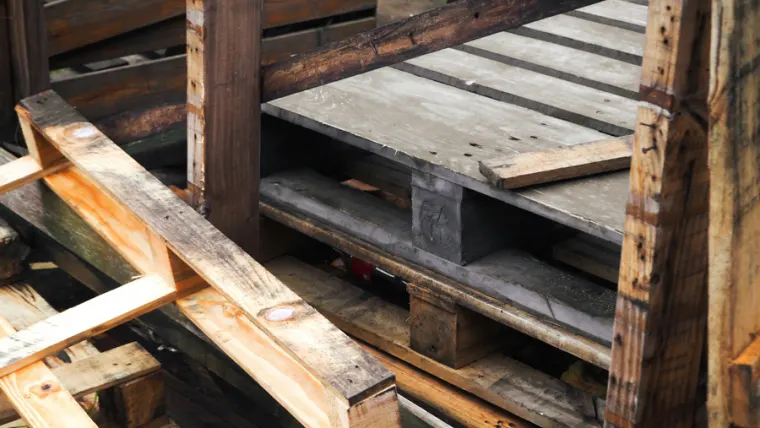
Repair keeps a wood pallet working. It does not make it the same pallet. Terry Crew, our Director of Customer Engagement, has a name for the worst results: "Frankenstein Pallets." Our post The Pallet Is Costing You More Than You Think describes them as pallets "cobbled together from old, mismatched boards that have no business being anywhere near an automated line." On a manual dock, a forklift driver adjusts. In an automated system, the pallet jams.
An APS pallet has no nails and no splinters to check, so that part of the inspection goes away. When an APS pallet does need work, the work is ours: retrieval, repair and recycling "stay on our side of the fence, including at sites you do not operate directly." The sensor also points the inspection somewhere. A shock event over the program's G-force limit is logged with a time and a place and flagged in Pulse, so the pallet that took the hit can be pulled for a look instead of waiting for a spot check.
Pallet Washing & Hygiene Between Trips
In a food loop, a pallet that comes back has to come back clean. For food covered by FDA's Sanitary Transportation rule, the definition of transportation equipment in 21 CFR 1.904 names pallets alongside containers, bins and totes. 21 CFR 1.906(b) then says that equipment "must be maintained in such a sanitary condition for their intended use as to prevent the food they transport from becoming unsafe during transportation operations."
The rule sets an outcome. It does not set a pallet washing schedule, so the interval is yours to define for your products and lanes. It also reaches the time between trips: section 1.906(d) requires equipment to be stored so it does not harbor pests or become contaminated in any way that could make food unsafe.
Material changes how much work that takes. In a test the National Consumers League published in May 2010, a lab found E. coli on 10% of 70 wood pallets and on 1.4% of 70 plastic pallets, and Listeria on 2.9% of the wood pallets and none of the plastic ones. Many of the pallets had been stored outside, and the sample was small. Read it as a signal, not a census.
Our lifecycle comparison rates wood as sanitizable "only via intensive, multi-step process." The APS pallet is recycled HDPE, and our Sustainability page says it plainly: "APS plastic pallets will not absorb water, rot, or harbor bacteria under normal use. They are spray-down ready and require little drying time." Three habits make either material easier to keep clean:
- Write the Standard Down Decide when pallets are washed on each food lane, every trip, at product changeovers or on visible soil, and record it.
- Store Clean Pallets Covered Keep washed pallets where weather and pests cannot reach them, in line with 1.906(d).
- Match the Pallet to the Wash A program that washes every trip is simpler to run on a non-porous pallet that takes a spray-down and dries quickly.
A washable pallet only helps if someone washes it. That is a process decision, and compliance with the rule stays with the shippers, loaders, carriers and receivers it covers. The pallet's job is to make the process quick to run.
Pallet Recovery & Reverse Logistics
Reverse logistics is the other half of every reusable pallet program. Rogers and Tibben-Lembke define it as "the process of planning, implementing, and controlling the efficient, cost effective flow of raw materials, in-process inventory, finished goods, and related information from the point of consumption to the point of origin for the purpose of recapturing or creating value or proper disposal" (Journal of Business Logistics, as quoted by NC State's Supply Chain Resource Cooperative). For a pallet, that is the empty trip home.
Losses are real and uneven. Writing in Material Handling & Logistics in October 2012, Keith Schall reported that the Reusable Packaging Association's asset loss survey was seeing rates "from single digits in the automotive industry to as high as 40% in other markets." Those are annual rates. The table below uses loss per trip, so divide an annual rate by your turns per year before reading across.
In a leaky loop, loss shortens lifespan faster than material can lengthen it. Suppose a fixed share of a fleet fails to come back on every trip, and every pallet that does come back keeps going until it reaches its expected life. The average pallet then completes far fewer trips than its expected life:
| Share Lost per Trip | Expected Life of 100 Trips | Expected Life of 200 Trips |
|---|---|---|
| 0.5% | 79 trips | 127 trips |
| 1% | 63 trips | 87 trips |
| 2% | 43 trips | 49 trips |
| 5% | 20 trips | 20 trips |
At 5% lost per trip, a pallet built for 200 trips and one built for 100 both average about 20. Durability pays only when the loop holds, so recovery belongs in the pallet decision from the start.
Schall's article lists the questions any reusable asset program should be able to answer. They still make a good audit for a pallet fleet:
- Destinations Where are your products, and your pallets, shipped?
- Fleet Size How many pallets are in your fleet?
- Location Where are they right now in your supply chain?
- Utilization What is your utilization rate, counting dwell times and dormant pallets?
- Annual Loss How many pallets do you recover each year, and how many do you lose?
- Damage & Repair Can you calculate your damage and repair rates?
For how owning, pooling and leasing divide that work, see our closed-loop pallet program guide.
This is the problem the APS sensor was built for. Each APS Smart Pallet reports over existing cellular and Bluetooth networks, with no fixed readers and no dock hardware, so the count does not depend on someone scanning at the dock. Our Sustainability page puts the goal simply: "Always know where the fleet is, how long it has been there, and where it is headed next." Silence counts too. "A missing report is itself a signal. Pulse flags the gap so you know to investigate, rather than silently losing visibility on that pallet."
Returnable Packaging in a Closed Loop Supply Chain
Pallets are the largest share of returnable packaging by value. The Reusable Packaging Association puts the global reusable transport packaging market at about $107 billion in 2023, with pallets the largest segment at about 61%, or $65.6 billion. Crates, totes, bins, containers and dunnage make up the rest of reusable packaging.
All of it depends on a closed loop supply chain, where the same assets cycle between known sites and come back. Our own definition for pallets: "A closed-loop pallet system is a model where pallets are recovered after use, reused when possible, and recycled back into the material stream at end of life, rather than leaving the network and being bought again." Some loops close more easily than others. Four conditions make the difference:
- Repeat Lanes The same origins and destinations week after week, so a pallet that leaves has a known way back.
- Sites That Send Back Plants, DCs, co-packers and customers that stage empties for pickup, including sites you do not run.
- Volume on the Return Leg Enough empties moving back that pickups are routine rather than special trips.
- A Count You Trust A way to know how many pallets left each site and how many came back.
Where those conditions do not hold, a one-way export load or a customer who will never send pallets back, a returnable pallet does not fit that lane. Look for a pallet built for the single trip and its rules, and keep the returnable fleet for the loops that close.
For adoption, loss and recovery figures across crates, containers and pallets, see our reusable packaging recovery statistics.
Pallet Recycling at End of Life
Every reusable pallet retires eventually, and wood has a better pallet recycling record than its reputation suggests. A 2024 Virginia Tech master's thesis by Yash Mansharamani estimated that 76.8 million pallets, 8.4% of new pallets in 2021, ended up in a landfill, with only 4.4% of new 2021 pallets buried, and that 95 to 97% of wooden pallets produced in the U.S. are repaired for reuse or converted into value-adding by-products such as mulch.
Plastic can close the loop more tightly, because high-density polyethylene can be reground and molded again. The catch is that it has to come back. HDPE natural bottles are among the better-recycled plastic containers: the U.S. EPA reports that HDPE natural bottles were recycled at 29.3% in 2018, against 8.7% for plastics overall. A plastic pallet lost in a yard three states away is just plastic in a yard.
That is why we treat end of life as a contractual commitment. The APS Closed-Loop Guarantee reads: "Every APS pallet is built to reuse, repair, and recycle with zero landfill waste. When a pallet reaches end of life, we take it back. That is not a sustainability claim. It is a contractual commitment baked into how we operate." The retired pallet goes back into the APS HDPE stream, with the recovery and recycling data "available for your Scope 3 reporting." Our Sustainability page lists 60 million lbs of plastic recycled and reprocessed per year. See the APS sustainability & recovery data.
So what makes sustainable pallets is less the material than the loop. Our own answer: "Plastic pallets can be more sustainable when they are made from recycled material, used repeatedly, recovered at end of life, and kept in a closed loop." Penn State's 2020 life cycle assessment shows why. It found in wood's favor while assuming 100 trips for plastic, 33 for pooled wood, and that both pallets were recycled and reused. As Pallet Enterprise noted, the trips achieved, the distances traveled to reposition and retrieve pallets, and real-world recycling all change the real result.
Choosing Durable Plastic Pallets for Reuse
If your loop closes, durable plastic pallets are built to collect the trips. Choosing one comes down to a short list, and every item can be checked on a spec sheet or in a contract:
- Load Ratings for Your Real Loads Static, dynamic and racking ratings, each matched to how the pallet is used: floor-stacked, in motion or in a rack.
- Temperature Range A published range that covers your coldest freezer and your hottest trailer.
- Material & Recycled Content The resin and the share of it that is recycled, stated on paper.
- Dimensional Consistency Pallets that stay the same size trip after trip, which matters most on conveyors, wrappers and AS/RS.
- Washability A non-porous deck that takes a spray-down, if your lanes need one.
- A Return & End-of-Life Plan Who retrieves, who repairs and where the pallet goes when it retires, in writing.
- Data on Every Pallet A way to know where pallets are and what happened to them without scanning each one.
Measured against that list, the APS 48 x 40 Smart Pallet is made from 100% recycled HDPE, weighs 55.75 lbs and carries the ratings above. The spec sheet lists 4-way entry, "Optimized For Automated Handling" and "Stackable, Conveyable, Rackable," and by our figures it holds its dimensions to under 1%, against 8 to 10% variance for standard wood. Pallets and technology are made in the USA. There is more on why APS chose plastic.
What makes it a Smart Pallet is the sensor, built in rather than bolted on. Each pallet reports location, temperature, humidity and shock to start, and the set is configured to the scope of your program. It is quiet when nothing is wrong and precise when something is: when a reading changes or crosses a threshold, Pulse flags the exception and routes it to the right person by push, email or SMS. For a reusable fleet, that puts data behind the audit questions above: where pallets are, how long they sit and which ones stopped reporting.
One flat monthly lease covers the pallet, the sensor and Pulse, with retrieval, repair and end-of-life recycling on our side. Our all-inclusive leasing model is designed to price at or below what companies are already paying for traditional wood pallet programs. Most partners start with a single lane or a defined pallet count before scaling.
It is not the answer for every lane. If you need a nestable pallet, a footprint other than 48 x 40 or a pallet for a one-way export, look for one built for that job.
A reusable pallet is only as reusable as the loop that brings it home. If you want to see what a tracked loop would tell you about your own fleet, we'd love to show you.
Reusable Pallets FAQ
How Long Do Reusable Pallets Last?
It depends on the material and the loop. Published figures run from about 3 to 5 trips for white wood to roughly 100 to 200+ for the APS recycled HDPE pallet, both APS estimates, and Penn State's 2020 study assumed 33 trips for quality pooled wood and 100 for plastic. Repair extends a wood pallet's life. Loss shortens every pallet's, because a pallet that never comes back has made its last trip.
How Many Trips Can a Plastic Pallet Make?
Penn State's 2020 release says plastic pallets normally travel more than 200 round trips before being taken out of service, while its life cycle model assumed 100. APS estimates roughly 100 to 200+ trips for its recycled HDPE 48 x 40 before recycling. What a fleet actually gets depends on handling inside the load and temperature ratings and on how many pallets come back.
What Happens to Reusable Pallets at End of Life?
Most wood pallets are recovered: a 2024 Virginia Tech study estimates 95 to 97% of U.S. wooden pallets are repaired for reuse or turned into by-products such as mulch, while 76.8 million went to landfill in 2021. Plastic pallets can be reground and molded again if they come back. Under an APS lease, we take the pallet back at end of life and it returns to the APS HDPE stream.
Sources
- Reusable Packaging Association, "What is Reusable Packaging?", 2020
- Reusable Packaging Association, Media Information: Reusable Packaging Market Data and Statistics (2023 market)
- Wikipedia, Reusable packaging
- Penn State News, "Wooden or plastic pallets: which are more eco-friendly?", February 3, 2020
- Pallet Enterprise, "Letter from Ed: Wood or Plastic? Which Pallet Is Better for the Environment?", March 1, 2020
- Hobbs, Horvath and Gething, "Investigation of the status of the wooden pallet market during the COVD-19 pandemic," BioResources 20(2), 2025
- Masis Ulloa, Horvath and White, "Comparison of damage to wood pallets in use with damages occurring using the Virginia Tech FasTrack simulation of pallet use," BioResources 18(3), 2023
- BSI, BS EN ISO 18613:2014, Pallets for materials handling: Repair of flat wooden pallets
- eCFR, 21 CFR 1.904, Definitions (Sanitary Transportation of Human and Animal Food)
- eCFR, 21 CFR 1.906, Requirements for vehicles and transportation equipment
- National Consumers League, "Unsanitary shipping pallets posing threats to food safety?", May 28, 2010
- NC State Supply Chain Resource Cooperative, "The Increasing Necessity for Reverse Logistics" (Rogers and Tibben-Lembke definition), 2004
- Material Handling & Logistics, Keith Schall, "Make Reusable Assets Show Returnable Value," October 4, 2012
- Mansharamani, Virginia Tech, "Investigation into the Landfilling and Recovery of Wood and Wooden Pallets at U.S. Landfills in 2021," 2024
- U.S. EPA, "Plastics: Material-Specific Data" (2018 data)
- Adaptive Pallet Solutions, "The Adaptive Pallet | Model 48x40" spec sheet, 2026
- Adaptive Pallet Solutions, Sustainability
- Adaptive Pallet Solutions, Why Plastic
- Adaptive Pallet Solutions, home page FAQ (end of life and Scope 3)
- Adaptive Pallet Solutions, Food & Beverage
- Adaptive Pallet Solutions, Smart Pallet Technology
- Adaptive Pallet Solutions, "The Pallet Is Costing You More Than You Think"
Featured Posts From the APS Blog

Milk Jugs, Snowboards, and Shampoo Bottles: Your Next Pallet Has Had a Past Life
Every APS pallet is 100% recycled HDPE, sourced from across the recovery stream. Bottles, containers, industrial scrap, melted down into a platform that survives a decade of forklifts.
 Rodrigo CastroCo-Founder & President3 min read
The Pallet Is Costing You More Than You Think
You have invested millions in automation and you track labor, freight and energy to the decimal. Somewhere on your dock, a wooden pallet is about to stop the line.
Rodrigo CastroCo-Founder & President10 min read
California Just Changed the Rules. Is Your Supply Chain Ready?
Thirty-seven countries already require large companies to disclose their carbon footprints. The United States has been the holdout, and that is changing fast.
Rodrigo CastroCo-Founder & President4 min read