
RFID Statistics in Supply Chain: Adoption, Accuracy, and Limits
Fifty-three billion RFID tag chips shipped in a single year, and retailers using them report inventory accuracy near 95 percent. Here is what the data says RFID does well, where the physics stops it, and what it cannot see once the truck doors close.

Key findings
- RAIN UHF RFID tag chip shipments hit 52.8 billion in 2024, up 17 percent, then fell to 42.7 billion in 2025 on destocking, tariffs and the chip inventory cycle. VDC Research still projects over 115 billion a year by 2029.
- In the Auburn University and GS1 US Project Zipper study, RFID lifted retail inventory accuracy from 63 percent to 95 percent and order accuracy to 99.9 percent, against 69 percent of orders carrying errors on barcode processes alone.
- A passive UHF inlay costs 7 to 15 cents; an active, battery-powered tag starts around $25. That gap is why passive RFID won retail, and why it carries no sensors.
- Read rates run near 100 percent on paper and apparel but drop to about 60 percent on pallets of canned goods or bottled water, because UHF energy bounces off metal and is absorbed by liquid.
- RFID logs a tag ID and a timestamp at a reader and nothing between read points, so the hours a pallet spends on a truck stay dark unless the pallet carries its own cellular sensor.
Somewhere in a retail distribution center right now, a forklift is driving a pallet through a dock door and 48 cases of denim are announcing themselves to a reader overhead, all at once, with nobody scanning anything. That is RFID at its best, and the data behind it is impressive: 53 billion tag chips in a year, inventory accuracy up 32 points, order errors down from two in three to one in a thousand.
We have a particular interest in these RFID statistics because APS Smart Pallets carry RFID tags for exactly that kind of in-DC scanning workflow, alongside the embedded cellular sensor module that does the rest of the job. So this is not a takedown. It is the real numbers: what RFID is, who has adopted it, what a tag costs, what the accuracy studies measured, where the physics stops it, and what a passive tag can never tell you once the truck doors close.
What RFID Is and How a Tag Talks to a Reader
The U.S. Food and Drug Administration defines RFID plainly: a wireless system of two components, tags and readers. The reader sends out radio energy; the tag answers with the number on its chip. The FDA's one-line distinction matters here: passive tags are powered by the reader and have no battery, while active tags carry their own.
Almost all of the volume in logistics and retail is passive UHF, which the industry now brands RAIN RFID. Impinj, one of the largest makers of those chips, puts the read range at up to 10 meters, about 30 feet, in its own product literature, and dates the governing EPC Gen2 standard (ISO 18000-6C) to 2004, with Gen2v2 in 2013 and Gen2v3 in 2024. A tag of that kind has no power, no sensor and no clock. It knows its own number and nothing else.
The Three Things Every RFID Read Produces
- A Tag ID The serial number on the chip, usually encoded to a GS1 EPC so the retailer and the brand read the same identity.
- A Reader ID Which fixed portal or handheld saw it, which is how a read becomes a location: this dock door, that conveyor gate.
- A Timestamp When the read happened. Put the three together and you get an event. You do not get a temperature, a shock, a route or anything about the gap before the next read.
Every statistic below follows from that structure. RFID is spectacular at answering what passed this point, and when. It is structurally unable to answer what happened in between. Our earlier post on what RFID pallet tracking actually tells you walks through that gap in detail.
RFID Adoption by Industry: Who Actually Uses the Tags
Adoption has run in two waves, and the same retailer pushed both. In 2005 Walmart required its top 100 suppliers to tag pallets and cases bound for 500 stores and five distribution centers, widened the program to 500 suppliers in 2006, then began backing away from the mandate in 2007, per RFID Journal. The tags of that era cost too much and read too poorly on mixed pallets. The second wave started at the item level, in apparel, where the physics is kind and the margins justify a tag.
That second wave is now the mainstream. Walmart's 2022 mandate set a September 2, 2022 deadline for tagged home goods, electronics, toys and other departments, and a February 1, 2024 expansion added nine more, from automotive and hardware to books and paint, for 14 product categories in all by Impinj's count. Shelly McDougal, Walmart's senior director of merchandising, wrote on LinkedIn, in a post Impinj quoted, that the effort "has improved inventory accuracy but more importantly has helped us better serve our customers."
| Milestone | Year | What it covered |
|---|---|---|
| First Walmart mandate | 2005 | Top 100 suppliers, pallets and cases, 500 stores, 5 DCs |
| Expansion, then retreat | 2006 to 2007 | 500 suppliers in 2006; Walmart began stepping back in 2007 |
| Item-level apparel program | 2020 | UHF tags on apparel through receiving, display and sale |
| Second mandate deadline | Sept 2, 2022 | Home goods, electronics, toys and other departments |
| Category expansion | Feb 1, 2024 | Nine more categories, from automotive and hardware to books and paint |
Surveys tell the same story from the buyer's side. A GS1 US survey of 801 companies in 2014 found that among the 177 respondents familiar with RFID, 57 percent of retailers were already implementing it and another 19.3 percent planned to within 12 months; 78 percent were receiving at least some tagged merchandise, and on average 47 percent of those goods carried an EPC UHF inlay. The catch: GS1 noted those RFID-aware respondents were mostly apparel and footwear companies, "only 22 percent of the 801 participants." Deep adoption in one vertical, thin everywhere else.
A decade on, that pattern is softening but not gone. Zebra's 2023 Warehousing Vision Study, a vendor-commissioned survey of more than 1,400 warehouse decision-makers and associates, found 58 percent of decision-makers plan to deploy RFID by 2028, and nearly 80 percent report inaccurate inventory and out-of-stock problems today. The 2025 MHI Annual Industry Report, drawn from more than 700 manufacturing and supply chain leaders, predicts adoption of sensors and automatic identification will reach 88 percent within five years. And IDTechEx estimates apparel still accounts for about two-thirds of all UHF tag volume, with the category only about 40 percent of the way through its addressable market.
- Aviation Followed a Mandate Too IATA Resolution 753 requires bags to be tracked at four points. IATA reports mishandling down 67 percent since the early 2010s, to 6.3 bags per 1,000 passengers, though 33.4 million bags still went astray in 2024 at a cost of about USD 5 billion.
Why It Matters
Adoption follows mandates, and mandates follow physics. Apparel was tagged first because fabric is transparent to radio. Canned goods, beverages and metal parts came last, if at all, for the same reason.
Tag Volumes, Prices and the Size of the RFID Market
The RAIN Alliance publishes the only census of UHF tag chips that comes straight from the chipmakers. Its February 2025 report, as detailed by RFID Journal, counted 52.8 billion RAIN UHF chips shipped in 2024, up from 44.8 billion in 2023, a 17 percent rise. Over two years the market grew 54 percent, and the Alliance expected another 20 percent in 2025, to about 64 billion.
Then 2025 happened. The Alliance's April 2026 update put 2025 shipments at 42.7 billion, a drop it blamed on the semiconductor inventory cycle, tariff uncertainty, and "retail destocking, particularly in U.S. apparel and general retail." The long view still points up: the market has grown 50 percent in four years, and VDC's November 2025 report projects annual tag chip shipments "to surpass 115 billion by 2029." An earlier VDC report for the Alliance put 2023 at 45.5 billion, so treat that base as approximate.
| Year | RAIN UHF tag chips shipped | Change |
|---|---|---|
| 2023 | 44.8 billion (45.5 billion in an earlier report) | Record year |
| 2024 | 52.8 billion | Up 17 percent |
| 2025 | 42.7 billion | Down, on destocking and tariffs |
| 2029 (forecast) | More than 115 billion | VDC Research projection |
What a Tag Costs, and Why It Keeps Falling
Price is the engine behind those volumes. RFID Journal's current FAQ puts a passive 96-bit EPC inlay at 7 to 15 U.S. cents, rising to 15 cents and up once it is embedded in a printable label. In 2009 the same publication called a 5.8-cent inlay, at orders of 5 million, record-setting. By 2022 it said tag prices had fallen "by up to 80 percent" since the first mandates, to "about 3 to 5 cents per tag in large volumes." IDTechEx notes the next frontier, smart packaging, needs tags "below 1 US cent to achieve mass adoption."
Active tags live in a different universe. RFID Journal puts them at "$25 and up," and at "$100 or more" with protective housing, long battery life or sensors. That gap is the entire story of RFID in one line: a tag cheap enough to put on a $12 t-shirt cannot carry a battery, and a tag with no battery cannot sense, log or transmit on its own.
A tag cheap enough for a t-shirt cannot carry a battery, and a tag with no battery cannot tell you what happened to it.
Inventory Accuracy Gains: What the Studies Actually Measured
The best-documented RFID result in the supply chain is Project Zipper, a year-long study by Auburn University's RFID Lab with GS1 US. Over a year starting in June 2017, it followed more than 1 million items from 8 brand owners to 5 retailers, comparing barcode scans against EPC RFID reads at ship and receive. Without RFID, 69 percent of orders "contained data errors." With it, order accuracy reached 99.9 percent.
Project Zipper: barcode-based process vs EPC RFID
The same body of work is where the headline "inventory accuracy from 63 percent to 95 percent" comes from, along with out-of-stocks cut by up to 50 percent and cycle count time cut by 96 percent. RFID Journal's 2022 report on Walmart's return to RFID cites Auburn for a similar spread: around 60 percent SKU-level accuracy without RFID and about 99 percent with it, plus an 80 percent improvement in shipping and picking accuracy and receiving time improved by 90 percent. We read 95 and 99 as the same finding in different stores, not a contradiction.
How to Read These Numbers
- They Measure Counts, Not Conditions Every accuracy figure above asks whether the system's count matched the shelf. None says whether the goods were cold, dry, intact or on the right truck.
- They Come From Apparel Zipper's items were overwhelmingly source-tagged apparel. The results are real; extending them to a pallet of bottled water is an assumption, not a measurement.
- They Live Inside Four Walls Every read happened at a brand DC, a retail DC or a store. The transit leg contributed no data, because RFID generates none there.
Key Takeaway
RFID earns its place inside the building. The 32-point jump in inventory accuracy is one of the clearest returns in supply chain technology, and it is the reason APS pallets carry RFID tags for in-DC workflows.
Read Rates and the Physics Limits: Metal, Liquid and Range
Ask an RFID veteran about read rates and you will get a question back: what is on the pallet? RFID Journal's editor put the spread plainly in 2009, and the physics has not changed since. On RF-friendly goods such as paper towels or apparel, "you will often read the tags on 100 percent of cases or items." On cases of cans or bottled water, "the read rate could be only about 60 percent," because only the tags on the outside of the pallet can be heard. UHF energy bounces off metal and is absorbed by water, and a tag buried in the center of a pallet of canned soup is, in his words, "next to impossible" to read.
Vendors have worked around this with on-metal hard tags, isolating pads and more sensitive chips, and the results are real, conditional and vendor-reported. Avery Dennison, a tag maker, tested labels on steel shipping containers for a 2007 white paper: most standard labels lost more than 50 percent of their free-space range on metal, the best managed near 3 meters on an isolating pad, and hard tags passed through a dock portal 20 times read 100 percent of the time, with a single miss on the weakest tag. Metro Group, which tagged about 3 million pallets in 2008, told RFID Journal it was "pretty close to 100 percent" at pallet level after switching to an Avery Dennison tag built for metal and fluids. Neither is an independent study.
| Factor | What it does to a passive UHF read | Typical fix |
|---|---|---|
| Metal | Reflects and detunes; a label on steel can lose over half its range | On-metal hard tags or an isolating pad |
| Liquids | Absorb UHF energy; inner cases on a water pallet go unread | Read cases on and off the pallet, not through it |
| Distance | Passive range tops out near 10 m; no reader, no read | More portals and handhelds, which means more infrastructure |
| Orientation and density | Misaligned or tightly stacked tags drop reads | Tag placement rules and higher-sensitivity chips |
Watch Out
A 97 percent read rate sounds excellent until you apply it to 2,000 pallets a day. That is 60 pallets whose location your system does not know, and it will not tell you which 60.
RFID vs Barcode: Where Each One Wins
The barcode is the most successful identification technology ever deployed; GS1 US counts over two million companies using its standards. It costs nothing beyond ink and is read everywhere. Its weaknesses are the ones RFID was built to fix: line of sight, one item at a time, and a person pointing a scanner.
| Barcode | Passive UHF RFID | |
|---|---|---|
| Cost per tag | Printed; effectively zero | 7 to 15 cents as an inlay, 15 cents and up as a label |
| Line of sight | Required | Not required; reads through cartons and fabric |
| Reads per pass | One | Dozens to hundreds, from up to about 10 m |
| Order accuracy (Project Zipper) | 69% of orders had data errors | 99.9% |
| Weak spots | Labor, damaged labels, one at a time | Metal, liquids, dense stacks, reader infrastructure |
| What it records | ID and time at a scan | ID and time at a read |
Notice the last row. Both produce the same kind of record, an identity and a moment, and both go silent between captures. RFID simply makes the capture cheaper per item, faster per pallet and less dependent on a person. That is why RFID vs barcode is the wrong framing for a tracking decision. The real line runs between identification technologies, which both are, and sensing technologies, which neither is.
- Choose Barcodes When Items are low value, read points are few, and a person is already handling each unit.
- Choose RFID When Volumes are high, reads need to happen in bulk at a door or gate, and the goods are kind to radio: apparel, paper, packaged dry goods.
- Choose Neither as Your Tracking System When You need to know where goods are and what condition they are in between facilities. That is a job for a sensor that travels with the load.
What RFID Cannot Tell You in Transit, and Where the Pallet Layer Fits
Everything above adds up to one structural fact. A passive tag is read where a reader is, and readers sit at docks, gates and shelves. Between your DC and your customer's, there is no reader, so there is no data. IATA's baggage data shows how much loss lives at the handoff: 41 percent of mishandling happens during transfers. Freight is no different. The transit leg is where the cargo theft, the temperature excursion and the shock event happen, and it is the one leg no fixed reader covers.
This is why we built APS pallets to carry both. The RFID tag handles the in-DC workflow, where the Project Zipper numbers apply and a 30-foot read at a dock door is exactly what a warehouse needs. The embedded sensor module, built into the pallet rather than bolted on, handles the rest: cellular GPS location plus temperature, humidity and shock, reporting on exception when the pallet moves or a threshold is crossed. No scanning, no reader infrastructure, no carrier cooperation required. Pulse routes the exception to the person who can act on it.
- RFID Gives You the Ping A timestamped tag ID at a dock door. Perfect for receiving, cycle counts and proof that a pallet entered or left a building.
- The Embedded Sensor Gives You the Story Where the pallet went, how long it sat, what temperature it saw and whether it was dropped, in a record the pallet generated itself rather than one inferred from a gate event.
- The Plastic Gives You the Read A recycled HDPE pallet is dimensionally consistent to under 1 percent, with no nails or moisture, so the tag stays where it was placed and the pallet feeds automated lines without jamming.
The economics do not punish you for wanting both. The APS program is an all-inclusive monthly lease designed to price at or below what companies already pay for wood pallet programs, covering pallet, sensors, exception reporting and visibility. Our savings calculators put numbers on the losses RFID alone cannot see, and because every pallet returns to a closed loop and is recycled into the next one, the sustainability case comes with it.
Key Takeaway
RFID is not a bad technology; 53 billion tags a year and a 32-point jump in inventory accuracy say otherwise. It is an identification technology, and the moment you ask it to sense, the data runs out at the dock door.
If your pallets carry anything time-sensitive, high-value or compliance-critical across the seven industries we build programs for, ask any vendor one question: where does the location data update, and what does the record look like for the six hours between two dock doors? An APS expert can show you what a tracked fleet would say. Let's Talk.
Sources
- RAIN Alliance, “RAIN Alliance Report Shipments of 52.8bn RAIN Tag Chips Globally in 2024,” 2025
- RFID Journal on the RAIN Alliance report, “RAIN Alliance Report Finds 2024 Tags Sales Approached 53 Billion,” 2025
- RAIN Alliance via WIoT Group, “42.7 Billion RAIN Tag Chips Shipped in 2025,” 2026
- RAIN Alliance, “RAIN tag chip shipments forecast to reach 115bn units by 2028” (VDC Research report), 2024
- VDC Research, “2025 RAIN RFID Market Report,” 2025
- MHL News on IDTechEx, “RFID Market to Grow 10% in 2025,” 2025
- IDTechEx (Printed Electronics World), “Passive RFID Market 2025: Growth Dynamics Explained,” 2025
- Impinj press release via Silicon UK, “Impinj Flagship M800 Series Tag Chips Surpass 5 Billion Lifetime Shipments,” 2025
- DC Velocity, “The quiet case for RFID,” 2018
- Just-Style, “RFID can help brands achieve near 100% order accuracy,” 2018
- RFID Journal, “Walmart Recommits to RFID,” 2022
- Impinj, “Walmart makes big RFID commitment with sweeping tagging mandate,” 2024
- CYBRA, “What You Need to Know About Walmart’s Latest RFID Tagging Mandate,” 2022 (updated 2026)
- RFID Journal, “GS1 US Survey Finds Strong RFID Adoption,” 2015
- Zebra Technologies, “Nearly Six in 10 Warehouse Leaders Plan to Deploy RFID by 2028,” 2023
- MHI and Deloitte, “2025 MHI Annual Industry Report,” via Intelligent CIO, 2025
- Impinj, “How can RFID systems be categorized?”
- U.S. Food and Drug Administration, “Radio Frequency Identification (RFID),” 2018
- RFID Journal, “How Effective Is RFID for Tracking Goods on Pallets?” 2009
- Avery Dennison, “Tracking Reusable Metal Shipping Containers Using Passive RFID,” 2007
- RFID Journal, “Metro Group Says New Tag Helped It Meet Its RFID Goals,” 2009
- RFID Journal FAQ, “How much does an RFID tag cost?”
- RFID Journal, “Invengo Debuts in the U.S. Market With 5.8-Cent Inlay,” 2009
- IATA, “RFID for Baggage” (Resolution 753 program page)
- GS1 US, homepage, “Over two million companies”
FAQ
What Is RFID and How Does It Work?
RFID, radio frequency identification, is a wireless system of tags and readers. The reader emits radio energy and the tag answers with the number on its chip. Passive tags, most of the supply chain volume, have no battery and are powered by the reader, the distinction the U.S. FDA uses. Passive UHF tags read from up to about 10 meters, or 30 feet, with no line of sight, so a dock-door reader can capture every tagged case on a pallet at once.
What Is the Difference Between RFID and a Barcode?
A barcode must be seen by a scanner, one item at a time, and costs nothing beyond printing. A passive UHF RFID tag costs roughly 7 to 15 cents, reads through cartons without line of sight and can be captured in bulk. In the Auburn University and GS1 US Project Zipper study, barcode-based processes left 69 percent of orders with data errors while RFID reached 99.9 percent order accuracy. Both record only an identity and a time; neither tracks goods between read points.
How Much Does an RFID Tag Cost?
RFID Journal puts a passive 96-bit EPC inlay at 7 to 15 U.S. cents and a printable RFID label at 15 cents and up, with large-volume retail tags reported at about 3 to 5 cents by 2022. Active tags with their own battery start around $25 and reach $100 or more with sensors or rugged housings. Readers, portals and installation are a separate cost the tag price never shows.
How Far Can an RFID Reader Read a Tag?
Passive UHF (RAIN) RFID tags read from up to 10 meters, about 30 feet, under good conditions, according to Impinj. Metal reflects and detunes the signal and liquids absorb it, so a label on steel can lose more than half its range and tags inside a pallet of bottled water may not read at all. On-metal tags and more antennas narrow the gap but never remove the need for a reader within range.
Can RFID Track a Pallet in Real Time?
No. A passive RFID pallet tag is read only when it passes a fixed reader or a handheld, so it produces a timestamp at each dock door and nothing in between. Real-time tracking in transit needs a device that travels with the pallet and reports on its own, such as the cellular GPS and condition sensor module embedded in APS Smart Pallets, which also carry an RFID tag for in-warehouse scanning.
Featured Posts From the APS Blog
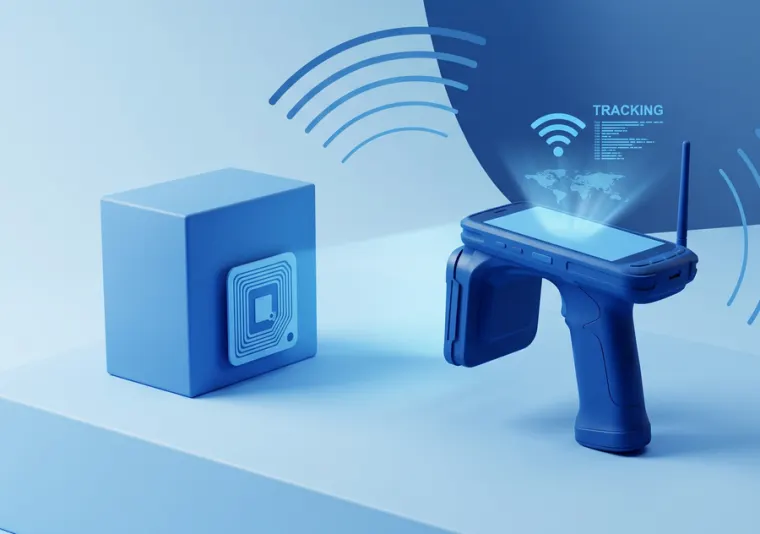
What RFID Pallet Tracking Actually Tells You (And What It Doesn't)
What gets packaged and sold as smart pallet technology is, in most cases, a ten-cent sticker on a rickety wooden pallet. Here is what passive RFID can and cannot see.
 Rodrigo CastroCo-Founder & President5 min read
How a Viral Cargo Theft Made the Case for Smart Pallets
Cargo theft losses across the US and Canada surged 60% to nearly $725 million, with food and beverage hit hardest and automotive supply chains increasingly exposed.
Rodrigo CastroCo-Founder & President5 min read
The Pallet Is Costing You More Than You Think
You have invested millions in automation and you track labor, freight and energy to the decimal. Somewhere on your dock, a wooden pallet is about to stop the line.
Rodrigo CastroCo-Founder & President10 min read