
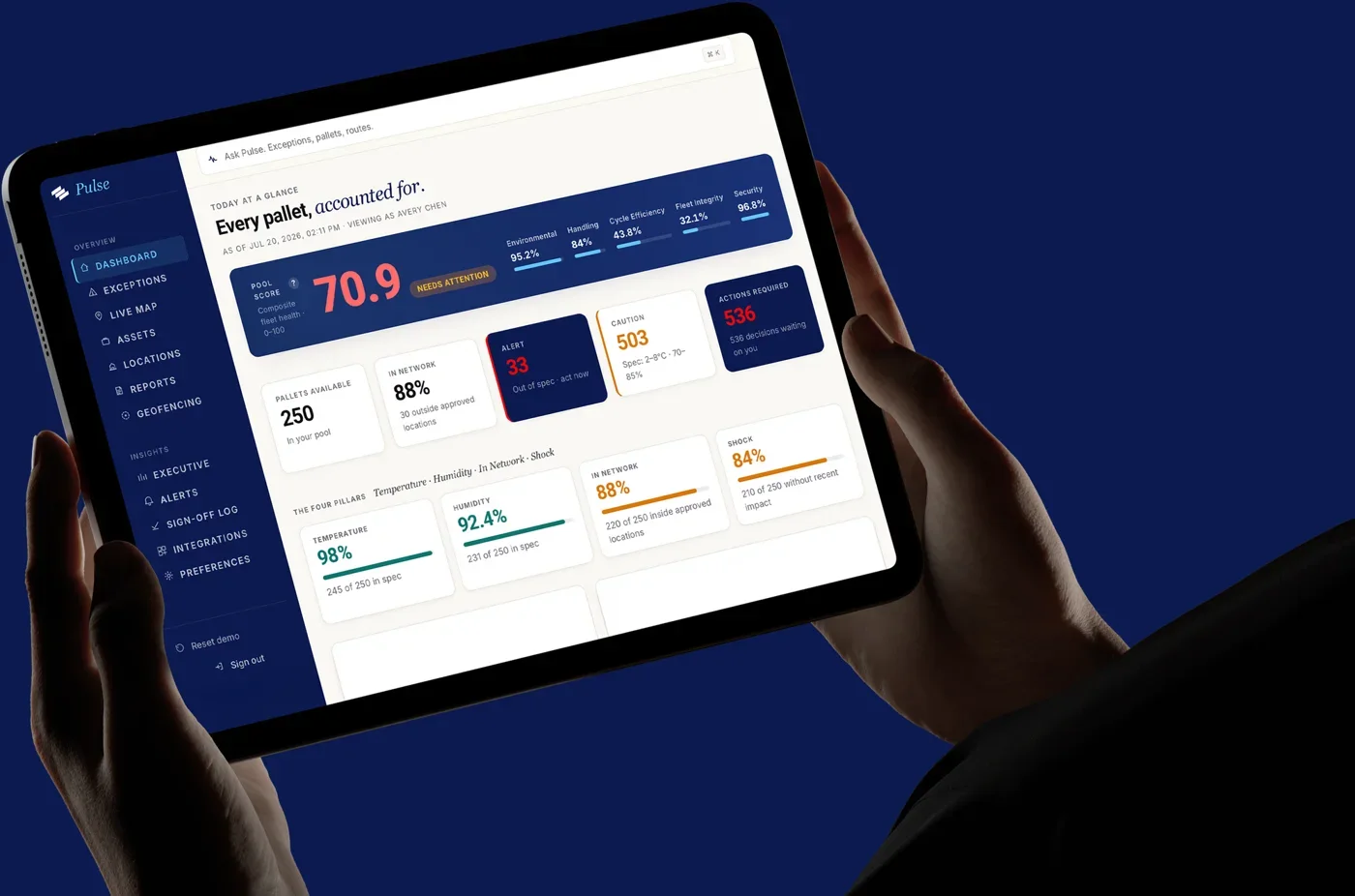
Walk any dock in America and count the assets that are talking to you. The trailer has telematics. The forklift logs every lift. The scanner gun knows who picked what. Then look down. The pallet under all of it, the one surface physically present at every handoff from plant to shelf, has nothing to say. Fastmarkets' model puts the count at 3.7 billion pallets in circulation in the United States in 2025. Most are wood, and almost all are silent.
Smart Pallets change that. A Smart Pallet carries its own sensors, its own cellular connection and its own place in a software platform, so it reports location and condition from wherever it is, with no scanner, no dock reader and no help from the carrier. It is the difference between a pallet that gets counted when it passes a door and a pallet that keeps a diary.
This guide is the long version of what we tell supply chain leaders in a first meeting: what a Smart Pallet actually is, what is inside one, why the shift from pilot to program is happening now, where it pays off by industry, and how to evaluate and roll out a program. The technology-by-technology comparison is a separate buyer's guide. This one is about the pallet.
Key Takeaways
- A Smart Pallet is three things working together: a dimensionally consistent platform, an embedded sensor module with its own connectivity, and software that turns readings into exceptions. A tag or a bolt-on tracker alone is not one.
- The market has moved: MHI's 2025 survey of 700+ supply chain leaders predicts 77% IoT adoption within five years, and the world's largest pallet pooler now spends tens of millions a year on pallet tracking.
- Smart pallets pay for themselves in five budgets that rarely talk to each other: loss and replacement, damage and claims, dwell and detention, line jams and downtime, and compliance paperwork.
- The best pallet tracking system is mostly quiet. Exception-based reporting logs timestamped, geolocated events only when something changes, and the silence between them is evidence too.
- Evaluate a program on where location updates, whether condition data is sensor-generated, what the record shows between facilities, and who owns the data. Pilot one lane for 90 days before you scale.
What Smart Pallets Are (and What Gets Sold Under the Name)
The phrase now covers almost anything with a sticker on it, so let us be precise. A Smart Pallet has three layers that work together: a physical platform built to a tight dimensional tolerance, an embedded sensor and communications module that travels with the load, and software that turns readings into decisions. Remove any one of the three and you have something else.
| What you are offered | How it reports | What you learn | What it is really |
|---|---|---|---|
| Barcoded pallet | Someone scans it | It was at a known point when a person pointed a gun at it | An inventory label |
| RFID pallet | A fixed reader catches it passing a portal | Tag ID and timestamp at each read point, nothing in between | A checkpoint system |
| Bolt-on GPS tracker | A battery device strapped or screwed to the pallet | Location while the battery lasts and the device stays attached | A tracker on a pallet |
| Smart Pallet | An embedded module reports on its own over cellular when something changes | Location plus temperature, humidity, shock and load state, with a timestamped record | A connected asset |
We have written at length about the second row. Passive RFID tags have no power of their own and answer only when a reader within a few meters asks; GS1 puts the typical passive UHF read range at several meters, up to 15 meters in special cases. That is a fine way to count pallets at a dock door and no way to know what happened on the truck. What RFID Pallet Tracking Actually Tells You makes that argument in full. One point bears repeating: APS pallets carry RFID tags too, because in-warehouse scanning is a real need. The tag is a feature of a Smart Pallet. It is not the Smart Pallet.
The third row deserves more credit than it usually gets and less than its marketing claims. A bolt-on tracker does see the road. But it has to be bought separately, attached, provisioned, charged and found again when the pallet comes home. Sam on our team puts it simply: a GPS tracker has to be bolted on and set up to connect, and ours does not have those extra steps. The sensor is part of the pallet because it was built into the pallet.
Watch Out
Ask any vendor one question first: where does the location update? If the honest answer involves dock doors, gateways or readers you have to install, you are looking at a checkpoint system wearing a Smart Pallet badge.
Inside a Smart Pallet: Platform, Sensor Module, Connectivity and Software
Take one apart on paper and the four parts explain most of the buying decisions.
The Platform Has to Earn Its Place First
Nobody leases a pallet for the electronics. The platform has to carry the load, survive the forklift and run through automation without jamming before the sensor is worth anything. APS pallets are molded from 100% recycled HDPE, hold their dimensions to under 1% variance against the 8 to 10% normal for wood, match wood in load-bearing capacity, and weigh up to 30% less, roughly 2,200 pounds out of a truckload. They are non-porous, washable, free of nails and splinters, and ISPM 15 exempt. The full case is on our Why Plastic page; the short version is that a sensor on a platform that breaks every fifth trip is a sensor you keep replacing.
The Sensor Module Is Built In, Not Bolted On

The module is a sealed unit embedded in the pallet body. Most programs start with the four readings that cover the most expensive failures, and the hardware carries more:
- Location High-gain GPS with a cellular antenna, so the pallet says where it is without any reader in range. This ends the habit of paying to replace pallets that never left your network.
- Temperature An automotive grade sensor logging the thermal history of the load, so a breach is known while there is still time to act.
- Humidity Catches the moisture conditions that ruin packaging, paper goods, leather and electronics mid-transit.
- Shock A 3-axis accelerometer that records the exact moment and location of an impact above a set threshold. A damage dispute becomes a dated, located event.
- Load state, light, pressure and over-the-air updates Load state flags a load partially removed in transit, light tells you a sealed trailer was opened, and over-the-air Wi-Fi and Bluetooth let thresholds change without touching the fleet.
Connectivity: Why Cellular Is the Default for Transit
A pallet in transit is, by definition, somewhere you do not control. The warehouse Wi-Fi is behind it and the customer's readers are ahead of it. Cellular is the one network already built along every highway and inside most buildings, which is why GPS pallet tracking from APS reports over existing cellular networks and uses Bluetooth for local tasks. No fixed readers, no dock hardware, no asking a 3PL to install a gateway. As our technology page puts it, it works on existing networks.
Software: Where Readings Become Decisions
The platform is called Pulse. Its job is not to show you 100,000 dots on a map but to decide which three of those pallets need a human in the next hour and to tell the right person by push, email or SMS. Pulse connects to the WMS and ERP you already run, and every alert carries a timestamp, a location and the reading that triggered it.
Why Smart Pallet Tracking Is Moving From Pilot to Program
For years, pallet-level tracking was a conference demo for IoT in logistics. Three things changed. The cost of a cellular sensor module fell to where it can live inside an asset that leases for the price of wood. Supply chain leaders discovered that their visibility platforms were only as good as the data reaching them. And the largest player in the pallet business started doing it.
Read those four numbers together. More than 700 leaders told MHI and Deloitte at the end of 2024 that they expect to adopt IoT and sensing within five years, and 55% are increasing technology investment, 60% by more than $1 million. Yet only 37% of the 525 executives EY surveyed in 2022 had actually seen visibility increase, and McKinsey's 2023 Supply Chain Pulse found 67% of 101 leaders planning visibility work and only 30% done. The appetite is there. The data is not. Companies bought dashboards fed by carrier updates, dock scans and estimates.
The pallet industry is shifting under the same pressure. The 2024 Pallet Report from Logistics Management and Peerless Research Group found 94% of respondents still using wood, but plastic usage rose to 43% of respondents from 38% a year earlier, and the share using a pallet rental company nearly doubled, to 14% from 8%.
When the Biggest Pooler Puts Sensors on Pallets, the Question Changes
The clearest signal is in a public filing. Brambles, the parent of CHEP, reported in its FY25 results that asset-efficiency initiatives, including an expanded loss-recovery fleet and improved pallet visibility enabled by digital, helped it recover and salvage roughly 25 million additional pallets against its FY21 baseline and cut uncompensated losses by about 50%. Its provision for irrecoverable pooling equipment fell from 3.9% of sales in FY21 to 1.4% in FY25, its Serialisation+ program has put 60,000 smart pallets into Chile and tracked more than 11 million trips, and it guided to about US$65 million of Serialisation+ spending in FY26. When the largest pooler in the world shows that visibility on the pallet recovers tens of millions of assets, the question is no longer whether the pallet should report. It is how much of the record you want, and who keeps it.
Why It Matters
A pooler instruments its pallets to protect its pallets. Pulse instruments the pallet to protect your product. Same hardware idea, very different beneficiary. If your pooled pallets are tagged, ask who sees the data and whether any of it describes the load rather than the deck boards.
Where Smart Pallets Pay Off, Industry by Industry
The pallet does not change between industries. The failure mode does, and so does the cost of a failure. These are the seven sectors APS builds programs for; the detail is on our Industries page.
| Industry | The failure that hurts most | The signal that catches it |
|---|---|---|
| Pharma and Life Sciences | A temperature excursion at a handoff nobody records | Temperature history plus a custody timestamp at every stop |
| Cold Chain Logistics | Visibility ends at the carrier handoff | Cellular location and temperature from the trailer |
| Food and Beverage | The fastest-growing theft target, plus FSMA records due in 24 hours | Geofence deviation, load-change alerts, a movement log |
| Consumer Goods | Retailer chargebacks for damaged or non-compliant pallets | Shock events dated and located, on a pallet that arrives in spec |
| Automotive | A broken returnable loop stops a just-in-time line | Dwell time by facility and a count of where the fleet is |
| Health and Wellness | Consumer goods volumes with near-pharma hygiene rules | A washable, non-porous platform that also reports humidity |
| Aerospace and Defense | Heavy, irregular loads and contract-based funding | Impact logging and a lease that fits contract budgets |
Theft and Loss: The Shipment Has to Protect Itself
Verisk CargoNet's analysis of 2025 counted 2,646 confirmed cargo thefts in the United States and Canada, up 18% from 2,243, with estimated losses near $725 million, a 60% jump in one year. The average theft was worth $273,990, up 36%, which tells you criminals are choosing targets, not trucks. Food and beverage took the largest hit at 708 incidents, up 47%, and while California still led with 1,218 incidents, New Jersey rose 50%, Indiana 30% and Pennsylvania 24%. We covered the new playbook in How a Viral Cargo Theft Made the Case for Smart Pallets. The structural point: a pallet with its own location and load-state sensors is a witness that does not belong to the carrier. The same logic covers the cold chain handoff, where, per a 2022 study citing the World Health Organization, as much as 25% of vaccine products arrive degraded: the pallet is under the product on that dock, and it logs the temperature there.
Dwell, Detention and the Lines That Stop
The American Transportation Research Institute's 2024 study put driver detention at $3.6 billion in direct expense and $11.5 billion in lost productivity in 2023, with drivers detained at 39.3% of all stops and 56.2% of refrigerated stops. The detail that matters for pallet data: 94.5% of fleets charge detention fees and get paid on fewer than half of those invoices, because nobody can prove when the trailer arrived and left. A pallet that logs its own arrival and departure settles that for both sides. Inside the building, a 2019 Peerless Research Group survey found 53% of 259 respondents dealing with jams or faults from poor pallet quality or bottom boards daily or weekly. That is a platform problem before it is a data problem; the downtime math is in The Pallet Is Costing You More Than You Think.
Exception-Based Reporting: Why the Best Pallet Tracking System Is Mostly Quiet
A fleet of 20,000 pallets reporting every reading every minute would produce a river of data nobody reads and a battery problem nobody wants. So Pulse does not work that way. The sensors behave like a smoke detector. When the pallet sits in a rack at the right temperature, the system stays quiet. When the pallet moves, when temperature or humidity crosses a threshold set for that lane and product, when a shock exceeds a G-force limit, or when the load state changes, the module wakes up and logs exactly what happened, timestamped and geolocated. Pulse routes that exception, by push, email or SMS, to the role that owns the lane, and into the WMS or ERP if you want it there. Normal conditions produce no traffic, and three quiet days in a distribution center are themselves a record: the product was in spec and undisturbed until the next movement window opened. We call this adaptive intelligence.
A Worked Example
A pallet of chilled product leaves a plant outside Reno on a Tuesday morning with a departure reading in spec. It is quiet for six hours on I-80. At a cross-dock in Salt Lake City it is staged outside a reefer door, and at minute 38 the temperature crosses the limit. The module logs 3:12 p.m., the coordinates of that dock and the reading; Pulse sends it to the receiving manager's phone and your cold chain lead; the pallet goes back inside at minute 44, and the arrival reading the next morning is in spec. You now hold three dated facts, departure, excursion and arrival, that establish what happened, where responsibility sat under your Incoterms, and that the product recovered. Nobody scanned anything.
Key Takeaway
Judge pallet tracking software by what it does with an exception, not by its map. Who gets told, how fast, and whether the record survives as evidence decide whether the data changes an outcome.
Supply Chain Traceability: Smart Pallets as Returnable Transport Items With a Record
Pallets, crates, totes and bins are returnable transport items, or RTIs: packaging meant to cycle back and be used again rather than discarded. Every RTI program lives or dies on two numbers, how many trips an item survives and how many items come back. A Smart Pallet improves both. APS pallets are built for roughly 100 to 200 or more trips before recycling, against about 3 to 5 for white wood and about 15 for pooled hardwood, and because each one reports its own location, the closed loop has 100% retrieval capability. At end of life the pallet is shredded back into the APS HDPE stream, as our Sustainability page explains.
Traceability is the other half, and it is increasingly a legal word. The FDA's Food Traceability Rule under FSMA Section 204 requires companies handling foods on the Food Traceability List to keep Key Data Elements at seven Critical Tracking Events, including shipping and receiving, and to produce those records within 24 hours of a request. The FDA proposed a 30-month extension to July 20, 2028, and Congress directed the agency not to enforce the rule before that date. A pallet that logs every movement with a time and a place is not a traceability system by itself, but it is the physical layer those records have been missing: shipping and receiving events generated by the asset rather than typed in afterward.
- Chain of custody An independent, timestamped record at every handoff, so a claim is argued from a record rather than from memory, and your Incoterms finally have facts under them.
- Regulatory records FSMA 204 shipping and receiving events, GDP-aligned handling records for pharma, HACCP temperature evidence for food, all from one movement log.
- Scope 3 disclosure California's SB 253 requires companies over $1 billion in revenue to disclose Scope 3 emissions starting in 2027, with third-party assurance to follow. Pallet movement data turns downstream transport from an estimate into a measured number.
How to Evaluate a Smart Pallet Program: The Buyer's Checklist
You will hear the word smart from every vendor in the category. These ten questions sort the answers; the first three eliminate most of the field.
- Where does location update? Readers, gateways or dock infrastructure mean a scanning system. You want the pallet reporting over cellular from wherever it is.
- Is condition data sensor-generated or inferred? A trailer reading tells you about the trailer. You want a reading taken at the pallet.
- What does the record look like between two facilities? Ask for actual data from a six-hour leg with no fixed readers. Blank means blank.
- Is the module embedded or attached? Bolted-on devices get knocked off and need separate provisioning. Embedded means the sensor's life is the pallet's life.
- How are exceptions routed? To whom, on which channel, how fast, and can it reach your WMS or ERP without a second login.
- What infrastructure do we have to install? The right answer is none. No readers, no dock hardware, no carrier cooperation.
- Who owns the data, and is it usable as evidence? You should own the record of your own product, with timestamps and coordinates that stand up in a claim.
- How is the program priced? One all-inclusive lease covering pallet, sensors, reporting and visibility, priced against what you pay for wood. Separate hardware, software and replacement charges are a red flag.
- Can we pilot one lane first? A 90-day pilot on a single lane with a baseline is the only honest way to size the return.
- What happens at end of life? Retrieval, recovery and recycling should be the vendor's problem, written into the lease.
Rolling Out Smart Pallets: Pilot, Scale, and the ROI Math
A Smart Pallet program is not an IT project. The pallets arrive, the loads go on them, and the data starts. The work is in choosing where to start and what you will do with the first exception.
- Pick one lane that hurts A chargeback-heavy retailer, a temperature-sensitive route, a facility with unexplained dwell. Narrow beats broad.
- Write down the baseline Pallets lost, claims denied, detention disputed, stoppages blamed on pallets, hours on paperwork. Measure before, or you cannot prove after.
- Set thresholds with the people who own the product Quality sets temperature and humidity limits. Operations sets geofences. Finance picks the exceptions it wants to see.
- Run 90 days and read every exception Month one teaches you about your lane, month two about your carriers and customers, and month three builds the business case.
- Integrate, then scale Connect Pulse to the WMS and ERP, extend to the next lanes, and let each lane's track record flag the next problem early.
Where the Return Comes From
The cost of a pallet sits in one budget. The costs a silent pallet creates land in at least five others, and the return is the sum of what you recover from each. Our savings calculator runs them with your own numbers.
| Cost bucket | Where it hides today | What the pallet data does |
|---|---|---|
| Loss and replacement | Pallet purchases that replace assets still inside your network | Location per pallet; a right-sized fleet |
| Damage and claims | Write-offs and denied claims nobody could document | Dated, located shock and temperature events |
| Dwell and detention | Fees you pay or cannot collect for lack of proof | Arrival and departure logged by the asset |
| Jams and downtime | Maintenance logs and overtime, never the packaging budget | A platform within 1% tolerance that automation accepts |
| Compliance paperwork | Hours assembling records after the fact | Movement and condition records generated as events happen |
Then there is the line that surprises most people in a first meeting: the pallet itself does not cost more. The APS all-inclusive monthly lease is designed to price at or below what companies already pay for wood pallet programs, one flat cost covering the pallet, the sensors, the exception reporting and the visibility layer, with no capital purchase and no replacement cost. The five buckets above are the return; the lease is the pallet budget you already have.
That is the honest version of the APS case. We did not invent the idea that assets should report; the trailer, the forklift and the scanner got there first. We built the one asset that touches every load at every node so that it finally could, and priced it so the decision is operational rather than financial. If you want to see what your pallets would be telling you, send us the lanes, the volumes and the compliance regime you answer to. The button says Let's Talk, and we mean it.
Sources
- Fastmarkets, “Annual pallet estimates viewpoint,” 2026
- MHI and Deloitte, “2025 MHI Annual Industry Report,” via Intelligent CIO, 2025
- EY, “Supply chain sustainability 2022,” 2022
- McKinsey “Supply Chain Pulse” survey, via Supply Chain Management Review, 2023
- Logistics Management / Peerless Research Group, “The Pallet Report 2024: Exploring the options,” 2024
- Logistics Management / Peerless Research Group, “The Pallet Report: State of the pallet industry,” 2019
- Verisk CargoNet, “Cargo Theft Losses Surge to Estimated $725 Million in 2025, Verisk CargoNet Analysis Reveals,” January 22, 2026
- American Transportation Research Institute, “New Research Documents Substantial Financial and Safety Impacts from Truck Driver Detention,” 2024
- Brambles Limited, “FY25 Results Presentation,” 2025
- U.S. Food and Drug Administration, “FSMA Final Rule on Requirements for Additional Traceability Records for Certain Foods,” updated 2026
- Tropical Diseases, Travel Medicine and Vaccines, “Adherence to WHO vaccine storage codes and vaccine cold chain management practices,” 2022
- GS1, “What is the read range for a typical RFID tag?”
- California Legislative Information, “SB 253, Climate Corporate Data Accountability Act,” 2023
FAQ
What Is a Smart Pallet?
A Smart Pallet is a shipping pallet with an embedded sensor and communications module that reports its own location and condition, temperature, humidity, shock and load state, over cellular networks to a software platform, with no scanners, readers or carrier involvement. A pallet with only a barcode or a passive RFID tag is counted at checkpoints; a Smart Pallet keeps a record everywhere.
How Is IoT Pallet Tracking Different From RFID Pallet Tracking?
RFID pallet tracking records a tag ID and a timestamp each time a pallet passes a fixed reader, so it tells you a pallet moved between read points and nothing about what happened in between. IoT pallet tracking puts a cellular module and sensors on the pallet itself, so it reports location and condition from the truck, the yard and the cross-dock. APS pallets carry both.
How Much Does a Smart Pallet Program Cost?
APS prices Smart Pallets as an all-inclusive monthly lease designed to land at or below what a company already pays for its wood pallet program. The lease covers the pallet, the embedded sensors, exception reporting and the Pulse platform, with no capital purchase and no separate hardware, software or replacement charges. The return comes from the costs it removes: lost pallets, denied claims, detention disputes, line jams and compliance paperwork.
Do Smart Pallets Need New Infrastructure in Our Warehouses?
No. The APS module reports over existing cellular networks and uses Bluetooth for local tasks, so a warehouse pallet tracking system built on it needs no readers, gateways or dock hardware, and carriers and customers do not have to do anything. Alerts arrive by push, email or SMS, and Pulse connects to the WMS and ERP you already run.
Can Smart Pallet Data Be Used as Evidence in a Freight Claim?
Yes. Each exception is logged with a timestamp, GPS coordinates and the reading that triggered it, and the quiet periods between events establish that conditions were in spec. That gives you departure, exception and arrival facts showing when and where damage or an excursion occurred, which is what carrier and insurance claims, and the Incoterms behind them, turn on.
Featured Posts From the APS Blog

How a Viral Cargo Theft Made the Case for Smart Pallets
Cargo theft losses across the US and Canada surged 60% to nearly $725 million, with food and beverage hit hardest and automotive supply chains increasingly exposed.
 Rodrigo CastroCo-Founder & President5 min read
The $35 Billion Secret Your Pharmacist Doesn't Know About
A vial of insulin leaves Chicago produced to an exacting specification and stored at the right temperature. What happens next is a $35 billion problem.
Rodrigo CastroCo-Founder & President7 min read
The Pallet Is Costing You More Than You Think
You have invested millions in automation and you track labor, freight and energy to the decimal. Somewhere on your dock, a wooden pallet is about to stop the line.
Rodrigo CastroCo-Founder & President10 min read