
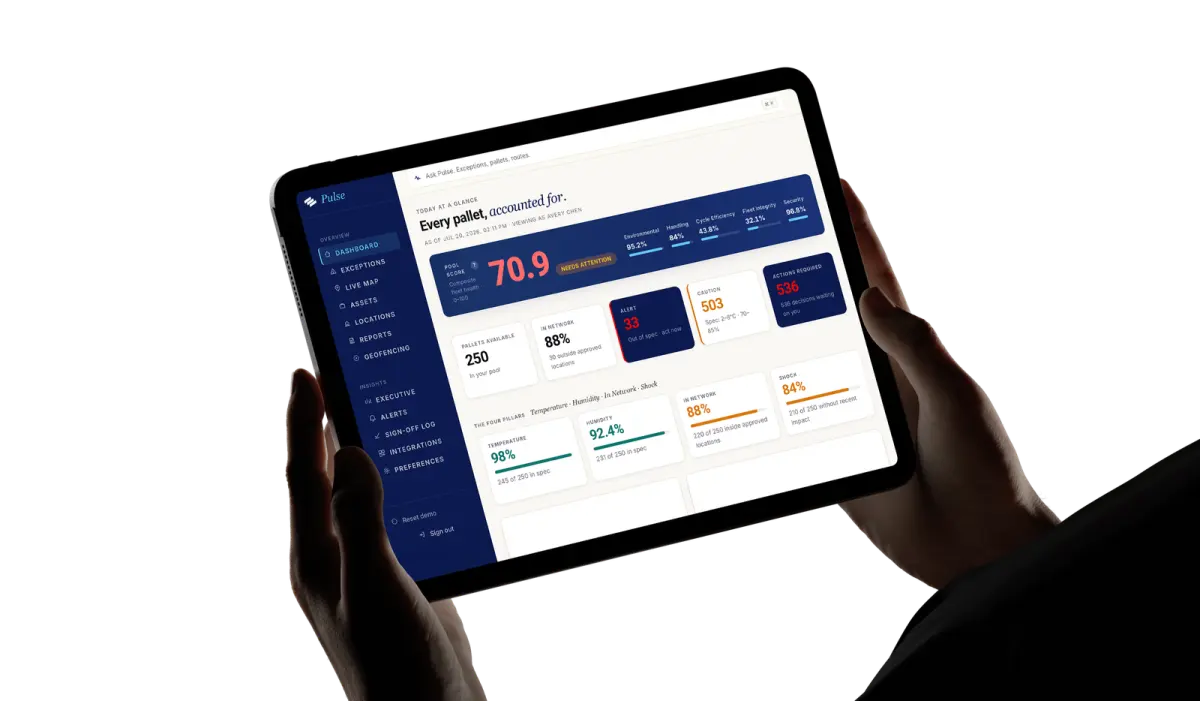
Ask a plant manager why the steel pallets at the back of the yard are still there and you will get the same answer: they never wore out. That is the whole case for metal. Steel and aluminum pallets do not splinter, do not rot, and do not care about a forklift's bad day. They also go silent the moment they leave the dock, and they are heavy or expensive. Here is how they compare with APS's leased HDPE Smart Pallets.
APS vs Metal Pallets Verdict
Which Pallet Belongs Under Your Load?
Metal pallets and APS Smart Pallets agree on one thing: wood is the problem. A steel or aluminum pallet is a capital asset you buy for its permanence. An APS Smart Pallet is a leased HDPE platform with a cellular sensor module built in, priced by the month. One is a very good shelf. The other is a shelf that reports back.
So the verdict turns on what the pallet does all day. Under a die in one building, or next to something hot, buy metal and keep it. On trucks between facilities you can name, carrying product that can spoil or get stolen, the lighter deck that logs its own trip wins.
Choose APS If
- Your Pallets Ride Trucks Between FacilitiesRepeating lanes between plants, DCs and partners are where weight, visibility and a monthly cost pay back every trip.
- You Need to Know What Happened in TransitLocation, temperature, humidity and shock are logged on the pallet, and Pulse routes the exception to a person.
- You Would Rather Not Buy Pallets at AllOne monthly lease covers the pallet, sensors, exception reporting and visibility. No capital purchase.
- You Answer to FSMA, GDP or GMPA pressure-washable deck plus a timestamped chain of custody gives you the record for FSMA, GDP and GMP files.
Choose Metal Pallets If
- Your Loads Live Next to Heat or FlameSteel does not burn and melts near 1500°C. HDPE melts at about 130°C. Foundries and heat-treat lines are metal's lane.
- You Need a Stainless Deck Inside a CleanroomFor a few pallets that never leave a GMP suite, a welded 304 or 316 stainless pallet is what cleanroom suppliers sell for the job.
Metal Pallets vs HDPE Pallets by Operation
Two Ways to Stop Buying Wood
A metal pallet is bought, not programmed: galvanized steel for the yard and the warehouse, aluminum when weight or corrosion matters, stainless for washdown and cleanrooms. A typical metal pallet such as Vestil's SPL-4048 is a welded 40 by 48 galvanized steel two-way listed at 100 pounds. The pallet is yours. So are the repairs, the freight weight and the day it gets scrapped.
APS designs and manages custom pallet leasing programs for closed-loop partners. Every Smart Pallet is 100 percent recycled HDPE, consistent to under 1 percent, with an embedded sensor module (cellular GPS, temperature, humidity, shock) and RFID tags for in-DC scanning. One flat monthly cost covers the fleet, the sensors, exception reporting in Pulse and visibility, with no capital purchase and no replacement cost, designed to price at or below wood. Our plastic pallet lifespan statistics post has the trip counts. The ratings below are editorial, resting on the weight, heat and data evidence in this post.
| Operation | APS | Metal Pallets |
|---|---|---|
| Closed-Loop Plant & DC Lanes | Best fit | Workable |
| Cold Chain & Pharma Lanes | Best fit | Workable |
| Cleanroom-Only Internal Moves | Workable | Best fit |
| Heat, Foundry & Kiln-Adjacent Loads | Poor fit | Best fit |
| High-Value Freight in Transit | Best fit | Poor fit |
Steel, Aluminum & HDPE Pallet Spec Sheet
Three Materials, Three Different Jobs
Steel pallets are the heavy end of the market: Custom Equipment Company lists its hot-dipped galvanized line at 80 to 114 pounds, rated 8,000 pounds static, 4,000 dynamic and 2,200 in the rack. Aluminum pallets sit closer to plastic on the scale and higher in the rack: Uline's 48 by 40 aluminum pallet weighs 46 pounds and is rated 30,000 on the floor, 5,000 on the forks and 5,000 in the rack. A steel pallet buys abuse resistance, an aluminum pallet buys corrosion resistance, and APS Smart Pallets, built to match wood in load-bearing capacity, are the only one with a sensor inside. Our guide to plastic pallet load ratings explains why the rack number comes first.
Each material is then scored out of ten on cost and lifespan, data, and hygiene and handling. Metal ties APS on hygiene, since steel, aluminum and HDPE all wash clean and skip ISPM 15. The split comes in the other two groups: metal is bought up front, and it carries no sensor at all.
| Criterion | APS | Metal Pallets |
|---|---|---|
| Cost & Lifespan | 10/10 | 4/10 |
| No capital purchase | YesMonthly lease | NoBought outright, $140 to $460+ |
| Replacement cost in the program | YesCovered by the lease | NoRepair or rebuy on your books |
| Service life beyond wood | Yes100 to 200+ trips | YesYears. No trip count published |
| Lighter than wood | YesUp to 30% lighter | NoSteel 100 lbs, aluminum 46 |
| Rust is not a line item | YesHDPE does not corrode | YesGalvanized steel or aluminum |
| Data | 10/10 | 0/10 |
| Location between facilities | YesCellular GPS, no readers | NoNone as sold. Bolt one on |
| Temperature & humidity | YesLogged on the pallet | NoNone as sold |
| Shock & handling events | YesTimestamped & geolocated | NoNone as sold |
| Exceptions reach a person | YesPulse routes them | NoNo sensor data as sold |
| In-DC RFID scanning | YesRFID tags on every pallet | NoNeeds on-metal tags added |
| Hygiene & Handling | 10/10 | 10/10 |
| Non-porous, washable deck | YesPressure-washable HDPE | YesStainless & aluminum wash down |
| ISPM 15 exempt | YesNo heat treatment | YesNo heat treatment |
| No nails, no splinters | YesRecycled HDPE, no nails | YesAll-welded construction |
| Dimensionally consistent | YesUnder 1% variance | YesWelded frame, no boards |
| Your product only | YesDedicated fleet, your loop | YesYou own it, you load it |
Two points per Yes, none per No, five rows a group. Metal figures are the named listings, checked October 2026. Data rows score the pallet as sold, since a tracker can be bolted onto any pallet. Service life is each side's own statement.
Metal Pallet Cost & Lifespan
What Permanence Costs
Search for metal pallets for sale and the listings make the pitch for you: welded, galvanized, built for long life. Search for steel pallets for sale and the same catalogs show the catch, the price and the weight per unit. A lease turns what a pallet costs to buy into what a trip costs to run.
Metal Pallet Cost per Trip
The Trip Count Nobody Publishes
APS publishes a trip range for its pallets. Metal pallet makers publish adjectives. Uline says its all-welded aluminum pallet "lasts 4 times longer than wood or plastic," and gives no number of trips. Nor does anyone else we found, so our 300 trips for metal is an assumption. Take Uline's claim literally and metal's per-trip cost falls further.
| Pallet (listing checked Oct 2026) | Price | Trips assumed | Purchase cost per trip |
|---|---|---|---|
| Vestil SPL-4048 galvanized steel, Material Flow | $140.05 | 300 | $0.47 |
| Uline H-4062 aluminum, 1 to 4 units | $460 | 300 | $1.53 |
| Uline H-8165 plastic rackable (polypropylene), 1 unit | $155 | 100 | $1.55 |
| Same plastic rackable, top of APS's stated range | $155 | 200 | $0.78 |
An illustration, not an APS quote. No maker publishes a metal trip count, so 300 is our assumption. 100 and 200 are the ends of APS's range for its own pallets, applied to a catalog plastic price. Purchase price only: no freight, repairs or sensor.
Metal Pallet Weight & Durability
Heavier, Harder & Rustproof Only if You Pay for It
Vestil's 40 by 48 galvanized steel pallet is listed at 100 pounds. The Nelson Company's new 48 by 40 recycled HDPE rackable weighs 35, Uline's 48 by 40 aluminum pallet 46, and Uline's new wood GMA pallet ships at 42. A steel pallet carries nearly three times the dead weight of the HDPE rackable on every trip. APS Smart Pallets are up to 30 percent lighter than wood, with 1 to 2 percent lower fuel use per trip.
Durability is where metal earns its keep. Steel is non-combustible: the Canadian Institute of Steel Construction puts its melting point at approximately 1500°C, above the 800 to 900°C it says a fully developed fire in a typical building will not likely exceed. Aluminum alloys the Aluminum Association had tested to ASTM E136 passed with no flaming. HDPE, by Direct Plastics' PE300 data sheet, melts at 130°C. Near heat, this is not a close call. The International Fire Code lets plastic pallets listed to FM 4996 or UL 2335 be treated as wood for sprinkler design, so check a plastic pallet's listing before you change a storage layout.
The footnote is corrosion. Bare steel rusts, so catalog pallets are hot-dip galvanized: the American Galvanizers Association explains that zinc isolates the steel like paint and then corrodes in its place once the barrier is breached. Aluminum relies on what the ASM Handbook calls a self-healing oxide film. HDPE has neither to maintain.
Upfront Metal Pallet Price
Three Plastic Pallets for One Aluminum Pallet
These are published prices, checked in October 2026 and subject to change. Vestil's SPL-4048 steel pallet lists at $140.05 at Material Flow and $160.95 at Core & Main. Vestil's AP-4048 aluminum pallet lists at $401.27 at Spill 911. Uline's 48 by 40 aluminum pallet is $460 each for one to four units, and in the same catalog a 48 by 40 plastic rackable is $155. Galvanized steel undercuts that plastic pallet. One aluminum pallet buys three, and none has a sensor. An APS program has no upfront price.
Bottom Line
Steel can be the cheapest pallet per trip and the heaviest one to ship. On our assumption a steel pallet wins the per-trip purchase math. It still weighs more than twice a plastic rackable, needs zinc to hold off rust, and tells you nothing. The APS lease removes the capital line and includes the sensor.
Smart Pallet Data Through Metal vs HDPE
A Pallet That Reports & One That Cannot
A metal pallet is a very good shelf and a very good radio shield, for the same reason. Our cellular sensor technology is built into the pallet, not bolted on, and the deck it lives inside is HDPE, which radio passes through far more easily than metal.
Cellular Signal Through Metal
Why the Deck Material Decides Where the Sensor Lives
A closed conductive box is a Faraday cage. As Matt Blaze of the University of Pennsylvania puts it, a Faraday cage "severely attenuates radio signals going in or out of it," though nothing built in the real world blocks perfectly, and any opening can leak. A steel pallet is not a sealed box, so a module buried in one would not go fully dark. It would be partly shielded, by an amount that depends on gaps, frequency and antenna position. Blaze notes that GPS signals start out relatively weak, and GPS.gov lists buildings, bridges and trees among common causes of lost accuracy.
The same physics shows up at the dock. RFID Journal's Mark Roberti explains that a standard passive tag placed on metal is detuned, "rendered unreadable or have an extremely short read range," so metal assets use on-metal tags with spacers, which he says make tagging metal not difficult. None of the metal pallets we checked lists a tag. HDPE is the opposite case. Curbell Plastics' radome white paper describes polyethylene as nonpolar, with a low dielectric constant and low loss tangent, the two properties that let radio pass through a plastic.
Pallet Condition Monitoring
Temperature, Humidity & Shock, Logged on the Pallet
A metal pallet can be the best-made object in the trailer and still tell you nothing, because it carries no sensor. Every APS Smart Pallet logs temperature, humidity, shock and location on exception-based reporting: quiet while conditions hold, awake the moment a threshold is crossed, when it writes a timestamped, geolocated event and Pulse routes it to the person who can act. The silence is data too, and every handoff gets an independent chain of custody.
Bottom Line
Metal shields. HDPE transmits. A tracker can be bolted to a steel pallet, but it has to be fitted and set up to connect. A module inside a steel deck sits behind a partial shield. A module inside an HDPE deck sits behind plastic that radio passes through.
Hygienic Pallets for Pharma & Aerospace
Both Beat Wood. Here Is the Split
Stainless steel pallets are what cleanroom suppliers sell for validated suites. ProCleanroom builds its transport pallet from AISI 304 stainless for a payload of no less than 1,500 kg and markets it for pharmaceutical and GMP environments. Terriva's Pharmatech pallets are 316 stainless or aluminum, fully welded and polished, rated to 1,000 kg and described as GMP-compliant. For a fixed set that never leaves a cleanroom, these hygienic pallets are the right buy.
The split is what happens past the airlock. Pharmaceutical pallets that leave the building live on trucks and docks, where hygiene becomes a documentation question. The FDA's FDA CGMP regulations page says the drug rules, including 21 CFR Parts 210 and 211, set minimum requirements for the methods, facilities and controls used in making and packing drugs. A clean deck answers the facilities part, not what the load experienced in transit. APS pallets are non-porous, pressure-washable recycled HDPE with no nails or splinters, and they carry the temperature and custody log with them. Our pharma pallet compliance guide has the detail.
Two more facts cut both ways. At the border, both skip the stamp: USDA APHIS lists plastic pallets and metal frames among the items it does not regulate as wood packaging. And aerospace splits too. VRR's aluminum PMC air cargo pallet weighs 88 to 101.5 kg bare and carries up to 6,804 kg, which is aircraft equipment, not a shipping pallet. Aerospace & Defense is one of our seven priority industries, on the ground.
Bottom Line
Hygiene is a tie on the deck and a win on the evidence. Buy stainless for the pallets that never leave the suite. Lease Smart Pallets for the ones that leave the building, because the auditor will want the thermal history as well as a clean surface.
Best Heavy Duty Pallets for Your Operation
Match the Deck to the Lane
The phrase heavy duty pallets covers two jobs. One is carrying something very heavy or very hot a short distance, forever. The other is carrying ordinary product a long distance, many times, without losing it. Metal owns the first. APS is built for the second.
The cards below follow that split between the two jobs. If your heavy loads stay near heat, in a validated cleanroom or inside one building, the metal card is yours. If your product rides trucks between sites and needs a record of the trip, start with the APS card.
Who APS Is Best For
Closed Loops That Need a Record
- Cold Chain & Pharma ShippersTemperature and humidity are logged on the pallet, exceptions reach a person in transit, and every handoff gets a chain of custody for GDP and FSMA records.
- Plant-to-DC, Automotive & Aerospace Ground LoopsRepeating lanes between facilities you control, feeding automated lines that want a pallet consistent to under 1 percent.
- Freight That Can Be Stolen or Argued OverElectronics, spirits, components and goods headed for retailers that deduct first get a pallet that reports its own location.
Who Metal Pallets Are Best For
Heat, Cleanrooms & One-Off Heavy Moves
- Heat-Adjacent & Fire-Sensitive StorageFoundries, kilns, heat-treat lines and idle storage under a strict fire code get a steel deck that melts near 1500°C instead of 130°C.
- Validated Cleanroom FixturesA small, fixed set of 304 or 316 stainless pallets that stays inside a GMP suite and gets washed in place.
- Dies, Coils & Machinery in One BuildingVery heavy point loads that never leave the plant are what a welded steel pallet was built for.
APS vs Metal Pallets Pros & Cons
The Honest List
Metal's strengths are real: strength and permanence, a deck that does not burn, stainless for validated suites, and an exemption from ISPM 15. For a pallet that never leaves the building, those can settle the question.
Its cons show up on the road. Steel is heavy to ship, aluminum carries a steep price premium, and a metal deck stays silent while shielding the signal. APS carries the same two cons as every lease we offer: it needs a closed loop, and it asks for a commitment.
APS
Pros
- Data Rides With the PalletCellular GPS, temperature, humidity and shock are logged on the pallet and routed by Pulse, with no readers.
- One All-Inclusive Monthly CostPallet, sensors, exception reporting and visibility in one number, designed to price at or below wood.
- Lighter Than WoodUp to 30 percent lighter than wood, about 2,200 pounds less dead weight per truckload.
- 100 Percent Recycled, Closed-Loop RecoveryEvery pallet is recycled HDPE, the loop has 100 percent retrieval capability, and retired pallets are shredded back into the stream.
Cons
- Needs a Closed LoopIf your pallets leave for receivers you cannot name, or never leave one building, a leased fleet is the wrong shape.
- A Lease Is a CommitmentA monthly fleet cost is predictable, and that cuts both ways: you pay it in a slow month too.
Metal Pallets
Pros
- Strength & PermanenceWelded steel and aluminum pallets carry heavy point loads, shrug off forklift abuse and are sold on a lifetime of years.
- Does Not BurnSteel is non-combustible with a melting point near 1500°C, and the aluminum alloys tested to ASTM E136 showed no flaming.
- Stainless for Validated Suites304 and 316 stainless pallets are welded, polished and spray-washable, and cleanroom suppliers sell them for GMP suites.
- ISPM 15 ExemptLike plastic, metal crosses borders with no heat treatment or stamp.
Cons
- Heavy & Expensive to ShipA 40 by 48 galvanized steel pallet lists at 100 pounds, nearly three times an HDPE rackable, and that weight rides every trip.
- Aluminum Costs Three Times as MuchAluminum pallets list at $400 to $460 against $155 for a plastic rackable in the same catalog, every one a capital purchase.
- Silent, and a Shield BesidesNo sensor, no log and no location between docks as sold, and a deck that attenuates radio, so tracking has to be bolted on outside.
APS vs Metal Pallets FAQ
Questions Buyers Ask Before Choosing
Buyers comparing metal with HDPE ask about strength, weight and tracking more than anything else. Short answers to those three follow, with the outside figures listed under sources.
Are Metal Pallets Stronger Than Plastic Pallets?
On heat, yes: steel melts near 1500°C and HDPE at about 130°C, and welded steel is built for heavy point loads. On published load ratings the gap is narrower. Vestil's galvanized steel pallet is rated 8,000 pounds static, 4,000 dynamic and 2,200 in the rack, The Nelson Company's 48 by 40 recycled HDPE rackable 25,000, 5,000 and 2,000, and Uline's aluminum pallet leads the rack at 5,000.
How Much Heavier Is a Steel Pallet Than an HDPE Pallet?
Nearly three times. Vestil's 40 by 48 galvanized steel pallet is listed at 100 pounds and Custom Equipment Company lists its galvanized line at 80 to 114 pounds, while The Nelson Company's new 48 by 40 recycled HDPE rackable weighs 35 pounds on its spec sheet. That is 65 extra pounds a pallet. If a trailer carries 26 of them on the floor, it hauls about 1,690 pounds of extra steel. Aluminum is the exception at 46 pounds, and costs about three plastic pallets.
Can GPS Tracking Work Through a Metal Pallet?
A tracker mounted outside a metal pallet can work once it is fitted and set up to connect. A module built inside a steel deck is inside a partial Faraday cage: a conductive enclosure severely attenuates radio in both directions, by an amount that depends on gaps and frequency. HDPE is nonpolar with a low dielectric constant and loss tangent, so radio passes through it far more easily. The APS sensor module is built into the pallet, not bolted on.
Sources
- Material Flow, "Heavy-Duty Galvanized Steel Pallets (Vestil SPL series)," 2026
- Core & Main Supply, "Vestil Galvanized Steel Pallet 48 In. x 40 In. x 4-3/4 In. 8000 Lb. Floor Capacity Gray SPL-4048," 2026
- Custom Equipment Company, "Steel Pallets with Hot-Dipped Galvanized Finish," 2026
- Spill 911, "Vestil AP-4048 40 x 48 Aluminum Pallet," 2026
- Uline, "Aluminum Pallet 48 x 40 (H-4062)," 2026
- Uline, "Solid Top Rackable Pallet 48 x 40, 2,200 lb Capacity (H-8165), polypropylene," 2026
- Uline, "New Wood GMA Pallet 48 x 40 (H-1218)," 2026
- The Nelson Company, "DE4840FP-RACX Plastic Pallet Spec Sheet," 2026
- VRR, "PMC Pallet, 96 x 125 Air Cargo Pallet," 2025
- ProCleanroom, "Stainless Steel Cleanroom Transport Pallet, Premium," 2026
- Terriva Pharmatech, "Transportation Pallets," 2026
- Canadian Institute of Steel Construction, "Unparalleled Safety," 2026
- ICC Building Safety Journal, Lemmon, Cowie and Weritz, "The Non-Combustibility of Aluminum," 2020
- ICC Building Safety Journal, Robert Neale, "Cellulose or Plastic? It's Not Just About Shopping Bags," 2021
- Direct Plastics, "HDPE Natural PE300 Material Data Sheet," 2020
- Curbell Plastics, "Plastics for High Performance Radomes," 2022
- Matt Blaze, University of Pennsylvania, "Faraday Cages and RF Attenuation," 2021
- RFID Journal, Mark Roberti, "How Does Metal Affect RFID Reads?"
- GPS.gov (archived page), "GPS Accuracy," 2022
- American Galvanizers Association, "Corrosion Protection," Galvanize It! Online Seminar
- ASM International, J. Gilbert Kaufman, "Corrosion of Aluminum and Aluminum Alloys," ASM Handbook Vol. 2B, 2019
- USDA APHIS, "Wood Packaging Material," 2026
- U.S. FDA, "Current Good Manufacturing Practice (CGMP) Regulations," 2025
Pallet Comparison Articles
Featured Posts From the APS Blog
The Pallet Is Costing You More Than You Think
You have invested millions in automation and you track labor, freight and energy to the decimal. Somewhere on your dock, a wooden pallet is about to stop the line.
 Rodrigo CastroCo-Founder & President10 min read

The $35 Billion Secret Your Pharmacist Doesn't Know About
A vial of insulin leaves Chicago produced to an exacting specification and stored at the right temperature. What happens next is a $35 billion problem.
Rodrigo CastroCo-Founder & President7 min read
What RFID Pallet Tracking Actually Tells You (And What It Doesn't)
What gets packaged and sold as smart pallet technology is, in most cases, a ten-cent sticker on a rickety wooden pallet. Here is what passive RFID can and cannot see.
Rodrigo CastroCo-Founder & President5 min read