
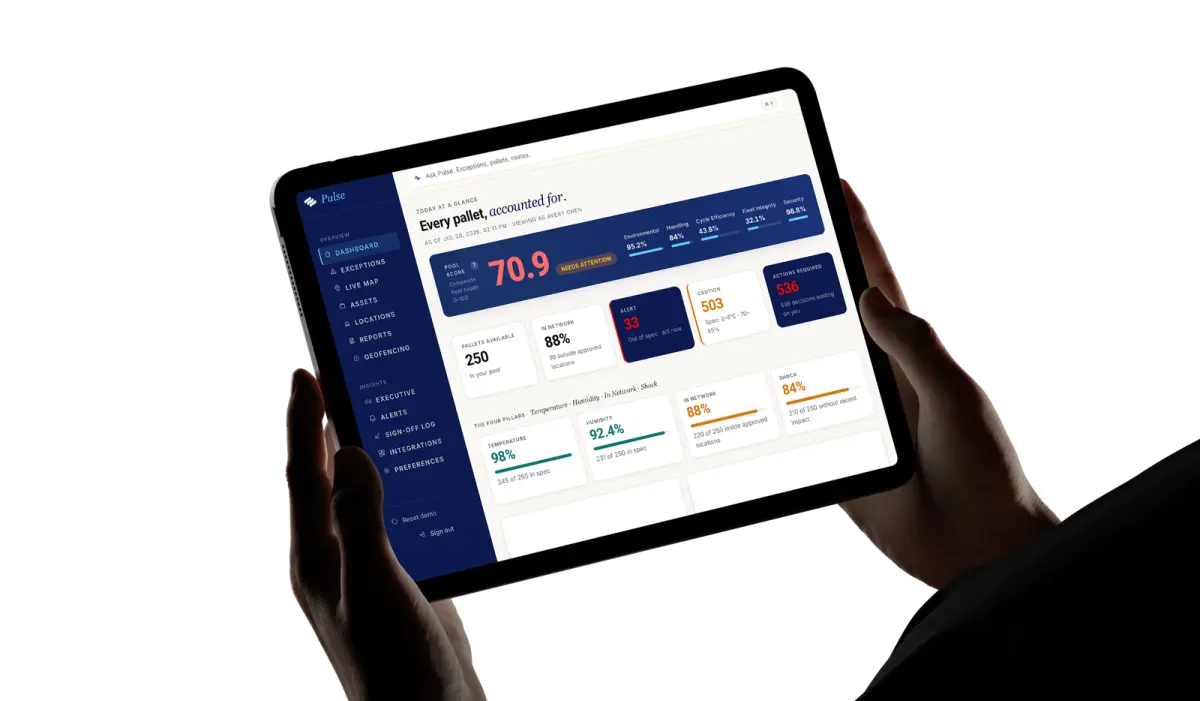
Somewhere in your plant there is a purchase order for pallets, and the person who signed it already knows what wood costs. The question that lands on our desk is the next one: if we are going to plastic, do we buy it or lease it? ORBIS is often the first name that comes up. Its pallet line traces back to 1973, and its 48 by 40 Odyssey survived 400 handling cycles in a Virginia Tech lab. We respect the pallet. What we want to compare is the deal that comes with it.
APS vs ORBIS Verdict
Buy the Pallet, or Lease the Program?
ORBIS Corporation is a subsidiary of Menasha Corporation, a family-owned company founded in 1849. Menasha created ORBIS in 1996, and today it makes reusable packaging, plastic pallets included, and sells it. You buy the pallet and you own it. Upkeep and losses are yours to manage, or you can hire ORBIS's packaging management service to manage them.
We make the opposite offer. APS designs and manages custom pallet leasing programs for closed-loop partners. The pallet arrives with a sensor module built in, the data arrives in Pulse, and the whole thing is one flat monthly cost designed to price at or below what you pay for wood. So the verdict is a question of ownership. Want to own pallets? ORBIS makes a good one. Want pallets that report back, in a program someone else designs and manages? Lease them.
Choose APS If
- You Want the Pallet Off the Balance SheetOne all-inclusive monthly lease covers the pallet, sensors, exception reporting and visibility, with no capital purchase.
- Lost Pallets Cost You TodayAn APS program is a closed loop with 100 percent retrieval capability, every pallet reports its own location, and the lease carries no replacement cost.
- You Need to Know What Happened in TransitTemperature, humidity, shock and location are logged on the pallet, with no readers at either end.
- An Auditor Will Ask for the RecordPulse keeps a timestamped chain of custody at every handoff for your FSMA, GDP and GMP records.
Choose ORBIS If
- You Want to Own the Asset OutrightIf capital is cheap and the pallets stay inside one plant, a purchased fleet with a 400-cycle test result is a sound asset.
- You Ship One Way or Buy in Small LotsORBIS sells one-way export pallets, and a reseller lists one standard ORBIS model with a six-pallet minimum.
Buying Plastic Pallets vs Leasing Smart Pallets
Two Ways to Pay for the Same Material
Search for plastic pallets for sale and you are shopping the way ORBIS works, because ORBIS sells. Its pallet page says it plainly: a wood pallet is a per-shipment consumable, and a reusable plastic pallet is a capital asset that spreads its purchase cost across every trip. When you buy plastic pallets from ORBIS you are buying that asset at a quoted price. It depreciates, it goes missing, and you buy the replacement.
ORBIS is honest about the catch. A reusable pallet only delivers its full value when it comes back, its pallet page says, and its comparison guide names loss in an open loop as the one factor that pushes the math the other way. Its Reusable Packaging Management service will manage and track the pallets for you, as a separately quoted service on top of the purchase.
A lease starts from the other end. We size a fleet of Smart Pallets to your lanes and lease it for one all-inclusive monthly cost covering the pallet, the embedded sensor module, exception reporting and visibility. Run your volumes through our pallet lease savings calculator before you believe either of us. Plastic pallets you buy and plastic pallets you lease solve different problems, and the table is the map.
| Operation | APS | ORBIS |
|---|---|---|
| Closed-Loop Plant & DC Lanes | Best fit | Best fit |
| Cold Chain & Pharma Lanes | Best fit | Workable |
| Automated Warehouses & ASRS | Best fit | Best fit |
| High-Value & Theft-Exposed Freight | Best fit | Workable |
| One-Way Export Shipments | Poor fit | Best fit |
The ratings are our editorial read of the evidence here: what each program charges, what each pallet records on its own, and whether the pallet is expected back. ORBIS takes the one-way row outright. It molds a 13-pound export pallet for that job and we do not.
ORBIS vs APS Plastic Pallet Spec Sheet
Same Footprint, Different Deal
ORBIS pallets come in rackable, stackable and nestable families, typically molded from HDPE or polypropylene. Its rackable plastic pallets include the 48 by 40 Odyssey HD, which with steel reinforcements weighs 49 pounds and is rated 30,000 pounds static, 6,000 dynamic and 2,800 in unsupported edge racking. Our guides to plastic pallet types & load ratings and pallet sizes & dimensions explain how to read those numbers. APS Smart Pallets are 100 percent recycled HDPE, consistent to under 1 percent and matched to wood in load-bearing capacity, with RFID tags and a cellular sensor module built in. If you are shopping heavy duty plastic pallets, ORBIS publishes its ratings model by model. The sheet covers what else comes with each pallet.
Below the specs, the sheet scores each deal out of ten on cost and ownership, data, and hygiene and handling. ORBIS scores well on the last group, because a molded plastic pallet is clean and consistent whoever makes it. The gap opens on ownership and data, where buying a pallet and leasing a reporting program part ways.
| Criterion | APS | ORBIS |
|---|---|---|
| Cost & Ownership | 8/10 | 4/10 |
| No capital purchase | YesMonthly lease | NoBought outright, quoted |
| One flat monthly number | YesAll-inclusive lease | NoPurchase. Upkeep is separate |
| No replacement cost | YesNot charged in the lease | NoYou buy the replacement |
| Service life | Yes100 to 200+ trips | Yes400 cycles in FasTrack testing |
| Works without a closed loop | NoNeeds a closed loop | YesOne-way export pallets offered |
| Data | 10/10 | 4/10 |
| Sensor standard on every pallet | YesEmbedded cellular module | NoTrack and trace is an option |
| Location without readers | YesCellular GPS, no readers | YesGPS is an order option |
| Temperature & humidity | YesLogged on the pallet | NoNot among listed options |
| Shock & handling events | YesTimestamped & geolocated | NoNot among listed options |
| In-DC scanning | YesRFID tags for in-DC scans | YesRFID, BLE or barcode options |
| Hygiene & Handling | 10/10 | 8/10 |
| Non-porous, washable | YesPressure-washable HDPE | YesFlow-through hygienic deck |
| ISPM 15 exempt | YesNo heat treatment | YesNo heat treatment |
| 100% recycled content | YesPost-consumer & post-industrial | NoRecycled content on select pallets |
| Consistent for automation | YesUnder 1% variance | YesMolded to precise tolerances |
| Recovered at end of life | YesShredded into the APS stream | YesTake-back for credit |
Scores: two points per Yes and none per No, five rows per group, so each group is out of 10. Service life is each company's own published figure. ORBIS tracking cells follow the Track and Trace option on its Odyssey page, which lists GPS, RFID, BLE and barcode.
Plastic Pallet Price & Lifespan
What You Pay, and for How Long
Ask how much are plastic pallets and you get two honest answers: a plastic pallet price per unit, which ORBIS does not publish and resellers do, and the plastic pallet cost per trip, the one number ORBIS and APS agree matters. Then there is the number neither captures: who pays when the pallet does not come back.
Plastic Pallet Cost per Trip
Divide the Price by the Trips, Then Keep Going
ORBIS's comparison guide, last updated in September 2026, sets a wood pallet at one unit and a plastic pallet at three, gives wood 11 trips and plastic 200 or more, and lands on roughly one sixth the cost per trip for plastic, with parity at about 33 trips. The 3x is ORBIS's modeling assumption, not a price. Our plastic pallet cost per use post works through the same division, including what loss does to it.
ORBIS also says what that division leaves out. Repair, disposal, product damage and freight sit outside the purchase-price math, and its guide says each one favors plastic further. Loss is the exception, and it runs the other way. A purchased pallet that never returns completed a fraction of its cycles, and its replacement is another purchase order. In a lease, the monthly number is the same whether a pallet turned twice or six times, so fast-cycling loops get cheaper per trip the harder they run.
Heavy Duty Plastic Pallet Lifespan
Four Hundred Cycles Is a Real Number
Credit where it is due. In results ORBIS announced in 2021, Virginia Tech's Center for Packaging and Unit Load Design ran its FasTrack sequence on the ORBIS Odyssey, which completed 400 cycles without failure while the whitewood stringer pallet failed on average after 11. APS Smart Pallets are built for roughly 100 to 200+ trips before recycling, against about 3 to 5 for white wood and about 15 for pooled wood. Both figures are each company's own, and both say plastic outlasts lumber by a wide margin.
The difference is who arranges the exit. Recycle with ORBIS takes retired pallets back and can credit them toward future packaging, once you schedule the pickup. The EPA plastics recycling data show why the exit matters: of 35.7 million tons of plastics in U.S. municipal waste in 2018, 8.7 percent was recycled and 27 million tons went to landfill. A retired APS pallet is shredded back into the APS HDPE stream, because it was ours the whole time.
Upfront Plastic Pallet Price
The Number ORBIS Does Not Print
ORBIS quotes. Resellers list. On October 17, 2026, Global Industrial listed the ORBIS 48 by 40 RackoCell rackable pallet at $269.95 each in lots of 6 to 20, falling to $225.95 at 50 or more. Repackify, a packaging marketplace, put new plastic pallets at $25 to $100 each in a 2025 article. That spread is wide because a light nestable pallet and a reinforced rackable one are priced as different products.
Whatever the quote, buying means booking it as capital and multiplying by the fleet. As an illustration, 5,000 pallets at that listing's 50-unit price comes to about $1.13 million before a single trip. That is our arithmetic on the October 17, 2026 listing, not an ORBIS quote, and a fleet that size would be quoted direct. With APS there is no upfront number to multiply. The lease is designed to price at or below your wood program, sensor and reporting included.
Bottom Line
Both make their case against wood on cost. Buying from ORBIS puts the capital, the washing and the losses on your books, and pays off when every pallet comes home. Leasing from APS puts all of that in one monthly number designed to sit at or below your wood spend, sensor included.
Plastic Pallet Tracking Data
An Option on the Order Form vs a Sensor in the Deck
ORBIS's Odyssey page lists Track and Trace as an option alongside hot stamps and molded-in logos: tracking by GPS, RFID, BLE, barcode scanning or a hybrid of those, with no detail on the hardware, what it logs or what it costs. That is tracking as asset accounting. It tells you where the pallet went and whether it came back.
An APS Smart Pallet is tracked in a different sense. Every pallet ships with an embedded sensor module, built into the pallet and not bolted on, carrying cellular GPS plus temperature, humidity and shock. It needs no scanning, no facility infrastructure and no carrier cooperation. The data lands in Pulse. Our embedded sensor technology page lays out the module and the platform.
Pallet Condition Monitoring
Temperature, Humidity & Shock, Logged on the Pallet
The tracking options on the ORBIS product page are ways to identify and locate a pallet. The page lists no temperature, humidity or shock sensing. Unless you add that yourself, the load's condition between dock and delivery is inferred from a thermostat log and a driver's word.
APS pallets run on exception-based reporting. The module stays quiet when conditions are normal and wakes up the moment the pallet moves or a threshold is crossed. It writes a timestamped, geolocated event, and Pulse routes it to the right person. It works like a smoke detector, and the silence is data too. A pharmaceutical load creeping toward 8 degrees Celsius on a loading dock gets flagged on the dock, not three weeks later in a quality investigation.
Pallet Location Visibility
Where It Is, Not Where You Last Counted It
For a purchased fleet, location is an inventory question. ORBIS's packaging management service offers tracking and reverse logistics so the pallets you bought keep coming back. It is a service you buy to protect an asset you bought.
A Smart Pallet locates itself over cellular networks. It logs a timestamped, geolocated event when it moves and builds a chain of custody independent of the carrier's telematics. On a repeating lane, that record becomes dwell time by facility and lane. A purchased pallet without a tracker answers where it was last counted. A Smart Pallet answers where it is.
Bottom Line
ORBIS tracks the pallet. APS tracks the load. An add-on tracker tells you where a purchased pallet is, or which reader it passed. An embedded sensor also tells you what happened to the product on top of it, and Pulse routes the exception to the right person.
Plastic Pallet Hygiene & Food Safety
Both Beat Wood. One Also Keeps the Record
On hygiene, ORBIS and APS are on the same side and wood is on the other. ORBIS molds flow-through decks for washing, offers FDA-compliant material options, and a reseller listing marks the RackoCell ISPM 15 exempt. APS pallets are non-porous, moisture and pest resistant, pressure-washable, with no nails and no splinters, and ISPM 15 exempt for the same reason.
Two differences remain. The first is material. Every APS pallet is 100 percent recycled HDPE. ORBIS says select pallets are made of recycled content and all are fully recyclable at end of life. The second is evidence. A washed pallet proves it was washed. An APS pallet carries the temperature record from plant to dock, because the log traveled with it. A clean deck is half an answer.
Bottom Line
Hygiene is a tie on the deck and a win on the paperwork. Choose either program over wood. Choose APS when the audit wants the thermal history as well as the washdown.
Best Plastic Pallets for Your Operation
Match the Deal to the Loop
Plastic pallet manufacturers and plastic pallet suppliers mostly sell you a pallet. ORBIS has done it for decades. We lease you a program. The right answer depends on whether your pallets come home, whether you want the asset on your books, and whether the load has something to say on the way.
The cards below split buyers by how they want to hold the asset. If you would rather own pallets outright, ship one way or buy a few at a time, the ORBIS card fits. If you would rather keep pallets off your books and have them report from inside a closed loop, the APS card does.
Who APS Is Best For
Closed Loops With Something to Protect
- Cold Chain & Pharma ShippersTemperature and humidity logged on the pallet, exceptions routed in transit, and a timestamped chain of custody for GDP and FSMA records.
- Plant-to-DC & Automotive LoopsLanes that repeat between facilities you control and feed ASRS and robotic lines that need a pallet consistent to under 1 percent.
- Finance Teams That Want One NumberNo capital purchase and no replacement cost, in a program APS designs and manages and a lease designed to price at or below wood.
Who ORBIS Is Best For
Owners, Exporters & Single Sites
- Operations That Want to Own the AssetIf capital is cheap and your pallets rarely leave the building, a purchased Odyssey with a 400-cycle test behind it is a long-lived asset.
- One-Way & Export ShippersORBIS molds a 13-pound one-way export pallet that loads 2,340 to a trailer, for freight that is never coming back.
- Small Lots & Spot BuysA reseller lists a standard ORBIS rackable model with a six-pallet minimum, so a single site can buy a small lot.
APS vs ORBIS Pros & Cons
The Honest List
ORBIS earns its pros. The Odyssey is a proven pallet, the catalog is deep, you own what you buy, and you can order six pallets or thousands. For an operation that wants the asset on its books, that is a sound purchase.
Owning brings its own list: the capital goes out up front, and loss, upkeep and tracking land on your team. Our lease trades those for two cons we state plainly, a closed loop and a commitment.
APS
Pros
- Data Rides With the PalletCellular GPS, temperature, humidity and shock are logged on the pallet and routed by Pulse, with no readers.
- One All-Inclusive Monthly CostPallet, sensors, exception reporting and visibility in one number, designed to price at or below a wood program.
- Built for RetrievalEvery program is a closed loop with 100 percent retrieval capability, and the lease carries no replacement cost.
- 100 Percent Recycled, Fully RecoveredEvery pallet is recycled HDPE, and a retired pallet is shredded back into the APS HDPE stream.
Cons
- Needs a Closed LoopIf your pallets leave for receivers you cannot name, a leased fleet is the wrong shape, and we will say so.
- A Lease Is a CommitmentA flat monthly fleet cost is predictable in both directions. You pay it in a slow month too.
ORBIS
Pros
- A Proven PalletThe Odyssey completed 400 FasTrack cycles without failure at Virginia Tech.
- A Deep CatalogRackable, stackable and nestable families in standard and custom footprints, with fire-retardant options.
- You Own ItA purchased pallet is yours to depreciate or resell, and Recycle with ORBIS can credit retired pallets toward future packaging.
- Buy Six or Buy ThousandsQuote direct for a fleet or buy a small lot from a reseller.
Cons
- Capital Up FrontThe purchase price is yours to carry. A reseller listed one 48 by 40 model at $225.95 to $269.95 each in October 2026.
- Loss, Upkeep & Tracking Are YoursAn unreturned pallet is a fraction of its trips and a new purchase order, and management is a separate service.
- Tracking Is an Add-On, Not a SensorTrack and trace is an order option covering GPS, RFID, BLE or barcode. The product page lists no temperature, humidity or shock sensing.
APS vs ORBIS FAQ
Questions Buyers Ask Before Signing Either
When the choice narrows to buying plastic or leasing it, three questions come up in almost every conversation we have. The short answers follow, and the figures behind them are in the sources list.
How Much Do Plastic Pallets Cost?
ORBIS quotes each order rather than publishing prices, so the public numbers come from resellers. Global Industrial listed the ORBIS 48 by 40 RackoCell at $269.95 each in lots of 6 to 20 and $225.95 at 50 or more on October 17, 2026. APS works differently. The Smart Pallet lease is one all-inclusive monthly cost covering the pallet, sensors, exception reporting and visibility, designed to price at or below a wood program.
Is It Better to Buy or Lease Plastic Pallets?
Buy when you want the asset on your books, your pallets rarely leave your facilities, or you ship one way and need a pallet you can write off. Lease when your pallets cycle between facilities you can name and you want the capital, the replacement cost and the pallet management off your plate. ORBIS's own guide names loss in an open loop as the one factor that pushes against plastic. Every APS lease runs in a closed loop with 100 percent retrieval capability.
What Happens to Lost Pallets in a Lease?
An APS program is a closed loop with 100 percent retrieval capability, and the lease carries no replacement cost. Every Smart Pallet locates itself over cellular with no readers, so a pallet that stops where it should not is a pallet Pulse can find. When you buy pallets, one that never returns is a new purchase order. That is the difference between owning a fleet and leasing a program.
Sources
- ORBIS Corporation, "About ORBIS," 2026
- ORBIS Corporation, "Our History," 2026
- ORBIS Corporation, "Plastic Pallets," 2026
- ORBIS Corporation, "Rackable Plastic Pallets," 2026
- ORBIS Corporation, "40 x 48 Odyssey HD Open Deck," 2026
- ORBIS Corporation, "4048 Odyssey HD Pallet Product Spec Sheet," 2025
- ORBIS Corporation, "Plastic vs. Wood Pallets: A Complete Comparison Guide," 2026
- ORBIS Corporation, "Recycle with ORBIS," 2026
- ORBIS Corporation, "Reusable Packaging Management," 2026
- Powder & Bulk Solids, "Plastic Pallet Can Handle 400 Cycles," 2021
- Global Industrial, "Orbis Rackable & Stackable Lip Open Deck Pallet, Polypropylene, 4-Way, 48 x 40," 2026
- Repackify, "Am I Overpaying for Pallets? A Case Study in Smart Procurement," 2025
- U.S. Environmental Protection Agency, "Plastics: Material-Specific Data," 2026
Pallet Comparison Articles
Featured Posts From the APS Blog
The Pallet Is Costing You More Than You Think
You have invested millions in automation and you track labor, freight and energy to the decimal. Somewhere on your dock, a wooden pallet is about to stop the line.
 Rodrigo CastroCo-Founder & President10 min read

Milk Jugs, Snowboards, and Shampoo Bottles: Your Next Pallet Has Had a Past Life
Every APS pallet is 100% recycled HDPE, sourced from across the recovery stream. Bottles, containers, industrial scrap, melted down into a platform that survives a decade of forklifts.
Rodrigo CastroCo-Founder & President3 min read
Stuck in the 20th Century: Neil Armstrong, iPhones, and Pallets
80% of global goods touch a pallet at some point. How can an asset that fundamental to modern trade have changed so little since 1969?
Rodrigo CastroCo-Founder & President3 min read