
Rehrig Pacific tells a story about a beverage distributor that kept only 78 percent of its pallets each year. Nearly a quarter of the pool disappeared annually, and every missing pallet meant another purchase. The fix was RFID-equipped pallets and a smart-enabled lift, and retention reached 99 percent in ten months. That story makes our point: an owned plastic pallet is only as good as your ability to get it back. So let's compare owning with leasing, and what each pallet can tell you.
APS vs Rehrig Pacific Verdict
Own the Fleet, or Lease the Program?
Rehrig Pacific has made reusable containers since 1913, when Will Rehrig built wooden dairy crates in Los Angeles. The family company now molds plastic pallets, crates, trays and totes at eight plants and sells them to food and beverage distribution fleets, among others.
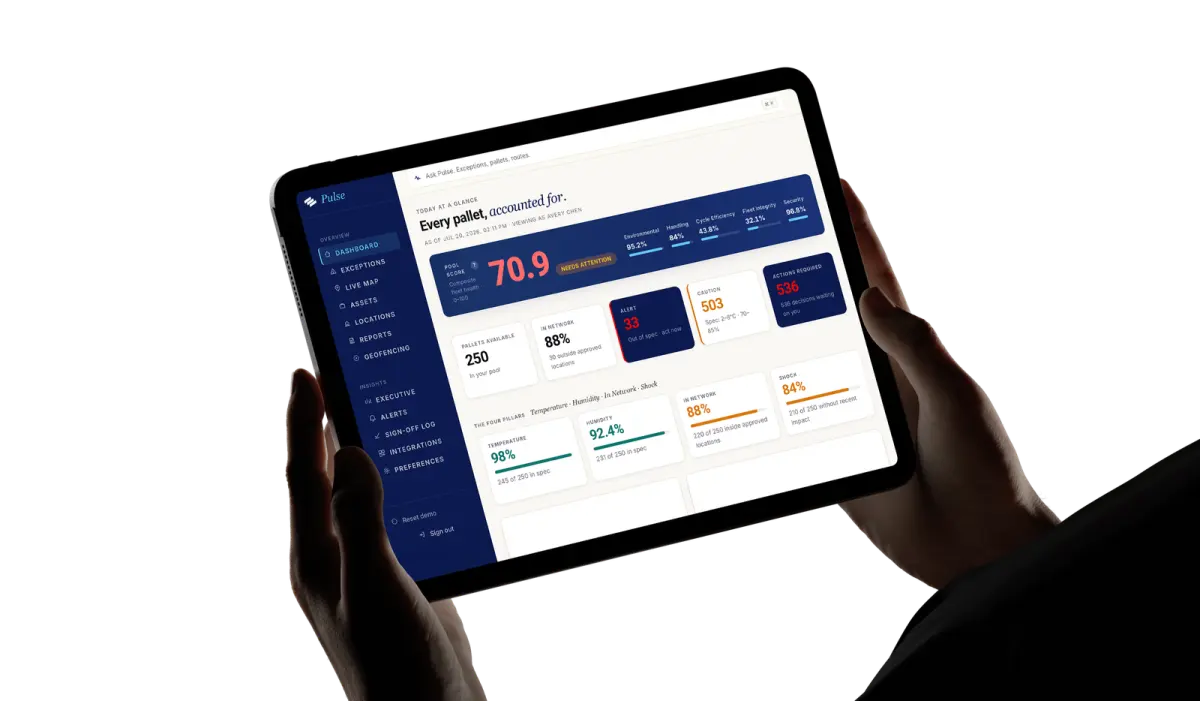
We make a different offer. APS designs and manages custom pallet leasing programs for closed-loop partners. Our Smart Pallets carry a sensor module built in and report through Pulse, for one flat monthly cost designed to price at or below wood. So APS vs Rehrig Pacific comes down to what you want to hold. One is a fleet of good plastic pallets. The other is a program that tells you what happened to the load.
Choose APS If
- You Want the Data, Not Just the DeckCellular GPS, temperature, humidity and shock are logged on every pallet, with no readers to install.
- Lost Pallets Are Your Biggest Pallet CostEvery APS program is a closed loop with 100 percent retrieval capability, and the lease carries no replacement cost.
- You Want One All-Inclusive NumberPallet, sensors, exception reporting and visibility in one all-inclusive lease, with no capital purchase.
- Your Records Face an AuditorPulse keeps an independent, timestamped chain of custody at every handoff for your FSMA, GDP and GMP records.
Choose Rehrig Pacific If
- You Run a Beverage or Grocery Delivery FleetRehrig has designed beverage packaging since the early 1950s and builds pallets, crates and delivery lifts to work together.
- You Want to Own the AssetIf pallets stay in your buildings or on your own routes, a purchased fleet, paid outright or financed, is a long-lived asset.
Rehrig makes a serious pallet. Its product pages describe it as RFID or barcode capable, read by equipment Rehrig installs. Ours carry the sensor inside.
Rehrig Pacific Pallets vs an APS Smart Pallet Lease
A Pallet You Own vs a Program That Reports
Rehrig is one of the plastic pallet manufacturers that sells straight to the fleet. You request a quote, Rehrig molds the pallets from HDPE or polypropylene, and the pallets are yours unless you take Rehrig's subscription. Rehrig pallets can be ordered RFID or barcode capable, and its Vision Asset Tracker software reports location, dwell time and turns as they pass the readers Rehrig installs.
An APS lease starts at the other end. Every Smart Pallet carries an embedded sensor module with cellular GPS and condition sensing, with no scanning, no facility infrastructure and no carrier cooperation. We made the same buy-or-lease case in our APS vs ORBIS comparison. To its credit, Rehrig advertises its own financing. Financing changes when you pay. It does not change what the pallet can tell you.
| Operation | APS | Rehrig Pacific |
|---|---|---|
| Beverage & Grocery Delivery Fleets | Workable | Best fit |
| Cold Chain & Pharma Lanes | Best fit | Workable |
| Automated Warehouses & AS/RS | Best fit | Best fit |
| High-Value & Theft-Exposed Freight | Best fit | Workable |
| Pallets That Leave the Loop | Poor fit | Workable |
The ratings are our editorial read of what each company publishes: how it charges, what the pallet reports on its own, and whether it is expected home. The delivery fleet row goes to Rehrig, whose pallets, crates and lifts are built to work together. It edges the last row because an owned pallet can go anywhere, and our lease needs a closed loop.
Our sheet scores each offer out of ten on cost and ownership, data, and hygiene and handling. Rehrig ties us on cost and does very well on hygiene, since molded plastic is clean and consistent whoever makes it.
The gap opens on data. A Rehrig pallet can carry a tag that a reader sees at your door. A Smart Pallet logs what happens between the doors.
| Criterion | APS | Rehrig Pacific |
|---|---|---|
| Cost & Ownership | 7.5/10 | 7.5/10 |
| Monthly payments available | YesFlat monthly lease | YesFinanced over 12 to 60 months |
| No replacement cost | YesNot charged in the lease | NoOwners replace lost pallets |
| Published service life | Yes100 to 200+ trips | YesGMA: 200+ cycles in Virginia Tech test |
| Works without a closed loop | NoNeeds a closed loop | YesYours to send anywhere |
| Data | 10/10 | 4/10 |
| Sensor built into the pallet | YesEmbedded cellular module | NoRFID or barcode capable |
| Location without installed readers | YesCellular GPS, no readers | NoRead by installed equipment |
| Temperature, humidity & shock | YesLogged on the pallet | NoNot among listed features |
| Dwell time reporting | YesBy facility and lane | YesDwell time and turns |
| In-DC scanning | YesRFID tags for in-DC scans | YesRFID or barcode reads |
| Hygiene & Handling | 10/10 | 8/10 |
| Non-porous, washable | YesPressure-washable HDPE | YesFlow-through, easy to clean |
| No nails or splinters | YesNo nails, no splinters | YesNo splinters or nails |
| Consistent for automation | YesUnder 1% variance | YesPrecise molded tolerances |
| 100% recycled content | YesPost-consumer & post-industrial | NoVaries by model, up to 90% |
| Recovered at end of life | YesShredded into the APS stream | YesRecycling program offered |
Scores: two points per Yes and none per No. Data and Hygiene have five rows, so each is out of 10. Cost & Ownership has four rows, so its 8-point total is multiplied by 1.25 to reach 10. Service life is each company's own figure. Rehrig cells follow its product, Asset Tracker and financing pages, checked October 26, 2026.
Bottom Line
Rehrig sells a strong pallet and will finance it. APS leases a pallet that reports. If your problem is the deck, both of us solve it. If it is what happens to the load between doors, only one of us lists a sensor inside the pallet to tell you.
Plastic Pallets for Sale vs Pallet Leasing Costs
Two Ways to Pay for the Same Plastic
Search for plastic pallets for sale and you are shopping the way Rehrig works: a quoted price per pallet, multiplied by a fleet. Pallet leasing turns that into a monthly number with more inside it.
Upfront Plastic Pallet Cost
Quoted, Financed or Subscribed
When you buy plastic pallets from Rehrig, you start with a quote. We found no public Rehrig price, from Rehrig or a reseller. What Rehrig does publish is how it helps you pay. Rehrig Financial Services advertises up to 100 percent financing and fixed monthly payments over 12 to 60 months, and also offers a subscription-based model. By Rehrig's account, a year of wood pallet spend typically exceeds a year of plastic on a payment plan.
That is a fair answer to the capital problem, and close to our own pitch against wood. The difference is what the payment buys. A financed Rehrig pallet is still an owned asset, and a lost one is another purchase. Rehrig does not publish how its subscription handles lost pallets. The APS lease has no capital purchase and no replacement cost, with sensors and reporting inside the same monthly number.
Cost per Trip Over a Pallet's Life
Divide by the Trips That Actually Happen
Rehrig's sales sheet for nestable pallets says a plastic pallet pays for itself by its fourth use, and its GMA Series case study reports more than 200 lifecycles in Virginia Tech testing. APS Smart Pallets are built for roughly 100 to 200+ trips before recycling, against about 3 to 5 for white wood, and our plastic pallet lifespan data walks through the rest. Both companies argue plastic beats wood per trip once the trips happen.
The catch is the word once. A purchase price is spread only across the trips a pallet completes before it is lost or retired. Here is that division at three trip counts.
| Trips Completed | Price per Trip | What It Represents |
|---|---|---|
| 200 | 0.5% of purchase price | Rehrig's GMA test result |
| 50 | 2% of purchase price | A pallet lost a quarter of the way in |
| 4 | 25% of purchase price | A pallet lost at its payback point |
Illustration only: purchase price divided by trips completed, before washing, repair or freight. 200 and 4 come from Rehrig's GMA case study and nestable sales sheet. 50 is our example.
The distributor in Rehrig's case study started at 78 percent retention, nearly a quarter of its pool gone each year. In our illustration, a 10,000-pallet fleet losing at that rate would buy about 2,200 replacements a year. A lease costs the same whether a pallet turns twice or six times, so a busy loop gets cheaper per trip.
Bottom Line
Both companies make their case against wood on cost. A purchased Rehrig fleet pays off when its pallets come home. The APS lease holds pallet, sensor and reporting in one monthly cost with no replacement charge.
Rackable Plastic Pallets & Load Ratings
What Rehrig Publishes, Model by Model
Rehrig sells nestable, stackable and rackable plastic pallets, and the rackables are built, in its words, to store on open span or unsupported racking. Static ratings cover a load sitting on the floor, dynamic covers a load on a forklift, and the rack rating covers a load spanning two beams. Here is Rehrig's 40 by 48 rackable lineup.
| Rehrig 40 x 48 Model | Static (lb) | Dynamic (lb) | Rack (lb) | Weight (lb) |
|---|---|---|---|---|
| GMA Rackable 2400 | 7,200 | 4,200 | 2,400 | 47 |
| GMA Rackable 2800 | 8,400 | 5,000 | 2,800 | 48.5 |
| GMA Rackable 3200 | 15,000 | 5,600 | 3,200 | 55 |
| Rackable | 10,000 | 4,000 | 2,000 | 44.2 |
| Rackable HD | 12,000 | 4,800 to 6,400 | 2,400 to 3,200 | 44.2 |
Source: Rehrig Pacific product pages, checked October 26, 2026. GMA rack figures are 2-inch edge rack ratings, and the Rackable lists edge rack capability. HD weight is the non-reinforced version.
Rehrig's GMA models use metal reinforcements for edge racking, and Rehrig designed the series for automated storage and retrieval. The 3200 adds 8 pounds over the 2400 for 800 more pounds on the rack.
APS states its strength differently. Our Smart Pallets match wood in load-bearing capacity and are dimensionally consistent to under 1 percent, against 8 to 10 percent variance for wood. If your racking spec needs a published rack number on a named model, Rehrig prints one for each 40 by 48 rackable, and that is a point in its favor.
Bottom Line
On the rack, Rehrig shows its work. Its ratings are public, specific and easy to cite in a racking spec.
Pallet Tracking & Condition Data
Read at the Door vs Logged on the Way
Rehrig calls its tagged pallets Smart Assets. We call ours Smart Pallets. One identifies a pallet when it passes a reader. The other records what happens to the load between readers. Our smart pallets technology page shows how the APS module and Pulse work.
Location Visibility
Last Known Location vs Current Location
Asset Tracker, part of Rehrig's Vision Technology platform, works like this by Rehrig's own description. You get barcode or RFID-enabled pallets, or yours are retrofitted, and Rehrig installs equipment to read them outbound and inbound. Its software reports trip time, balances, dwell time and turns. The page says the platform uses RFID, GPS and barcode technologies. In the beverage case study, a smart-enabled Duo Lift read RFID-equipped pallets and showed the last known location of every pallet.
That is solid asset accounting, and Rehrig reports it lifted that distributor's retention from 78 to 99 percent. An APS Smart Pallet locates itself over cellular GPS with no readers anywhere. Each move logs a timestamped, geolocated event in a chain of custody independent of the carrier, and repeat lanes yield dwell time by facility and lane. A tagged pallet tells you where it was last read. A Smart Pallet tells you where it is.
Temperature & Shock Alerts
The Part a Tag Cannot Feel
The Asset Tracker page says Rehrig's RFID tracking monitors performance conditions in real time. Neither that page nor the pallet pages we read lists a temperature, humidity or shock reading. On its pharmaceutical page, Rehrig says its products can sustain extreme temperature changes moving from coolers to trailers. That describes a pallet surviving the cold, not the product riding on it.
APS pallets run on exception-based reporting. The module stays quiet while conditions are normal and wakes when the pallet moves or a threshold is crossed. It writes a timestamped, geolocated event, and Pulse routes the exception to the right person, much like a smoke detector. The silence is data too. A pallet of vaccines warming on an August dock gets flagged on the dock, not three weeks later in a quality review.
Bottom Line
A read tells you the pallet arrived. A sensor log tells you how. For cold chain, pharma or high-value freight, the record between reads is what your quality team will ask for.
Pallet Retrieval in a Closed Loop
Getting the Pallet Back Is the Whole Game
Reusable plastic pallets only pay off when they come back, and Rehrig writes about that problem itself. A 2024 post by its vice president of sales for supply chain compares reusable packaging to car keys and recommends habits that keep pallets moving. The critical touchpoints, he writes, often lie in the last mile, where drivers and store owners are sometimes unaware that reusable packaging needs to be returned.
That advice is sound. It is also work your team does. In an owned fleet, retrieval is a habit you build and a loss rate you carry. In an APS program it is designed in: a closed loop with 100 percent retrieval capability, a Smart Pallet that reports its own location, and no replacement cost in the lease. Our closed-loop pallet program guide compares the ways to run a loop.
End of life matters too. Rehrig offers a recycling program for retired pallets and a network of over 100 recycling facilities. Every retired APS pallet is shredded back into the APS HDPE stream. The EPA plastics recycling data show why the exit matters: of 35.7 million tons of plastics generated in U.S. municipal waste in 2018, 8.7 percent was recycled.
Bottom Line
For an owner, retrieval is a habit. For a lease, it is part of the design. Rehrig gives owners good tools and advice for it. APS builds the loop, puts a locator in every pallet and leaves replacement cost out of the lease.
Best Plastic Pallet Program for Your Operation
Match the Program to the Loop
Plastic pallets beat wood in both programs. The real split is owning versus leasing, and a pallet read at the door versus one that reports from the road.
Pallet rental and leasing fit pallets that cycle between facilities you can name. Ownership fits pallets that stay in your buildings or ride your own routes.
Who APS Is Best For
Closed Loops With a Load Worth Watching
- Cold Chain & Pharma ShippersTemperature, humidity and shock logged on every pallet, with Pulse routing each exception to the right person.
- Plant-to-DC & Automotive LoopsRepeat lanes between facilities you control, feeding automated lines that need a pallet consistent to under 1 percent.
- Teams That Would Rather Not Buy PalletsNo capital purchase and no replacement cost, on a lease designed to price at or below wood.
Who Rehrig Pacific Is Best For
Delivery Fleets & Pallet Owners
- Beverage & Grocery Delivery FleetsRehrig designs pallets, crates and Fusion lifts and sleds to work together on direct store delivery routes.
- Buyers Who Want to Own, With HelpRehrig Financial Services finances the purchase over 12 to 60 months or offers a subscription-based model.
- Racked Storage Built to a SpecEach 40 by 48 rackable lists static, dynamic and rack ratings, and the GMA Series was designed for AS/RS.
Rehrig earns its pros: more than a century of reusable containers, a third-party lifecycle test and public load ratings.
Owning still brings readers to install, a loss rate to manage and no listed sensor between the doors. Our lease has two cons we state plainly.
APS
Pros
- The Load Reports ItselfCellular GPS, temperature, humidity and shock, logged on the pallet and routed by Pulse.
- One All-Inclusive Monthly CostPallet, sensors, exception reporting and visibility in one number, designed to price at or below wood.
- Designed for RetrievalA closed loop with 100 percent retrieval capability, and no replacement cost in the lease.
- 100 Percent Recycled HDPEEvery pallet is recycled HDPE, and a retired pallet is shredded back into the APS stream.
Cons
- Needs a Closed LoopIf your pallets go to receivers you cannot name, a leased fleet is the wrong fit.
- A Lease Is a CommitmentA flat monthly cost is predictable both ways. You pay it in a slow month too.
Rehrig Pacific
Pros
- A Tested PalletRehrig reports its GMA Series lasted more than 200 cycles in Virginia Tech testing.
- Published Load RatingsEach 40 by 48 rackable lists static, dynamic and rack ratings on its product page.
- Financing or SubscriptionFixed monthly payments over 12 to 60 months, or a subscription-based model.
- Built for Delivery FleetsPallets, crates, lifts and sleds designed to work together on delivery routes.
Cons
- Loss Is Yours to ManageAn owned pallet that never returns is a replacement purchase.
- Tracking Needs ReadersAsset Tracker reads tagged pallets with equipment Rehrig installs at your buildings.
- No Condition Sensing ListedThe pallet pages and the Asset Tracker page list no temperature, humidity or shock reading.
APS vs Rehrig Pacific FAQ
Short Answers Before the Quote
Three questions come up whenever Rehrig Pacific and APS share a shortlist.
What Does Rehrig Pacific Make?
Rehrig Pacific is a Los Angeles company, founded in 1913, that began with wooden dairy crates and now molds plastic pallets, crates, trays, totes and waste carts at eight plants. Its supply chain business sells plastic pallets in nestable, stackable and rackable styles, plus Vision tracking software and Fusion delivery lifts.
Is Leasing Plastic Pallets Cheaper Than Buying?
It depends on how many pallets come back and what you need them to report. A purchased pallet spreads its price over the trips it completes, so loss raises the real cost per trip. An APS lease has no capital purchase and no replacement cost, includes sensors and reporting, and is designed to price at or below a wood program.
Do Rehrig Pacific Pallets Have Built-In Tracking?
Rehrig pallets can be ordered RFID or barcode capable, and its Asset Tracker reads them with equipment Rehrig installs at your buildings. We found no built-in temperature, humidity or shock sensing on its pallet pages. APS Smart Pallets carry an embedded module with cellular GPS, temperature, humidity and shock, plus RFID tags for in-DC scans.
Sources
- Rehrig Pacific, "Pallets," 2026
- Rehrig Pacific, "40 x 48 GMA Rackable 2400 Pallet," 2026
- Rehrig Pacific, "40 x 48 GMA Rackable 2800 Pallet," 2026
- Rehrig Pacific, "40 x 48 GMA Rackable 3200 Pallet," 2026
- Rehrig Pacific, "40 x 48 Rackable Pallet," 2026
- Rehrig Pacific, "40 x 48 Rackable Pallet HD," 2026
- Rehrig Pacific, "40 x 48 Standard Duty Nestable Pallet," 2026
- Rehrig Pacific, "37 x 37 Pallet," 2026
- Rehrig Pacific, "About Us," 2026
- Rehrig Pacific, "Our History," 2026
- Rehrig Pacific, "Financial Services," 2026
- Rehrig Pacific, "Supply Chain Financing" sales sheet
- Rehrig Pacific, "Asset Tracker," 2026
- Rehrig Pacific, "Improving Beverage Delivery Operations With Smart Asset Control," 2025
- Rehrig Pacific, "GMA Series Plastic Pallet Lifecycle Study," 2024
- Rehrig Pacific, "Boost Efficiency and Sustainability With Nestable Plastic Pallets," 2024
- Rehrig Pacific, "Building Better Behaviors to Reduce Reusable Packaging Loss," 2024
- Rehrig Pacific, "Beverage," 2026
- Rehrig Pacific, "Pharmaceuticals," 2026
- Fortune, "How a 112-Year-Old California Manufacturer Used Cloud Computing to Upgrade Its Business," 2025
- Recycling Today, "Rehrig Pacific Breaks Ground on Arizona Manufacturing Facility," 2023
- U.S. Environmental Protection Agency, "Plastics: Material-Specific Data," 2026
Pallet Comparison Articles
Featured Posts From the APS Blog
The Pallet Is Costing You More Than You Think
You have invested millions in automation and you track labor, freight and energy to the decimal. Somewhere on your dock, a wooden pallet is about to stop the line.
 Rodrigo CastroCo-Founder & President10 min read

What RFID Pallet Tracking Actually Tells You (And What It Doesn't)
What gets packaged and sold as smart pallet technology is, in most cases, a ten-cent sticker on a rickety wooden pallet. Here is what passive RFID can and cannot see.
Rodrigo CastroCo-Founder & President5 min read
Milk Jugs, Snowboards, and Shampoo Bottles: Your Next Pallet Has Had a Past Life
Every APS pallet is 100% recycled HDPE, sourced from across the recovery stream. Bottles, containers, industrial scrap, melted down into a platform that survives a decade of forklifts.
Rodrigo CastroCo-Founder & President3 min read