
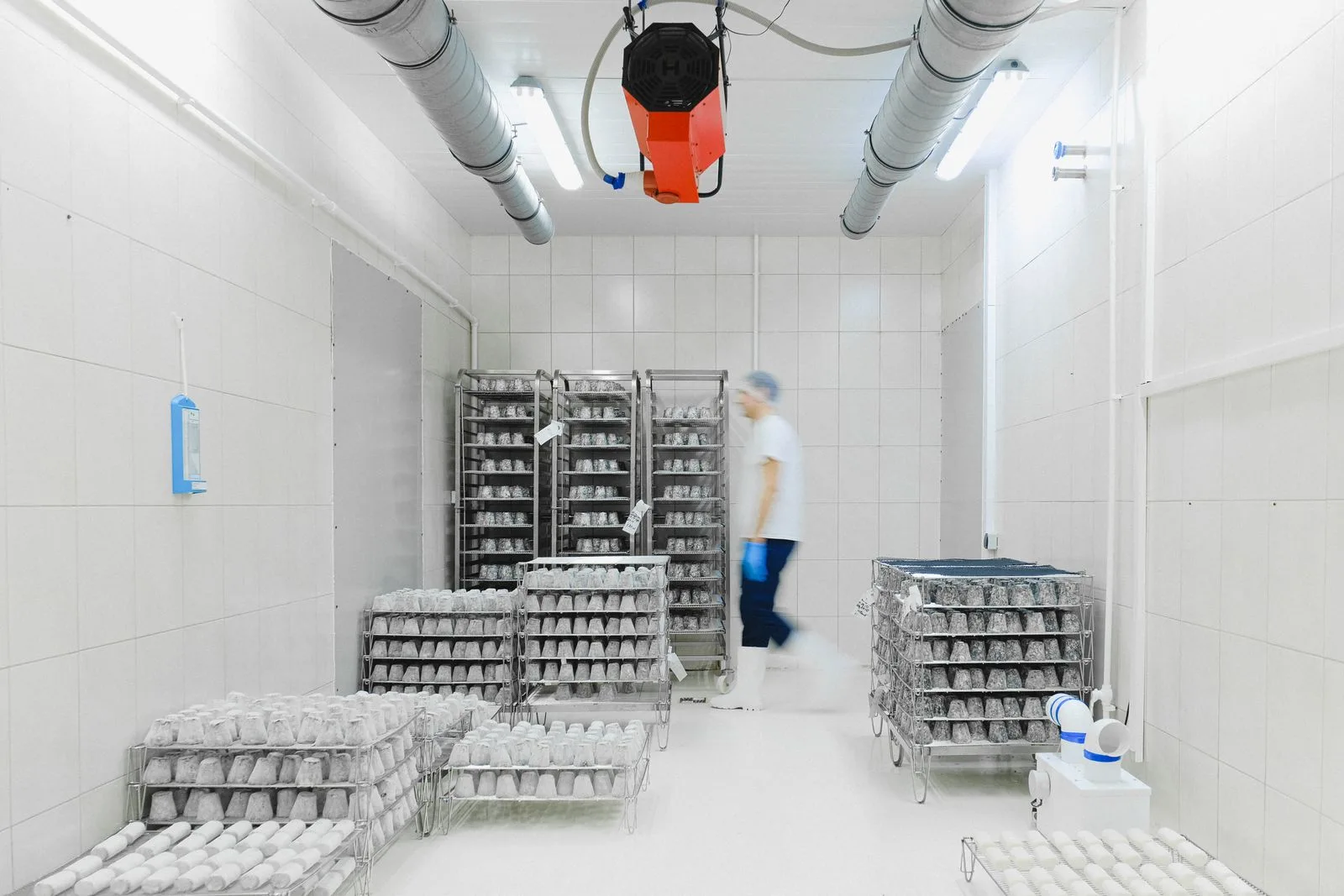
Lack of effective refrigeration costs 526 million tons of food production a year, 12 percent of the global total, according to a 2022 report from the UN Environment Programme and the Food and Agriculture Organization. Where refrigeration exists, the question shifts from capacity to control. Did this load hold its range at every step?
Picture a reefer backing into a receiving door on a hot afternoon. Its driver has a printout for the trailer. Your receiver has a probe thermometer for one case. Neither can say what happened while the load sat on a cross-dock between two carriers. That gap is where cold chain logistics gets hard.
This guide walks the chain from the cold room to the receiving dock, with the temperature ranges, the rules and the equipment choices at each step. We lease Smart Pallets for closed-loop programs, so where APS appears we say so. Every rule here comes from FDA, CDC, WHO or the European Commission, cited by section so you can check it.
Key Takeaways
- The product sets the range. CDC's range for refrigerated vaccines is 36 F to 46 F, FDA's consumer guidance sets refrigerators at or below 40 F, and every medicine follows its own label.
- Regulators point at the same weak spot. EU GDP asks for particular attention at transportation hubs, and WHO wants shipments off the airport apron as soon as possible.
- FDA's Sanitary Transportation rule counts pallets as transportation equipment that must be suitable and adequately cleanable for their intended use.
- A calibrated logger records the trip for the file. A sensor built into the pallet reports an exception during the trip, not after it.
- FDA proposed moving the FSMA 204 traceability compliance date to July 20, 2028, and Congress directed FDA not to enforce the rule before then.
What Cold Chain Logistics Covers
Any product that must stay inside a set temperature range from production to use moves through cold chain logistics. CDC's vaccine chapter gives the cleanest definition: "A cold chain is a temperature-controlled supply chain that includes all vaccine-related equipment and procedures." Swap vaccines for chilled meat, biologics or cut flowers and the definition still holds.
So what is cold chain in the terms a regulator uses? WHO's model guidance for medicines (Technical Report Series 961, Annex 9, 2011) calls an environment temperature-controlled when its temperature is "actively or passively controlled at a level different from that of the surrounding environment within precise predefined limits." Two words carry the weight, controlled and predefined. Someone has to set the limits, and someone has to show they held.
Day to day, cold chain management keeps four kinds of work in step, usually across companies that share no system:
- Storage Cold rooms, freezers and staging areas at plants, DCs and 3PL warehouses, each qualified for the range it holds.
- Transport Reefer trailers, containers, rail and air legs, plus every dock, hub and apron where the load waits between them.
- Packaging & Pallets Insulated shippers, coolant, cases, wrap and the pallet underneath, which touches the load the whole way.
- Monitoring & Records Loggers, sensors, alarms and the temperature history a quality team or an auditor will ask to see.
CDC adds that manufacturers, distributors, public health staff and providers "share responsibility" for keeping the chain intact. Shared responsibility is also where accountability gets blurry. For the loss figures behind all this, and where the most quoted ones come from, see our cold chain spoilage statistics.
Cold Chain Storage & Temperature Ranges
There is no single temperature for cold chain storage. The product sets it. WHO's guidance says the ranges for storage and transport "are determined by the product manufacturer, based on stability data," which is why a cold room is qualified for a range and not for a word like cold.
Most programs work inside a handful of bands. These figures come from FDA's consumer food storage guidance, CDC's vaccine storage chapter and FDA's minimum standards for state licensing of prescription drug wholesalers. Your own product specification governs.
| Product band | Range | Source |
|---|---|---|
| Refrigerated food | At or below 40 F (4 C) | FDA consumer storage guidance |
| Frozen food | 0 F (-18 C) | FDA consumer storage guidance |
| Refrigerated vaccines | 36 F to 46 F (2 C to 8 C) | CDC Pink Book, Chapter 5 |
| Frozen vaccines | -58 F to 5 F (-50 C to -15 C) | CDC Pink Book, Chapter 5 |
| Prescription drugs | The labeling or an official compendium (USP/NF) | 21 CFR 205.50(c) |
For medicines, 21 CFR 205.50 ties storage to the label or the compendium. Under it, prescription drugs "shall be stored at appropriate temperatures and under appropriate conditions in accordance with requirements, if any, in the labeling of such drugs, or with requirements in the current edition of an official compendium, such as the United States Pharmacopeia/National Formulary (USP/NF)." The same section asks for "temperature and humidity recording equipment, devices, and/or logs" to document it. Humidity is in the rule, not only temperature.
Storage is also where pallets spend most of their working life, so the pallet's rating has to match the room. On its spec sheet, the APS 48 x 40 Smart Pallet is rated from -20 F to 140 F. That covers refrigerated rooms and standard frozen storage at 0 F. A program that stores below -20 F, such as ultra-cold pharma, needs a pallet rated for that range.
Check the Rating
Match every piece of equipment in the room to the coldest temperature it will see, the pallet included. Plan around the published rating.
Refrigerated Transport & Carrier Handoffs
Refrigerated transport is the part of temperature controlled logistics where control changes hands most often. One load can leave a qualified cold room, wait on a dock, ride a reefer, stop at a cross-dock, move to a second carrier and stand on a receiving apron before anyone measures it again.
In the United States, FDA's Sanitary Transportation rule (21 CFR Part 1, Subpart O) splits the duties for food that needs temperature control for safety among four parties:
- Shipper Specifies in writing to the carrier an operating temperature for the trip, "including, if necessary, the pre-cooling phase," and keeps written temperature-control procedures (21 CFR 1.908(b)).
- Loader Checks before loading that each refrigerated compartment is ready, including that "it has been properly pre-cooled, if necessary" (1.908(c)).
- Carrier Where the written agreement makes the carrier responsible, pre-cools as specified and, on request, must "demonstrate that it has maintained temperature conditions" during the trip (1.908(e)).
- Receiver Assesses on arrival that the food "was not subjected to significant temperature abuse," for example by checking the food's temperature and the trailer's setting (1.908(d)).
Its scope is road and rail. FDA's own summary says the requirements "do not apply to transportation by ship or air because of limitations in the law." A lane with an ocean or air leg needs its own controls for that stretch.
Pharma guidance names the handoff directly. Under the European Commission's Good Distribution Practice guidelines (2013/C 343/01), where a route includes "unloading and reloading or transit storage at a transportation hub, particular attention should be paid to temperature monitoring," and temporary storage should be kept as short as possible. WHO asks for shipments to be moved from "the wharf or airport apron" to temperature-controlled storage as soon as possible after arrival.
Each handoff adds a party with its own equipment and its own record. Our cold chain page lists it as a core challenge: "Every carrier, a different system." A carrier's reefer download describes the trailer, so it covers the product only while the product is inside that trailer.
Cold Chain Packaging & Pallets in the Cold
Everything between the product and the room or trailer around it counts as cold chain packaging: insulated shippers, coolant, liners, cases, stretch wrap and the pallet underneath. EU GDP asks for "qualified equipment (e.g. thermal packaging, temperature-controlled containers or temperature-controlled vehicles)" for temperature-sensitive medicines, chosen with "the anticipated external temperature extremes" and the longest expected transit time in mind.
Two GDP details are easy to miss. Cool-packs should sit so the product does not touch them directly, and there should be a system so that incompletely cooled packs are not reused in error. Packaging is a procedure as much as a material.
In a food program, the law covers the pallet too. FDA's Sanitary Transportation rule defines transportation equipment to include "bulk and non-bulk containers, bins, totes, pallets," and requires it to be "suitable and adequately cleanable for their intended use." The rule names no pallet material. It sets a test of fitness and cleanability. For how that rule and others land on pallet choice, see our guide to pallet compliance for food & pharma.
Wood Pallets in Coolers & Freezers
A wood pallet is easy to source, and every dock knows how to handle one. In dry storage that familiarity counts for a lot. Cold chain work asks something different of it, and the issue is water.
In its Wood Handbook (Chapter 14, 2021), the USDA Forest Products Laboratory explains the mechanism. Fungi need "suitably mild temperatures, moisture, and air." Dry wood reaches the moisture level for serious decay only when it "is contacted by water in the form of rain or condensation," and humid air alone "will permit development of some mold fungi." Air-dried wood usually sits at or below 20% moisture content, which the Handbook calls "a reasonable margin of safety against fungal damage."
A freezer is not the mild temperature fungi need. Exposure comes from the routine around it: sanitation washdown, wet floors and the condensation the Handbook names. Our own cold chain page states APS's view of the result: "Repeated washdown and freezer exposure degrades wood pallets faster than dry-goods use."
Plastic Pallets & Washdown
A plastic pallet takes the water question out of the material. APS describes its own recycled HDPE pallets this way: "APS plastic pallets will not absorb water, rot, or harbor bacteria under normal use. They are spray-down ready and require little drying time." APS builds them for repeated washdown and sustained cooler or freezer exposure, and the spec sheet lists them as "Sanitary & Easy to Clean."
Whatever pallet you run, four checks decide whether it suits a washdown program:
- Published Temperature Range The low limit covers your coldest room. For the APS 48 x 40, that limit is -20 F.
- Load Ratings Static, dynamic and racking capacity on the spec sheet match how the pallet is used. For the APS 48 x 40, the ratings are 30,000 lbs static, 5,000 lbs dynamic and 2,800 lbs racked.
- Cleaning Procedure FDA requires a food shipper to keep written procedures that ensure vehicles and equipment are in appropriate sanitary condition (21 CFR 1.908(b)(3)). Your pallet has to fit that procedure.
- Return Path Plastic pays back over many trips, so it belongs in a loop where pallets come home. APS runs its pallets in closed loops and handles retrieval and repair.
Cold Chain Monitoring & Tracking
Good cold chain monitoring answers two questions at two speeds. One is for the file: what temperature did this product see, from start to finish? The other is for the shift: is something going wrong right now, and who needs to know? A data logger is built for the first. For the second you need a device that reports while the load is still moving.
On an APS program the second job belongs to Pulse & the built-in sensor, which report location, temperature, humidity and shock from the pallet itself.
Temperature Monitoring & Data Loggers
Logger standards are specific. CDC recommends, and the Vaccines for Children program requires, a "digital data logger" set to record at least every 30 minutes, with a current Certificate of Calibration Testing, an out-of-range alarm and a recommended uncertainty of +/-0.5 C (+/-1 F). CDC's toolkit, updated July 14, 2026, calls for data loggers in routine storage, transport and temporary clinics, with at least one backup device.
A logger is the device of record. It is calibrated, its data is downloaded and reviewed, and its history goes into the file. A logger with no live connection is read after the trip, though, when any excursion is already over. Keep the calibrated logger your procedures or your regulator name. What is left open is what tells you mid-route that the logger will have bad news.
Sensors That Travel With the Pallet
"The pallet is the one asset in your supply chain that goes everywhere your product goes," as we wrote in an earlier post. It rides from the outbound dock to the trailer, through the cross-dock and onto the receiving floor, including the handoffs where room and trailer records stop.
We built the APS Smart Pallet around that fact. The sensor is built into the pallet, not bolted on. Most programs start with four readings: location, temperature, humidity and shock. Our module carries more, and the set is configured to the scope of each program. It reports over existing cellular and Bluetooth networks, so there are no fixed readers and no dock hardware to install.
It does not stream a constant feed. In an earlier post we put it this way: the sensors "don't stream data constantly like a dashcam. They behave more like a smoke detector." When the pallet moves or a reading crosses a threshold, it logs a timestamped, geolocated event, and Pulse routes the exception to the right person by push, email or SMS. In a cold lane that changes four things:
- Breach Alerts in Transit An out-of-range reading reaches a named person during the trip, so the call to the carrier can happen before the dock.
- Dwell at the Seams Where the program is set up for it, dwell time by facility and by lane shows which dock or cross-dock holds cold pallets longest.
- Gaps Get Flagged A missing report is itself a signal. Pulse flags the gap so you know to investigate, rather than silently losing visibility on that pallet.
- One Record Across Carriers Every reading is independently timestamped at the moment it happens, not entered after the fact, so the history does not depend on any one carrier's system.
Your logger keeps the file. A Smart Pallet speaks up when the file is about to go wrong.
Cold Chain Risk & the Temperature Excursion
A temperature excursion is any period a product spends outside its approved range. WHO defines it as "an excursion event in which a TTSPP is exposed to temperatures outside the range(s) prescribed for storage and/or transport," where TTSPP means a time- and temperature-sensitive pharmaceutical product. CDC treats "any temperature reading outside ranges recommended in the vaccine manufacturers' package inserts" as an excursion that "requires immediate action."
An excursion does not automatically mean the product is lost. It means a qualified person has to decide. CDC's steps for vaccines include labeling exposed doses "DO NOT USE," keeping them apart without discarding them, and contacting the immunization program or the manufacturer. For food, FDA's rule says that when a shipper, loader, receiver or carrier becomes aware of a possible material failure of temperature control, the food may not be sold or distributed unless "a qualified individual" determines the deviation did not make it unsafe (21 CFR 1.908(a)(6)).
Risk gathers where control changes hands. EU GDP's "particular attention" at transportation hubs and WHO's push to clear customs quickly, "to avoid delays during customs clearance that may cause temperature excursions," both point at the stops between moves.
Excursion costs are easy to understate because so much of the loss is quiet. A load that arrives warm gets held or rejected, and someone pays for it. An excursion nobody recorded is worse, because there is nothing for the qualified person to evaluate. For one product's version of the story, a vial of insulin on a hot loading dock, read the pharmacist's $35 billion secret.
Plan the Response
Before peak season, write down who gets a temperature alert, who decides on the product, and which record they will need. An alert with no owner is just noise.
Food & Pharmaceutical Cold Chain Records
Records are where cold chain work becomes provable. Requirements differ by product, and none of them names a pallet type or a sensor. Each one, in its own terms:
| Rule | What it asks for | Retention |
|---|---|---|
| FDA Sanitary Transportation (21 CFR 1.908, 1.912) | Operating temperature in writing, written procedures, and carrier proof of temperatures held, on request | 12 months past the agreement or procedure |
| FDA Food Traceability Rule (FSMA 204) | Key Data Elements for Critical Tracking Events, to FDA within 24 hours of a request, or a time FDA agrees to. Not enforced before July 20, 2028 | 2 years |
| FDA minimum standards for state licensing of drug wholesalers (21 CFR 205.50) | Temperature and humidity recording equipment, devices or logs | Distribution records: 3 years |
| EU GDP (2013/C 343/01) | Proof medicines were not exposed to damaging conditions, excursion reports and yearly calibration | At least 5 years |
The pharmaceutical cold chain asks the most of its records. EU GDP says that "regardless of the mode of transport, it should be possible to demonstrate that the medicines have not been exposed to conditions that may compromise their quality and integrity," and that customers should get that information on request. A deviation such as a temperature excursion should be reported to the distributor and the recipient, and investigated under a set procedure.
On the food side, the FDA sanitary transportation rule keeps its required records short. FDA's summary lists written procedures, agreements and training, kept for no more than 12 months. Temperature data itself comes into play when a shipper or receiver asks the carrier to show the range held, for example with "time/temperature data taken during the shipment."
FSMA 204 is the date to watch. FDA's original compliance date was January 20, 2026. FDA then proposed a 30-month extension to July 20, 2028, and the Continuing Appropriations, Agriculture, Legislative Branch, Military Construction and Veterans Affairs, and Extensions Act of 2026 directed FDA not to enforce the rule before that date.
Where a Smart Pallet fits: Pulse keeps a timestamped record of custody, condition and location that you own and can "export or integrate into your own systems at any time." It supports the file for GDP and FSMA records. Compliance stays with the shipper's procedures, its calibrated equipment and its qualified people. This guide summarizes rules as published on the dates in our sources, and it is not regulatory advice. Your quality lead and your product labeling set the requirements for your loads.
Choosing Smart Pallets for Cold Chain Shipping
In a closed loop, cold chain shipping is where Smart Pallets earn their keep. A closed-loop fleet cycles between your plants, DCs, 3PLs and customers and comes back, so the sensor, the material and the service around them pay off on every trip. Ask these questions of any supplier, us included:
- Temperature Rating Does the published range cover your coldest room and your hottest dock? APS rates its 48 x 40 from -20 F to 140 F.
- Cleanability Can the pallet go through your washdown procedure and back into service quickly, without soaking up water?
- Built-In Sensing Is the sensor part of the pallet, or a separate tracker someone has to bolt on and set up to connect?
- Exception Routing Does an out-of-range reading reach a named person by push, email or SMS during the trip, and does a silent pallet get flagged?
- Record Ownership Can you export the full history into your own WMS, ERP or quality system? On the APS program, you own the data.
- Retrieval & Repair Who brings pallets back from sites you do not run? Under the APS lease, retrieval, repair and recycling stay on our side of the fence, including at sites you do not operate directly.
- Cost Model What is included? One flat monthly APS lease covers the pallet, the sensor and Pulse, and it is designed to price at or below what companies are already paying for traditional wood pallet programs.
Fit matters as much as features. A one-off export or a lane where pallets never come back is not a closed loop, and a one-way pallet suits it better. For a loop that cycles, most APS partners start with "a single lane or a defined pallet count before scaling." See how a program is scoped on APS for cold chain logistics.
The cold room is qualified. The trailer is qualified. The gaps between them are where the regulators tell you to look, and the pallet is the one piece of equipment that crosses every gap with the load.
Want to see what your cold lanes would report? Send us the lanes, the volumes and the compliance regime you answer to.
Cold Chain Logistics FAQ
What Is Cold Chain in Supply Chain Management?
Cold chain in supply chain management is the equipment and procedures that keep a temperature-sensitive product inside its approved range from production to use. CDC describes it as a temperature-controlled supply chain that begins with cold storage at the plant, runs through transport and delivery, and ends when the product is used, with every party sharing responsibility.
What Is a Cold Chain Break?
A cold chain break is any point where a product leaves its approved temperature range, for example during loading, unloading or a wait at a hub. Regulators call the event a temperature excursion. CDC says to keep exposed vaccines apart rather than discard them, and FDA's transport rule bars selling food after a possible temperature-control failure unless a qualified person decides it was not made unsafe.
What Is a Cold Chain Shipment?
A cold chain shipment is a load that must stay inside a set temperature range while it moves, such as refrigerated food held at or below 40 F, FDA's consumer refrigerator guidance, or vaccines at 36 F to 46 F. Under FDA's food transport rule, the shipper specifies the operating temperature in writing, the carrier holds it where the written agreement assigns that, and the receiver checks for temperature abuse.
Sources
- UNEP, "Amid Food and Climate Crises, Investing in Sustainable Food Cold Chains Crucial," press release with FAO, November 12, 2022
- CDC, Epidemiology and Prevention of Vaccine-Preventable Diseases (Pink Book), Chapter 5: Vaccine Storage and Handling, April 3, 2024
- CDC, Vaccine Storage and Handling Toolkit, updated July 14, 2026
- WHO, Model guidance for the storage and transport of time- and temperature-sensitive pharmaceutical products, TRS 961 Annex 9, 2011
- European Commission, Guidelines of 5 November 2013 on Good Distribution Practice of medicinal products for human use, 2013/C 343/01
- U.S. FDA, FSMA Final Rule on Sanitary Transportation of Human and Animal Food
- 21 CFR 1.904, Definitions (Sanitary Transportation), eCFR
- 21 CFR 1.906, Requirements for vehicles and transportation equipment, eCFR
- 21 CFR 1.908, Requirements for transportation operations, eCFR
- 21 CFR 1.912, Records requirements, eCFR
- 21 CFR 205.50, Minimum requirements for the storage and handling of prescription drugs, eCFR
- U.S. FDA, FSMA Final Rule on Requirements for Additional Traceability Records for Certain Foods (compliance date status)
- 21 CFR 1.1455, Food traceability records: availability and retention, eCFR
- U.S. FDA, "Are You Storing Food Safely?" consumer update
- USDA Forest Products Laboratory, Wood Handbook, Chapter 14: Biodeterioration of Wood (Arango, Lebow and Glaeser), 2021
- Adaptive Pallet Solutions, The Adaptive Pallet Model 48x40 spec sheet, 2026
- Adaptive Pallet Solutions, Smart Pallet Technology (Pulse)
- Adaptive Pallet Solutions, Smart Pallets for Cold Chain Logistics
- Adaptive Pallet Solutions, Sustainability
- Rodrigo Castro, "Pallets, Paperwork, and Proof," Adaptive Pallet Solutions
- Rodrigo Castro, "California Just Changed the Rules. Is Your Supply Chain Ready?" Adaptive Pallet Solutions
Featured Posts From the APS Blog

The $35 Billion Secret Your Pharmacist Doesn't Know About
A vial of insulin leaves Chicago produced to an exacting specification and stored at the right temperature. What happens next is a $35 billion problem.
 Rodrigo CastroCo-Founder & President7 min read
Your Wine Survived Years in a Barrel. It Didn't Survive Two Days on a Truck
Over $1 billion of alcohol is damaged in transit every year, and the bottles arrive looking fine. That is the problem.
Rodrigo CastroCo-Founder & President6 min read
Pallets, Paperwork, and Proof: How Two of the Least Sexy Industries Finally Found Each Other
Incoterms decide the exact point where risk transfers from seller to buyer. Almost nobody has the data to enforce what they are supposed to guarantee.
Rodrigo CastroCo-Founder & President6 min read