
At 8:01 on the morning of June 26, 1974, Clyde Dawson of Marsh Supermarkets slid a pack of Wrigley's Juicy Fruit across a scanner in Troy, Ohio, and the first Universal Product Code was read at a retail checkout. Joe Woodland had drawn the idea in the sand on Miami Beach in 1949 and patented it in 1952. Half a century on, the technology under most pallets in North America is still that barcode, or a passive RFID tag that behaves like a barcode you can read from across the dock.
If you are buying pallet technology today, you face a wall of acronyms that all promise visibility: RFID, BLE, LPWAN, LoRaWAN, NB-IoT, LTE-M, GPS, EPC, RAIN. The vendors are not lying, exactly. Each technology does see something. The trouble is that they see different things, from different places, at different costs. What is RFID, really? Is an RFID tag a tracker? When does a barcode beat a tag? What does a pallet have to carry to tell you it was dropped in Tulsa at 3 a.m.?
This guide is the technology comparison. It explains RFID technology from the tag up, puts RFID against the barcode on evidence, walks through the technologies that travel with the pallet, and ends with the questions we would ask any vendor, including us.
Key Takeaways
- Every pallet tracking technology answers one of two questions. Checkpoint technologies (barcode, passive RFID) tell you a pallet passed a point. Carried technologies (active RFID, BLE, LoRaWAN, cellular IoT) tell you where it is.
- RFID is a radio conversation between a tag and a reader. Passive UHF tags read at several meters, up to about 15 in special cases per GS1, and 52.8 billion shipped in 2024. Almost none know what happened on a truck.
- Against barcodes, RFID is a real step up for inventory: Auburn University's RFID Lab and GS1 US measured inventory accuracy rising from 63% to 95% and order accuracy reaching 99.9%.
- The infrastructure question decides the bill. Barcodes and RFID need readers you install; BLE and LoRaWAN need gateways; cellular IoT uses a network that already runs along every highway.
- A supply chain digital twin is only as good as the ground truth feeding it. Gartner found 60% of 380 supply chain leaders piloting or planning one; the pallet is the sensor node that can feed it from every handoff.
Supply Chain Visibility Technology: Six Ways to Make a Pallet Findable
Strip the marketing off and every option for tracking a pallet lands in one of two families. Checkpoint technologies need a reader at a fixed point; they record that a pallet passed. Carried technologies put a powered radio on the pallet; they record where it is and, with sensors, what is happening to it. The first family is cheap per pallet and expensive per building. The second is the reverse.
- Barcode or QR code A printed label read one at a time by a scanner with line of sight. Costs almost nothing and tells you where a person pointed the scanner.
- Passive RFID A chip and antenna with no battery, powered by the reader's signal. Reads many tags at once through packaging at several meters. Nothing between portals.
- Active RFID A battery-powered tag that broadcasts on its own, readable at 100 meters or more per GS1, inside a yard or campus with receivers you install.
- Bluetooth Low Energy beacons Small battery tags that advertise to nearby gateways or phones. Excellent inside a building you control; silent once the pallet leaves it.
- LoRaWAN Long-range, low-power radio on unlicensed spectrum, up to 15 km rural per the LoRa Alliance, talking to gateways someone has to deploy.
- Cellular IoT with GPS A module with a SIM that reports location and sensor data over the mobile network from anywhere with coverage. Nothing to install at either end.
| Technology | Power on the pallet | Typical reach | Infrastructure you provide | Data in transit |
|---|---|---|---|---|
| Barcode | None | Line of sight, inches | Scanners and people | None |
| Passive RFID | None | Several meters, up to ~15 m special cases | Fixed readers or handhelds | None |
| Active RFID | Battery | 100 m or more | Receivers on site | Only within your site |
| BLE beacon | Battery | Room to building scale | Gateways or phones | Only near a gateway |
| LoRaWAN | Battery | Up to 15 km rural | Gateways and a network server | Where your gateways reach |
| Cellular IoT + GPS | Battery | Wherever the network is | None | Continuous, with condition sensing |
Key Takeaway
The last two columns are the buying decision: who pays for the infrastructure, and what the record looks like between your dock and the customer's. Everything else is implementation detail.
What Is RFID? Tags, Readers and the Physics Between Them
Radio Frequency Identification is a conversation. A reader transmits a radio signal; a tag within reach uses that signal to answer with the identifier on its chip; the reader passes the identifier to software that knows what the number means. That is the whole trick, and how the tag gets its power and which frequency it uses explain everything about where RFID works and where it does not.
What an RFID Tag Is
An RFID tag is an integrated circuit holding an identifier, attached to an antenna tuned to a frequency band and laminated into a label, a hard case or a molded housing. Passive tags have no battery; they harvest energy from the reader's signal and reflect a modulated version back, a technique called backscatter. Semi-passive tags add a battery for sensors or memory but still wait for a reader. Active tags carry a battery and a transmitter and announce themselves on their own schedule. Pallets mostly carry passive UHF tags built to GS1's EPC Gen2 protocol, first published in 2004 for the 860 to 930 MHz band, updated as Gen2v2 in 2013. The industry calls these RAIN RFID tags.
What an RFID Reader Does
An RFID reader, formally an interrogator, is the side with the power. In Gen2 systems the reader always talks first, singulating tags one by one in milliseconds so a portal can inventory a pallet of cases as a forklift drives through. Readers come as fixed portals at dock doors and conveyor gates, overhead arrays, and handhelds. Every one of them is bolted to a place. A tag outside a reader's reach is a tag that is not being read.
Read Range, Honestly
Range depends on frequency, reader power, antenna design, polarization and tag orientation, so any single number is a simplification. GS1's guidance is the fair one to quote: low-frequency and high-frequency tags read up to about 1 meter; passive UHF RAIN tags typically read at several meters, up to 15 meters in very special cases; active tags read at 100 meters or more. Two physical facts matter for pallets. Water absorbs UHF energy, so a pallet of beverages shields the tags behind it. Metal reflects and detunes. Neither is a flaw in RFID; both are reasons read rates in a real distribution center are something you measure, not something you assume.
Where RFID Is Winning
Retail mandates drive the volume. Walmart, having tagged apparel, required suppliers to tag home goods and some hardlines, entertainment and toys by September 2, 2022, citing dramatic results in keeping product available, and it has kept adding categories. That is RFID doing what it was built for: counting items inside buildings that have readers. It is also the context for the claim that a tag on a pallet is real-time tracking, which we took apart in What RFID Pallet Tracking Actually Tells You. RFID is a checkpoint technology. Superb at the checkpoint.
RFID vs Barcode: What Changes When You Stop Needing Line of Sight
This is the comparison most warehouse teams face, and the evidence is unusually good because a university lab measured it. Between June 2017 and June 2018, Auburn University's RFID Lab and GS1 US ran Project Zipper, following more than a million items from eight brands to five retailers and comparing shipments reconciled with UPC barcodes against shipments reconciled with RFID data.
Those are not marginal gains. When 69% of inbound orders carry a data error under barcodes, the receiving dock is reconciling fiction. RFID removes the two things that make barcodes fail at scale: the human who has to point the scanner, and the one-at-a-time read.
| Barcode | Passive RFID | |
|---|---|---|
| Line of sight | Required | Not required; reads through cartons and wrap |
| Reads per pass | One label at a time | Hundreds of tags in seconds |
| Who triggers the read | A person with a scanner | A fixed portal or a handheld sweep |
| Unit cost | Ink on a label | A chip and antenna; higher, falling with volume |
| Durability | Smudges, tears, fades | Survives inside a label or housing; can be molded in |
| Liquids and metals | Irrelevant | Absorb or reflect UHF; test per load type |
| Data between read points | None | None |
Read that last row again. The honest comparison between RFID and barcode is a comparison of two ways to record a checkpoint. RFID records it faster, more accurately and without a person. Neither records anything on the truck. If your problem is inventory accuracy inside buildings you run, RFID is the right upgrade. If your problem is what happens between buildings, the next section is the right aisle.
Watch Out
A vendor quoting 99% RFID read rates is quoting a controlled test. Ask for the read rate on your product mix, at your portal speed, with your pallet pattern. A 97% read rate still means a person counts the pallet by hand.
BLE, LoRaWAN and Cellular IoT: The Technologies That Travel With the Pallet
Once the pallet carries its own power and radio, the question stops being whether you can see it and becomes who owns the network it talks to. That decides where visibility ends: at your receivers for active RFID, at a gateway for BLE and LoRaWAN, and nowhere short of the coverage map for cellular.
Bluetooth Low Energy: The Inside Game
BLE beacons are cheap, small and everywhere. The Bluetooth SIG projects device shipments to surpass 5.3 billion units in 2025 and approach 8 billion by 2029, with single-mode Bluetooth LE growing at a 22% compound rate while single-mode Bluetooth Classic shrinks 14% a year, driven in part by smart labels and electronic shelf labels. Inside a facility you control, BLE is a very good way to know which bay a pallet is in. The limit is the gateway: the moment the pallet rolls onto a trailer it is advertising to the air. The APS module uses Bluetooth for exactly that kind of local work, including over-the-air configuration.
LoRaWAN: Long Reach, Your Gateways
LoRaWAN is the long-range, low-power standard maintained by the LoRa Alliance. It runs on unlicensed ISM bands, so there is no carrier bill, reaches up to 15 km in rural areas, and the Alliance cites 10 or more years of battery life. Its architecture is a star of stars: end devices talk to gateways, gateways forward packets over IP to a network server. That is the catch for freight. Someone has to deploy the gateways, which works for a port, a rail yard or a campus, and not for a pallet that is on I-40 tonight and in a customer's yard tomorrow.
Cellular IoT: The Network Someone Else Already Built
Cellular IoT puts a SIM on the pallet and uses the mobile operators' network, the one already built along every interstate, inside most distribution centers and across the border. Two low-power variants, NB-IoT and LTE-M, were standardized by 3GPP for devices that send small messages rarely and have to last; the GSMA reports one billion active connections at the end of 2025, and 3GPP's design requirement is a 10-year battery life. Add a GPS receiver and the module knows where it is to within about 4.9 meters under open sky, per GPS.gov. For a pallet, 5 meters is the difference between the trailer and the dock. It is plenty.
One cautionary tale belongs here. Per the FCC's consumer guide, AT&T's 3G shutdown finished by February 2022 and Verizon's by December 31, 2022, to free spectrum for 5G, and trackers built on 3G modems went dark. Ask which network generation a module uses and how its firmware is updated. A module that can be reconfigured over the air, as the APS module can over Wi-Fi and Bluetooth, can follow the network forward.
From Supply Chain Data to a Supply Chain Digital Twin
A supply chain digital twin is a living model of your network, nodes, lanes, inventory and assets, updated with real data often enough that you can ask it what is happening now and what would happen if. A Gartner survey of 380 supply chain leaders reported in 2023 found 60% piloting or planning a digital supply chain twin, while just 27% planned a digital twin of the customer. The constraint is the one nobody puts on the slide: a twin is only as truthful as the supply chain data feeding it, and most of what feeds it today is typed in by a person, estimated from a schedule, or inferred from a checkpoint scan.
- Ground truth, not inference A twin that places a pallet in a trailer because the trailer was scheduled is a model of your plan. One that places it there because the pallet said so is a model of your network.
- Condition, not just position Position tells you about lateness. Temperature, humidity and shock history tell you about the product. A twin with only positions can simulate delays, not spoilage.
- Events, not streams A twin needs the moments something changed, with a time and a place. That is what exception-based reporting produces.
- Compounding history One reading is a data point. Ten thousand readings on the same lane are a track record that flags the next problem before it costs anything.
This is why we think of the pallet as the sensor node the digital twin has been missing. It is physically present at every pick, every trailer and every dock, and when it carries its own module it feeds the twin with primary-source events from each of those places. Our technology page calls the outcome preventative insight: every lane builds a record, so you stop finding out about damage, loss and inefficiency after the fact.
AS/RS Pallets and Pallet Management: What Automation Demands of the Platform
Part of pallet technology has nothing to do with radios, and buyers who skip it end up with a brilliant sensor on a platform that jams the line. Automated storage and retrieval systems, conveyors, palletizers and robotic cells are built around consistency; they do not eyeball a warped deck board the way a forklift driver does. The 2025 MHI Annual Industry Report predicts 83% adoption of robotics and automation among the 700-plus leaders it surveyed, and every one of those systems will be fed by a pallet.
The 2025 Pallet Report from Modern Materials Handling and Peerless Research Group makes the tension plain: 92% of the pallets its 129 respondents use are wood, conveyors and palletizers are in half of their facilities, 89% want a pallet specification written for automation, and 75% rate broken or damaged components as extremely important. The pallet most people run is the one least suited to the equipment they are buying. ISO 8611-2:2025, the international flat pallet standard, specifies the performance requirements that set a new pallet's nominal load and the tests required for each handling environment. Ask for a pallet's results against it, then ask what the standard does not cover: how much the geometry drifts between trip one and trip fifty.
- Dimensional tolerance Wood varies 8 to 10% and moves with humidity; APS recycled HDPE holds under 1%. An AS/RS shuttle notices the difference every cycle.
- Bottom deck and flatness Missing or damaged bottom boards are a common cause of the jams facilities report, and deflection a rack tolerates will stop a conveyor photo-eye. A molded deck has no boards to lose.
- Hygiene and washdown Non-porous, pressure-washable platforms for the food, pharma and health and wellness lines described on our Industries page, where wood cannot be sanitized without a multi-step process.
- Where the electronics live A sensor module has to sit where forks, conveyors and wrappers will not touch it. Embedded in the pallet body beats anything strapped to a stringer.
We make the case for plastic on our Why Plastic page, and the cost of getting this wrong, including facilities that put a plastic pallet under their wood pallet just to get through the line, is in The Pallet Is Costing You More Than You Think. For this guide the point is narrower: pallet management for an automated facility starts with a platform the machines accept.
Why It Matters
Automation makes the platform decision and the technology decision the same decision. A sensor that reports perfectly from a pallet that jams the AS/RS twice a shift has told you something true and expensive.
The Buyer's Checklist: Twelve Questions to Ask Any Pallet Technology Vendor
Ask these of every vendor, including APS, grouped by the four things you are actually buying: the data, the hardware, the software and the deal.
The Data
- Where does location update? Readers and gateways mean a checkpoint system. A SIM on the pallet means a carried one.
- Is condition data generated at the pallet or inferred? A trailer's reefer reading is not the pallet's temperature. You want the sensor on the asset.
- Show me a six-hour transit leg. The actual record between two facilities with no fixed readers. A blank is an answer.
The Hardware
- Embedded or attached? Attached devices fall off, go missing and need their own provisioning. Embedded lives as long as the pallet.
- Which network, and what happens when it changes? The 3G shutdown stranded a generation of trackers. Ask about over-the-air updates.
- How does the pallet itself perform? Dimensional tolerance, ISO 8611 results, washdown, rackability. The radio rides on the platform.
The Software
- What happens when a threshold is crossed? Who gets told, on which channel, how fast. A dashboard nobody watches is not an alert.
- Does it integrate with our WMS and ERP? Or is it a second system your team has to live in.
- Who owns the data, and will it hold up in a claim? You should own the record of your product, with timestamps and coordinates nobody can dispute.
The Deal
- What is in the price? Hardware, connectivity, software, replacements and recovery as one line, benchmarked against what you pay for pallets now.
- Can we pilot a single lane? Ninety days, one lane, a written baseline. Anyone who will not pilot is selling a deck.
- What happens to the pallet at end of life? Retrieval and recycling should be the vendor's obligation, not your disposal problem.
Where APS Fits: Both Layers of the Stack on One Platform
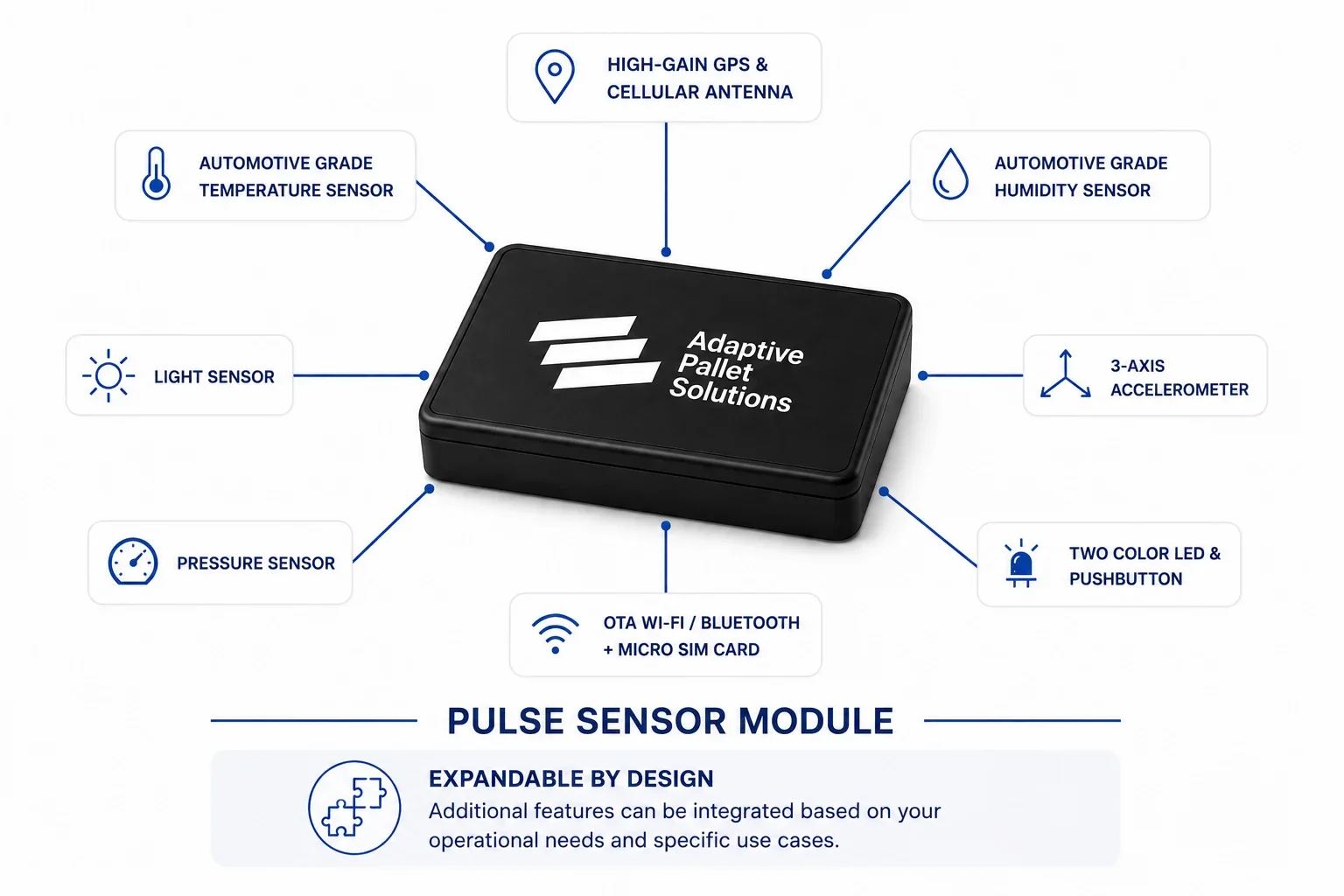
Having spent this guide being fair to every technology, here is where we land. Checkpoint and carried technologies answer different questions, and a serious operation needs both answers, so every APS pallet carries both. An RFID tag supports in-warehouse and in-DC scanning at the portals you already run. The embedded Pulse Sensor Module shown at the top of this page handles everything the portals cannot see: location in transit and temperature, humidity, shock and load state, with light and pressure sensing when a program needs them. The platform is 100% recycled HDPE, consistent to under 1%, washable and automation ready.
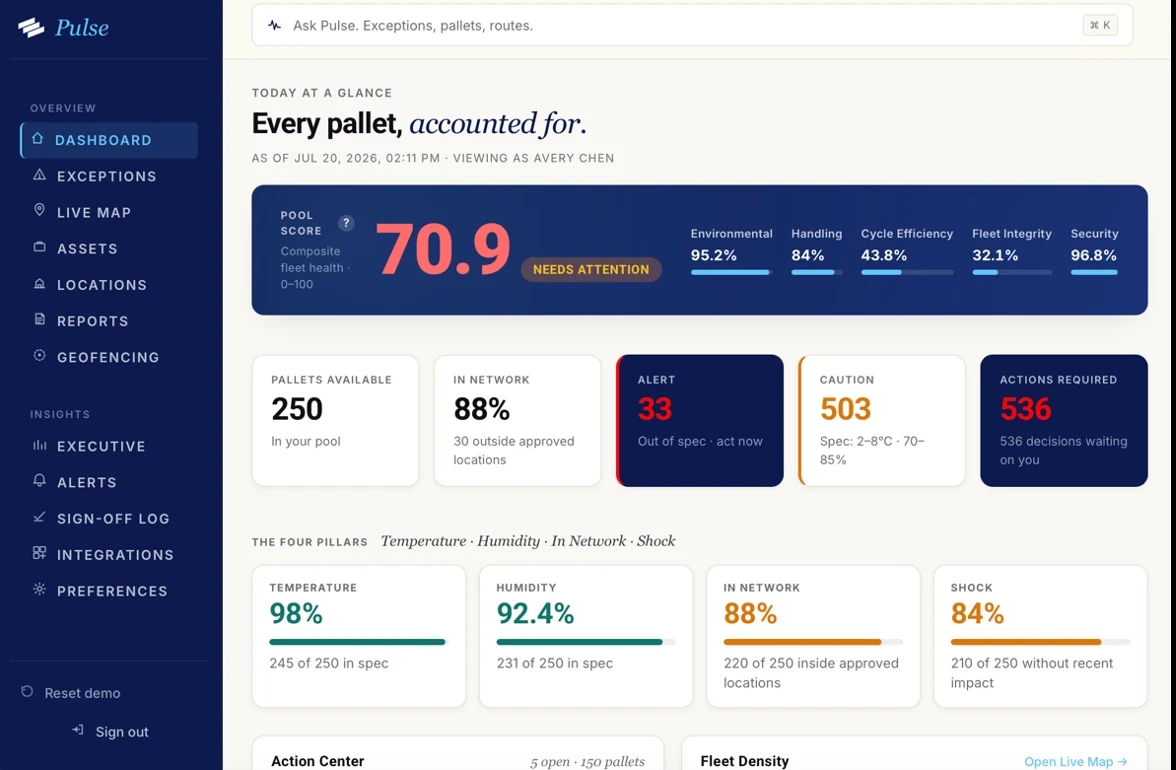
The software is Pulse, built on exception-based management. You do not monitor 20,000 pallets; you see the ones that need attention, routed to the right person by push, email or SMS and into the WMS and ERP you already run. Sam on our team draws the line in one sentence: RFID gives you an alert or a ping, a GPS tracker has to be bolted on and set up to connect, and ours does not have those extra steps because the sensor is built in and condition monitoring comes out of the box. The pricing follows the same logic. One all-inclusive monthly lease covers the pallet, the sensors, the exception reporting and the visibility layer, designed to land at or below what you pay for wood today; our savings calculator shows what that replaces. There is no hardware line and no software line, because there is no separate hardware and software. There is a pallet that reports.
If that sounds like the row you want to be in on the checklist, send us the lanes, the volumes and the compliance regime you answer to, and an APS expert will come back with a program scoped to your operation rather than a generic deck. And if the honest answer after reading this is that your problem is inventory accuracy inside four walls, buy the RFID portals. We will still be here when the trucks start losing things.
Sources
- History.com, “The first barcode scanner is used at a grocery store”
- GS1, “EPC UHF Gen2 Air Interface Protocol”
- GS1, “What is the read range for a typical RFID tag?”
- RAIN Alliance, “Shipments of 52.8bn RAIN Tag Chips Globally in 2024,” 2025
- RFID Journal, “RAIN Alliance Report Finds 2024 Tags Sales Approached 53 Billion,” 2025
- RAIN Alliance, “RAIN RFID tag chip shipments forecast to reach 115bn units by 2028,” 2024
- DC Velocity, “The quiet case for RFID” (Auburn University RFID Lab and GS1 US, Project Zipper), 2018
- RFID Journal, “Walmart Recommits to RFID,” 2022
- Bluetooth SIG, “2025 Bluetooth Market Update: Device forecast,” 2025
- LoRa Alliance, “About LoRaWAN”
- GSMA, “Over one billion LPWAN connections,” 2026
- Sørensen et al., “A Modelling and Experimental Framework for Battery Lifetime Estimation in NB-IoT and LTE-M,” arXiv preprint submitted to IEEE Internet of Things Journal, 2021
- Federal Communications Commission, Consumer and Governmental Affairs Bureau, “Plan Ahead for Phase Out of 3G Cellular Networks and Service,” 2021 (fcc.gov blocks fetchers; identical PDF confirmed on the Town of Hanover, MA mirror below)
- Town of Hanover, MA, mirror of the FCC consumer guide “Plan Ahead for Phase Out of 3G Cellular Networks and Service,” posted November 2021
- GPS.gov, “GPS Accuracy”
- Gartner supply chain leader survey, via Supply Chain Management Review, 2023
- MHI and Deloitte, “2025 MHI Annual Industry Report,” via Intelligent CIO, 2025
- Modern Materials Handling / Peerless Research Group, “The Pallet Report 2025,” 2025
- ISO, “ISO 8611-2:2025 Pallets for materials handling, Flat pallets, Part 2: Performance requirements and selection of tests,” February 2025 (iso.org blocks fetchers; scope text confirmed on the AFNOR Editions entry below)
- AFNOR Editions, catalog entry and scope text for ISO 8611-2:2025, 2025
FAQ
What Is the Difference Between Active and Passive RFID Tags?
A passive RFID tag has no battery; it draws power from the reader's signal and reflects an identifier back, which limits it to a few meters, up to about 15 meters in special cases per GS1. An active RFID tag carries a battery and its own transmitter, so it can be read at 100 meters or more, but it costs more and still needs receivers you install. Neither reports from a truck between your sites.
Is RFID Better Than a Barcode for Pallet Tracking?
For counting pallets and cases inside buildings you control, yes. Auburn University's RFID Lab and GS1 US measured inventory accuracy rising from 63% to 95% and order accuracy reaching 99.9% when brands and retailers used RFID instead of barcodes, because tags read in bulk without line of sight. Both remain checkpoint technologies, so in-transit visibility needs a carried technology such as cellular IoT.
What Is a Supply Chain Digital Twin?
A supply chain digital twin is a continuously updated digital model of a company's network, including facilities, lanes, inventory and assets, used to see current state and simulate decisions. A Gartner survey of 380 supply chain leaders found 60% piloting or planning one. Its usefulness depends on the data feeding it, which is why pallet-level sensor events from every handoff matter: they replace schedules and estimates with what actually happened.
Do Plastic Pallets Work in an AS/RS?
Plastic pallets are generally better suited to automated storage and retrieval systems than wood because they hold their dimensions, have no boards to break or nails to protrude, and present a consistent bottom deck to conveyors and shuttles. APS recycled HDPE pallets hold dimensional variance under 1% against 8 to 10% for wood. Confirm any pallet against your system's specification and ISO 8611 results before committing a fleet.
How Long Do Batteries Last in IoT Pallet Trackers?
It depends on the radio and how often the device reports. The LoRa Alliance cites 10 or more years for LoRaWAN devices, and 3GPP set a 10-year battery life requirement for NB-IoT and LTE-M devices under a defined traffic profile. Exception-based reporting, where the module stays quiet in normal conditions and transmits only when something changes, is designed to keep the radio off most of the time. Ask any vendor for battery life at your reporting cadence, not the brochure maximum.
Featured Posts From the APS Blog
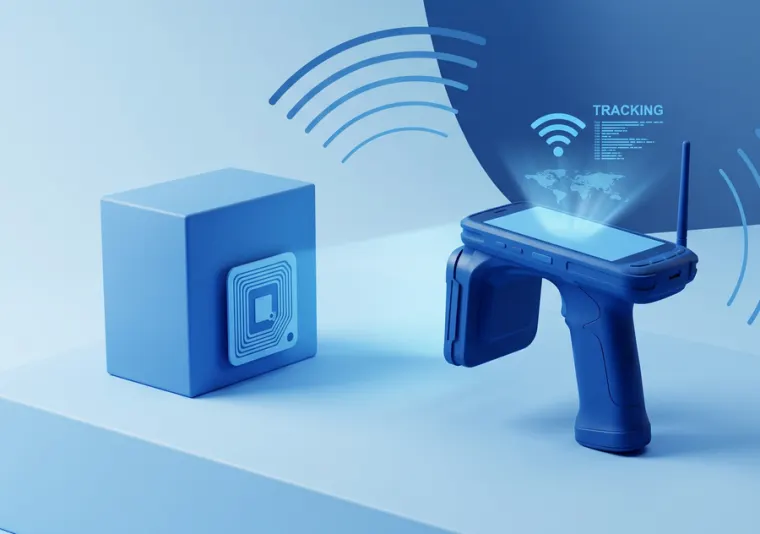
What RFID Pallet Tracking Actually Tells You (And What It Doesn't)
What gets packaged and sold as smart pallet technology is, in most cases, a ten-cent sticker on a rickety wooden pallet. Here is what passive RFID can and cannot see.
 Rodrigo CastroCo-Founder & President5 min read
Stuck in the 20th Century: Neil Armstrong, iPhones, and Pallets
80% of global goods touch a pallet at some point. How can an asset that fundamental to modern trade have changed so little since 1969?
Rodrigo CastroCo-Founder & President3 min read
Pallets, Paperwork, and Proof: How Two of the Least Sexy Industries Finally Found Each Other
Incoterms decide the exact point where risk transfers from seller to buyer. Almost nobody has the data to enforce what they are supposed to guarantee.
Rodrigo CastroCo-Founder & President6 min read