
Roll a pallet of apparel through a dock door portal and passive RFID looks like magic: dozens of tags answer at once and nobody lines up a scanner. Walk out to the yard with an active tag rated to 400 feet and you may find a trailer from the gate. Now put either pallet on a truck and drive it two hours east. Both tags still work. Nobody is listening.
Active vs Passive RFID Verdict
Pick the Tag by the Read Point
The active vs passive RFID question usually arrives as a range contest, and on range alone active wins easily: Savi rates one battery-powered 433 MHz tag at 400 feet outdoors. A passive tag is rated in meters, not hundreds of feet. But range is the wrong first question.
The better question is where your reads happen and how many things you need to tag.
Choose Active RFID If
- Your Assets Live in YardsYou need to find trailers, containers or large assets across open ground, where one tag heard from hundreds of feet beats a reader at every gate.
- The Asset Is Worth the TagA tag at $25 and up, with a battery to watch, is small next to the value of what it marks.
- You Want the Tag to Speak FirstBeacon tags transmit on a timer, so a receiver hears them without asking, and some models add motion sensing.
Choose Passive RFID If
- You Tag Every Pallet and CaseInlays cost cents, so you can afford to tag every pallet and every case on it.
- Your Reads Happen at DoorsDock doors, conveyors and handheld counts are where passive RFID is strongest, reading many tags at once.
- Nobody Wants to Change BatteriesA passive tag runs on the reader's radio field, so there is no battery to replace.
For most pallet programs that makes passive the default and active the specialist. Both share one limit: an RFID tag of either kind reports only when a reader or receiver can hear it. On the highway between two facilities, there usually is not one.
How Active RFID Tags Work
A Battery, a Radio & a Schedule
The Pentagon's RFID FAQ puts the difference in one line: an active tag "has the ability to produce its own radio signal," and to do it, it needs a power source, "traditionally" an integrated battery. Active RFID pairs that battery with a transmitter. ISO/IEC 18000-7 sets the air interface for active tags at 433 MHz, and some active systems run at 2.45 GHz.
Active RFID tags come in two flavors. One kind broadcasts on a schedule whether anyone is listening or not: RFID, Inc.'s 433 MHz tags list a transmission rate of 2.01 seconds. The other, a transponder, waits for a reader's request, which TechTarget notes is easier on the battery. Savi, which says it helped drive ISO 18000-7, rates the replaceable battery in its ST-621 license plate tag at approximately five years at two collections a day.
Range is where active RFID earns its price. Savi rates the ST-621 at 400 feet (122 meters) of operating range, outdoors and unobstructed. RFID, Inc. lists 3 to 60 feet with its reader's internal antenna and 600 feet with an external directional one, a reminder that a rated figure depends on the hardware around it. That reach suits containers, trailers and yards, and the Pentagon's FAQ lists both kinds of tag in its system.
The battery also powers options, such as the motion detector on RFID, Inc.'s line. It sets the bill too. RFID Journal puts active tags at $25 and up, and at $100 or more with protective housing, extra-long battery life or sensors.
Bottom Line
Active RFID buys reach with a battery. It fits big, valuable assets in places a receiver covers. It is an expensive way to tag a pallet that turns every week.
How Passive RFID Tags Work
No Battery, No Signal Until Asked
Passive RFID tags have no battery and no transmitter. A reader sends out a continuous radio wave, the tag draws enough power from it to wake its chip, and it answers by changing how its antenna reflects that wave. ISO/IEC 18000-63 calls this a passive-backscatter, Interrogator-Talks-First system: the tag modulates its reply "only after being directed to do so" by a reader.
GS1 says the most broadly implemented tags in its industries are UHF passive tags, also branded RAIN. GS1's EPC Gen2 air interface, first published in 2004 and now in its third version, defines how readers and passive tags talk. Its ISO counterpart, the 18000-63 Type C interface, covers 860 to 960 MHz. The GS1 EPC RFID standards are, in GS1's words, "focused on UHF and HF passive RFID tags," and GS1 publishes a pallet tagging guideline for returnable transport items.
Between reads, a passive tag does nothing. No power means no sensing and no signal until the next rfid reader field reaches it.
UHF RFID Read Range
Rated Meters & Real Meters
The RAIN Alliance describes reads from "a few centimeters to several meters." Impinj, which makes RAIN chips and readers, says up to 10 meters, about 30 feet. GS1 says RAIN tags can be read "at distances well in excess of 10 metres." Rugged hard tags push further. Confidex rates its Survivor hard tag, in its Impinj M780 version, at up to 10 meters on non-metal surfaces and up to 27 meters on metal, and calls those "theoretical values" calculated for a non-reflective environment.
A loaded pallet is not that. At UHF, RFID Journal's editor wrote in 2009, radio waves "bounce off metal and are absorbed by water," so on pallets of cans or bottled water only the outer cases may answer. Treat any rated range as an upper bound and test with your own loaded pallets.
Battery-assisted passive tags sit in between: a battery powers the chip, but there is no transmitter, so the tag still waits for a reader. Confidex rates its Survivor B at up to 60 meters, again in theory, while the EU's intellectual property office says such tags usually work no more than 30 meters from the reader.
RFID Reader Infrastructure
Every Read Point Is Hardware
A passive system is only as good as its read points. A fixed reader drives antennas at a dock door, a conveyor or a gate, and every read point needs that hardware plus cabling, power, a network and software that turns raw reads into events. Impinj pitches its R700 fixed reader for dock doors, conveyors and store exits. It supports up to 32 antennas through antenna hubs, and Impinj rates it at up to 1,300+ tag reads a second.
On atlasRFIDstore's homepage on October 26, 2026, the Impinj R700 listed at $1,499, Zebra's rugged four-port FXR90 at $3,190 and a TSL 1128 Bluetooth reader at $1,369. That is the reader alone, before installation, cabling or software, and the R700 needs external antennas.
Active systems need receivers too, among them Savi's mobile reader, rated to talk to tags up to 150 feet away. With longer rated range, fewer can cover the same ground.
Bottom Line
Passive RFID moves the cost from the tag to the read point. Tags cost cents, so you can tag everything. Every door, conveyor and gate that needs a read needs a reader, and the tags say nothing anywhere else.
RFID Tag Cost per Pallet
Cents per Tag, Dollars per Door
Most rfid tag cost figures are volume quotes, and RFID Journal notes that most tag sellers do not publish prices. Its rough guide: a passive 96-bit EPC inlay costs 7 to 15 U.S. cents, 15 cents and up once it is embedded in a printable label, and active tags generally run $25 and up. Our RFID adoption statistics post covers how those prices fell as volumes climbed.
A pallet tag is rarely a bare inlay, though. It has to survive forklifts, washdowns and weather, and the price climbs with the housing.
| Item | Type | Price |
|---|---|---|
| EPC inlay, chip and antenna | Passive | 7 to 15 cents |
| Custom universal asset tag (Vulcan RFID) | Passive | From $2.03, Oct 2026 |
| Battery-assisted passive tag | BAP | A few euros |
| Active tag | Active | $25 and up |
| Active tag with housing, long battery or sensors | Active | $100 or more |
| Fixed reader, Impinj R700, reader only | Passive | $1,499, Oct 2026 |
Sources: RFID Journal, "How much does an RFID tag cost today?" (checked October 2026), atlasRFIDstore homepage listings (October 26, 2026, with the tag at its starting price) and EUIPO's technology guide on BAP tags.
Now spread the tag over a pallet's working life. Assume, for illustration only, 10,000 returnable pallets making 100 trips each. A passive asset tag listed from $2.03 is about 2 cents a trip and $20,300 for the fleet. A $25 active tag is 25 cents a trip and $250,000. A $100 sensor-equipped active tag is $1 a trip and $1 million. None of that includes readers, labor or replacement batteries.
Price is one column, so the sheet below scores both tag types out of ten on cost and upkeep, range and reading, and data between readers.
Passive wins on cost and active wins on range. Both come up short on data between readers, the group most pallet buyers care about once freight leaves the building.
| Criterion | Active RFID | Passive RFID |
|---|---|---|
| Tag Cost & Upkeep | 4/10 | 8/10 |
| Tag costs under a dollar | NoGenerally $25 and up | Yes7 to 15 cents as an inlay |
| No battery to replace | NoAbout 5 years, Savi ST-621 | YesPowered by the reader |
| Rugged hard-case tags sold | YesIP64 housing, Savi ST-621 | YesIP68 hard tag, Confidex |
| Fewer read points per site | YesRated to 122 m outdoors | NoAntennas at each read point |
| Built on GS1 EPC standards | NoGS1 focuses on passive tags | YesEPC Gen2 & Tag Data Standard |
| Range & Reading | 10/10 | 6/10 |
| Rated range past 30 m | YesUp to 122 m, Savi ST-621 | NoUp to 27 m on metal, Confidex |
| Transmits without a query | YesBeacon tags send on a timer | NoAnswers only when queried |
| No line of sight needed | YesRadio broadcast | YesNo line of sight, per GS1 |
| Open air interface standard | YesISO/IEC 18000-7, 433 MHz | YesISO/IEC 18000-63, GS1 Gen2 |
| Portable readers sold | YesSavi SMR-650, up to 46 m | YesTSL 1128 Bluetooth reader |
| Data Between Readers | 4/10 | 2/10 |
| Sensor options on the tag | YesSensor tags, $100 or more | YesTemperature-sensing inlays |
| Senses with no reader present | YesBattery powers the tag | NoReads temperature when queried |
| Location on the road | NoOnly near a receiver | NoOnly at a reader |
| No site hardware needed | NoReaders or signposts | NoReaders and antennas |
| In-transit exception alerts | NoSilent out of range | NoSilent between reads |
Scoring: two points per Yes, none per No, five rows a group. Marks rest on the standards, datasheets and prices cited in this post. Rated ranges are vendors' figures under ideal conditions.
Bottom Line
The tag is rarely the big line. Every door you want covered needs a reader, and every active tag carries a battery that runs down.
What Each Misses Between Readers
The Hours No Reader Hears
RFID tracking, active or passive, produces an event when a tag and a reader meet: this tag, this place, this time. The Pentagon's FAQ describes users retrieving tag data through "communication between tags and readers (fixed or handheld), at a specific time and place." Between meetings, it learns nothing new.
A passive tag misses everything in between. Even sensor-equipped passive inlays, such as the Magnus S3 temperature tags RFID Journal covered in 2016, give a temperature "when interrogated by a UHF RFID reader." Six hours in a hot trailer leave no trace unless a reader was parked beside it.
An active tag misses less, inside its coverage. It broadcasts on its own schedule and powers its own sensors, and battery-assisted passive tags can store sensor readings until the next read. But a broadcast is not a delivery. A tag broadcasting from a truck on the interstate is talking to no one unless a receiver is in range. Our earlier post on what RFID tracking tells you walks through that gap leg by leg.
Both tags do their own job well. The cons below are about scope, not quality.
Read them with the gap above in mind. The con that matters most for a pallet in transit is one they share.
Active RFID
Pros
- Long Rated RangeSavi rates its ST-621 at 400 feet outdoors.
- Speaks FirstBeacon tags transmit on a timer, so a receiver hears them without sending a query.
- Room for SensorsThe battery can power sensors such as motion detection.
Cons
- Cost per TagGenerally $25 and up per tag, which adds up fast across a pallet fleet.
- The Battery Sets the ClockSavi rates about five years at two collections a day. RFID, Inc. warrants two years.
- Still Needs ReceiversA reader, signpost or handheld must be in range, so the tag goes unheard between sites.
Passive RFID
Pros
- Cents per TagAt 7 to 15 cents an inlay, every pallet and case can carry one.
- No BatteryThe tag runs on the reader's field, with nothing to recharge or replace.
- Fast Bulk ReadsThe RAIN Alliance cites up to 1,000 items a second, read without line of sight.
Cons
- Short RangeRated in meters, and metal and water can block reads on loaded pallets.
- A Reader at Every Read PointEach door, conveyor and gate that needs data needs its own hardware.
- Silent Between ReadsNo power means no sensing or logging until the next read.
Bottom Line
RFID records where a pallet was seen. Active tags are seen from farther away. Neither one tells you what happened on the road between two read points.
BLE vs RFID & Cellular Options
Other Radios, Other Trade-Offs
If the gap is between readers, which radios close it? TechTarget wrote in 2022 that BLE beacons are a common active tag in the 2.4 GHz band, costing "as little as one US dollar at the low end," though more susceptible to performance and interference issues. On range, the Bluetooth SIG's own answer is "it depends": anywhere from more than a kilometer down to less than a meter.
The most interesting BLE products blur the line with passive RFID. Wiliot's IoT Pixels are battery-free Bluetooth tags that harvest energy from ambient radio, sense temperature, humidity, light and location, and Wiliot says its Gen 3 Pixels broadcast up to 40 meters. In the ble vs rfid debate, that is a real step for continuous sensing indoors. But the tags still need Wiliot's network infrastructure nearby to energize them and a listening Bluetooth device to relay their data, so between sites the question stays the same: who is listening?
Cellular is the radio built for the road. Trackers on LTE-M and NB-IoT, the low power cellular standards the GSMA champions, report over existing mobile networks with no reader at either end. The GSMA says LTE-M allows battery lifetimes "as long as 10 years or more for a wide range of use cases," and it frames these networks around brief messages about the length of an SMS. Our pallet technology buyer's guide sets all four side by side.
The table rates the two RFID types by use case. The ratings are ours, and they rest on tag cost, rated range, and whether a reader is likely to be in range where the work happens.
| Use Case | Active RFID | Passive RFID |
|---|---|---|
| Dock Door Receiving & Shipping | Workable | Best fit |
| Tagging Every Pallet in a Fleet | Poor fit | Best fit |
| Yards, Containers & Trailers | Best fit | Workable |
| High-Value Assets Across a Site | Best fit | Workable |
| Location & Condition in Transit | Poor fit | Poor fit |
Bottom Line
Each radio answers a different question. Passive RFID answers what passed this door. Active RFID and BLE answer what is nearby. Cellular answers where a pallet is right now.
RFID Pallet Tracking Inside Smart Pallets
RFID for the Dock, Sensors for the Road
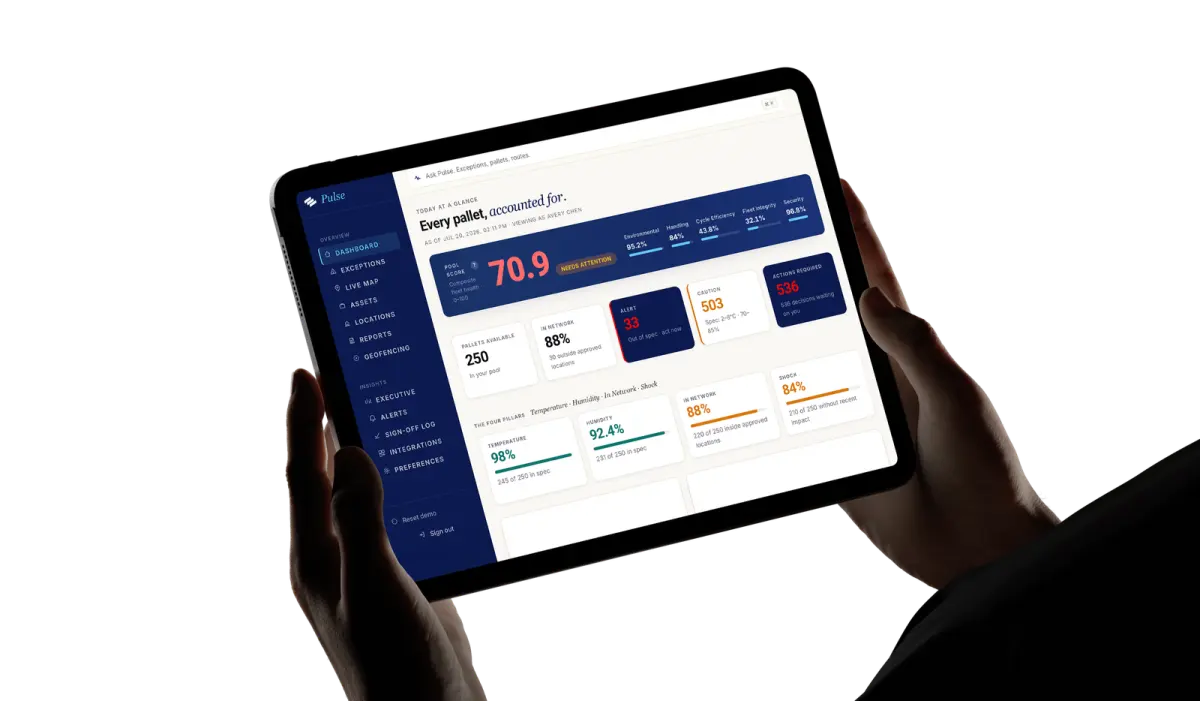
This is where we come in. We do not think rfid pallet tracking is the wrong idea. We think it is half of one. Inside a DC, a read at a dock door is fast, cheap and standardized, and APS Smart Pallets carry RFID tags for exactly those in-DC scanning workflows.
The other half is the road. Every APS Smart Pallet also carries an embedded sensor module, built into the pallet, not bolted on, with cellular GPS location plus temperature, humidity and shock. It needs no scanning, no facility infrastructure and no carrier cooperation, and it reports by exception: quiet while conditions hold, then a timestamped, geolocated event when the pallet moves or a threshold is crossed. The APS Pulse platform routes that exception to the right person and builds dwell time by facility and lane.
That is the line between identification and condition data. A read says a pallet was there. A sensor that travels with it says what happened on the way. The silence is data too.
The pallet underneath is 100 percent recycled HDPE, dimensionally consistent to under 1 percent and good for roughly 100 to 200+ trips. Smart Pallets come on an all-inclusive monthly lease designed to price at or below what companies pay for wood pallet programs, with the pallet, sensors, exception reporting and visibility in one cost.
Bottom Line
Keep the RFID read. Add what happens between reads. An APS Smart Pallet gives your DC its RFID scan and your team the in-transit record no reader can supply.
Active vs Passive RFID FAQ
Quick Answers on Active & Passive RFID
Three questions come up whenever buyers compare active and passive RFID for pallets. Short answers follow.
What Is the Difference Between Active & Passive RFID?
An active RFID tag has its own power source, usually a battery, and its own transmitter, so it can be heard from much farther away: Savi rates one 433 MHz tag at 400 feet outdoors. A passive RFID tag has no battery and answers only when a reader's radio field powers it, usually from a few meters away. Passive inlays cost cents and active tags generally run $25 and up.
How Far Can Passive RFID Read?
The RAIN Alliance puts passive UHF reads at a few centimeters to several meters, and Impinj at up to 10 meters. Some rugged hard tags are rated further, up to 27 meters on metal for one Confidex model, calculated for a non-reflective environment. On loaded pallets, inner cases may not read at all, because UHF signals bounce off metal and are absorbed by water.
Do Pallets Need Active RFID for Real Time Tracking?
No. Active RFID gives real-time location only where receivers can hear the tag, such as a yard or a building. Between facilities, a pallet needs a wide-area radio such as cellular. That is why APS Smart Pallets pair RFID tags for in-DC scanning with an embedded cellular GPS and sensor module that reports exceptions from the road.
Sources
- GS1, "RFID" (EPC/RFID standards), 2026
- GS1, "EPC UHF Gen2 Air Interface Protocol," 2026
- ISO, "ISO/IEC 18000-63:2021, Parameters for Air Interface Communications at 860 MHz to 960 MHz Type C," 2021
- ISO, "ISO/IEC 18000-7:2014, Parameters for Active Air Interface Communications at 433 MHz," 2014
- RAIN Alliance, "What Is RAIN," 2026
- Impinj, "How Can RFID Systems Be Categorized?," 2026
- Impinj, "Impinj R700 RAIN RFID Reader," 2026
- U.S. Department of Defense, "RFID Frequently Asked Questions," 2026
- RFID Journal, "How Much Does an RFID Tag Cost Today?," checked October 2026
- RFID Journal, "How Effective Is RFID for Tracking Goods on Pallets?," 2009
- RFID Journal, "SMARTRAC, RFMicron Release Passive RFID Temperature Sensor Technology," 2016
- Savi, "Savi License Plate Tag (ST-621) Datasheet," 2018
- Savi, "Savi Mobile Reader (SMR-650) Datasheet," 2018
- RFID, Inc., "433.92 MHz Active RFID Tags & Readers Data Sheet"
- Confidex, "Confidex Survivor Product Datasheet," 2022
- Confidex, "Confidex Survivor B Product Datasheet"
- EUIPO, "Battery-Assisted Passive RFID Tags," Anti-Counterfeiting Technology Guide
- TechTarget, "Active vs. Passive RFID Tags: Which to Choose?," 2022
- atlasRFIDstore, product listings (Impinj R700, Zebra FXR90, TSL 1128, Vulcan RFID asset tag), checked October 26, 2026
- Bluetooth SIG, "Understanding Bluetooth Range," 2026
- Wiliot, "IoT Pixels," 2026
- GSMA, "Long Term Evolution for Machines: LTE-M," 2026
- GSMA, "Mobile IoT," 2026
Pallet Comparison Articles
Featured Posts From the APS Blog
What RFID Pallet Tracking Actually Tells You (And What It Doesn't)
What gets packaged and sold as smart pallet technology is, in most cases, a ten-cent sticker on a rickety wooden pallet. Here is what passive RFID can and cannot see.
 Rodrigo CastroCo-Founder & President5 min read

How a Viral Cargo Theft Made the Case for Smart Pallets
Cargo theft losses across the US and Canada surged 60% to nearly $725 million, with food and beverage hit hardest and automotive supply chains increasingly exposed.
Rodrigo CastroCo-Founder & President5 min read
The $35 Billion Secret Your Pharmacist Doesn't Know About
A vial of insulin leaves Chicago produced to an exacting specification and stored at the right temperature. What happens next is a $35 billion problem.
Rodrigo CastroCo-Founder & President7 min read