
Walk a grocery DC and you will see the black iGPS pallet under bagged lettuce, bottled water and ice cream. It has been there since 2006, when iGPS launched the first all-plastic, RFID-tagged pallet pool to take on wood pallet rental. Twenty years on, iGPS calls itself the nation's largest plastic pallet pooler, and it is the comparison we get asked about most, because on paper we look alike: both HDPE, both tagged. The pallets are cousins. The programs are not. One is rented from a shared pool and priced on usage. The other is leased by the month and reports back.
APS vs iGPS Verdict
Which Pallet Program Should You Choose?
iGPS and APS make the same first argument against wood. The disagreement starts after the pallet is molded. iGPS puts four passive RFID tags in a pallet it rents from a shared pool. We put a cellular sensor module in a pallet we lease by the month inside your own loop. One tells you a pallet passed a reader. The other tells you what happened to the load between readers.
So the verdict is a question of lanes. If your product disappears into the open retail network, a plastic pool like iGPS is the right structure. If your pallets cycle between facilities you can name, APS gives you the same plastic platform plus data a pooled RFID pallet was never built to collect.
Choose APS If
- You Run Repeating LanesYour pallets move between plants, DCs and partners you can name, and come back.
- You Need to Know What Happened in TransitTemperature, humidity, shock and location are logged on the pallet, with no reader at either end.
- You Want One Monthly NumberOne lease covers the pallet, sensors, exception reporting and visibility, with no capital purchase and no per-trip fees.
- You Answer to a RegulatorFSMA, GDP and GMP audits want a record. A timestamped chain of custody is that record.
Choose iGPS If
- You Ship One-Way to RetailIf your loads end at grocery or club store DCs you do not control, a pool that collects at the receiver is the right structure.
- Dock-Door RFID Is All You NeedIf a dock-door read answers your visibility question, four GS1 Gen 2 tags do that job well, at no extra charge.
iGPS Pallet Pooling vs APS Pallet Leasing
Two Ways to Never Buy a Pallet Again
iGPS launched in Orlando in March 2006 under CEO Bob Moore, and Logistics Management counted about 10 million pallets in its pool in 2010. Balmoral Funds and partners have owned the company, now iGPS Logistics, since 2013, and Jeff Pepperworth has run it since 2019, and in April 2026 it told Pallet Enterprise it is the nation's largest plastic pallet pooler, with 13 depots and more than 240 iDepot locations at retail partner sites.
Pallet pooling works like this. You order pallets, ship on them, and they transfer out of your account at a receiver in the pooler's network, where an iDepot partner, paid a per-pallet fee by iGPS, inspects them and stages them for the next shipper. What you pay is a quote: iGPS publishes no rate card, and its own 2026 cost guide says plastic pallet pooling "does not have one standard cost per load." The structure is simple enough: you pay per use, iGPS says shippers need 10,000 or more pallets a year to get all of its cost savings, mixed generations arrive unless you pay to sort, and attrition, iGPS's word for pallets that never come back, is priced into the rate. That is not a criticism. It is how every pool serves one-way freight.
A closed-loop lease is the other way to never buy a pallet. APS designs and manages custom pallet leasing programs for closed-loop partners: a fleet sized to your lanes, leased for one all-inclusive monthly cost covering the pallet, the embedded sensor module, exception reporting in Pulse and visibility, with no capital purchase and no replacement cost. The pallets come back to you, not to a shared pool, and the lease is designed to price at or below what you already pay for wood. Our guide to closed-loop pallet programs lays the five models side by side. Plastic pallet pooling and plastic pallet leasing solve different problems. The table below is the map.
| Operation | APS | iGPS |
|---|---|---|
| Open-Loop Retail Distribution | Poor fit | Best fit |
| Closed-Loop Plant & DC Lanes | Best fit | Workable |
| Cold Chain | Best fit | Workable |
| High-Value Freight | Best fit | Poor fit |
| Automated Warehouses & ASRS | Best fit | Best fit |
iGPS vs APS Pallet Spec Sheet
Same Material, Different Jobs
iGPS pallets and APS Smart Pallets are both molded from HDPE at a true 48 by 40. iGPS plastic pallets weigh about 50 pounds, carry four embedded passive RFID tags and a barcode. APS pallets are 100 percent recycled HDPE, consistent to under 1 percent, with RFID tags plus a cellular sensor module built in.
The sheet scores each program out of ten in three groups: cost and lifespan, data, and hygiene. Every row names what the pallet does on that line, so you can jump to the group that decides your purchase. If your loads are temperature sensitive or worth stealing, read the data group first, because that is where a passive tag and an embedded sensor module sit furthest apart.
| Criterion | APS | iGPS |
|---|---|---|
| Cost & Lifespan | 8/10 | 6/10 |
| No capital purchase | YesMonthly lease | YesRented from the pool |
| One predictable number | YesFlat monthly, all-inclusive | NoQuoted. Moves with usage |
| Lost pallets priced out | YesClosed loop, 100% retrieval | NoAttrition built into the rate |
| Service life | Yes100 to 200+ trips | Yes100+ trips, iGPS's figure |
| Works for one-way shipping | NoNeeds a closed loop | YesPool collects at the receiver |
| Data | 10/10 | 2/10 |
| Location between facilities | YesCellular GPS, no readers | NoOnly at RFID read points |
| Temperature & humidity | YesLogged on the pallet | NoNo sensor on the pallet |
| Shock & handling events | YesTimestamped & geolocated | NoNo sensor on the pallet |
| Condition exception alerts | YesPulse routes them to the right person | NoNo sensor data to alert on |
| In-DC RFID scanning | YesRFID tags on every pallet | Yes4 GS1 Gen 2 tags, GRAI serial |
| Hygiene | 10/10 | 5/10 |
| Non-porous, washable HDPE | YesPressure-washable | YesDetergent & water |
| ISPM 15 exempt | YesNo heat treatment | YesNo heat treatment |
| 100% recycled content | YesPost-consumer & post-industrial | NoVirgin & recycled in the pool |
| Your product only | YesDedicated fleet, your loop | NoShared pool, mixed generations |
Scores: two points for each Yes and none for a No, from the evidence in this post. Hygiene has four rows, so its total is scaled to 10. Service life is each company's own published figure.
Plastic Pallet Cost & Lifespan
What a Trip Really Costs
Nobody buys a pallet for its sticker price. The unit is the trip, and the trip price depends on how many trips the pallet survives and how many pallets go missing. Pallet rental from a pool and a monthly lease both turn capital into an operating cost. They split the risk differently.
Pallet Rental Cost per Trip
Per Use From a Pool, Per Month From a Lease
In a pool, the trip is the invoice, and some share of every pool never comes home. iGPS is open about that: its CEO said in 2020 that the company accounts for "attrition (shrink)" in its pricing. iGPS says its pricing is "fully competitive with the rental of multi-use wood pallets," and Logistics Management put it at $4 to $6 a trip in 2010, priced to compete with CHEP.
In a lease, the month is the invoice. You pay one flat monthly cost for the fleet, whether a pallet turned twice that month or six times, so fast-cycling lanes get cheaper per trip. There is no per-trip charge, no rental clock and no lost-pallet charge. Our plastic pallet cost per use post works the per-trip math for owned plastic against wood. The lease removes the capital line from that model.
Reusable Plastic Pallet Lifespan
100 Trips Is the Floor, Not the Ceiling
Reusable plastic pallets outlast wood by a margin neither of us needs to exaggerate. iGPS says its pallets average 100 trips against about 25 for a wood block pallet, and Penn State researchers, reporting a 2020 life cycle study, noted that plastic pallets normally travel more than 200 round trips. APS pallets are built for roughly 100 to 200+ trips, against about 3 to 5 for white wood and about 15 for pooled wood, and a retired pallet is shredded back into the APS HDPE stream.
The difference is who collects the benefit. In a pool, a long-lived pallet lowers the pooler's cost first. In a lease, that long life is why the monthly number can sit at or below wood.
Upfront Pallet Cost
Why Neither Program Asks You to Buy One
A standard 48 by 40 GMA wood pallet traded at $11 to $13 in Seattle in September 2024, $15 to $17 for the premium grade, per Fastmarkets. A reusable plastic pallet runs from about $50 to more than $200 at published U.S. supplier prices, according to iGPS's own 2026 cost guide. That gap is why both programs exist. With iGPS the operating line buys a pallet and a tag read. With APS it buys the pallet, the sensor and the reporting.
Bottom Line
Both programs beat buying. Pooling is a per-use charge with shrink built in. The lease is a flat monthly cost with retrieval built into the closed loop. If your pallets come back, the lease is the cheaper shape, and the sensor comes with it.
RFID Pallets vs Smart Pallet Data
A Tag Read & a Sensor Log Are Different Things
This is where the two pallets stop being cousins. iGPS has put passive UHF RFID tags in every pallet since day one: four identical tags that meet the GS1 EPC Class 1 Gen 2 standard and carry an EPC GRAI serial, readable three ways (by RFID, barcode or printed serial), at no extra charge. That is a real capability. It is also exactly what RFID pallet tracking is: a reader at a choke point, a tag ID and a timestamp.
A passive tag has no battery. It answers when a reader powers it at a dock door or a conveyor, at distances well past 10 meters, per GS1. Between read points there is nothing, which is why iGPS's own RFID page describes tracing product "by wirelessly reading at critical choke points." You get every portal the pallet crossed. You do not get the truck. Our RFID statistics post has the adoption and accuracy numbers, and the GS1 RFID standards confirm what a Gen 2 tag is designed to carry.
Pallet Condition Monitoring
Temperature, Humidity & Shock, Logged on the Pallet
An RFID tag cannot tell you the load got warm. It has no sensor and no power to run one, so iGPS pallets carry no temperature, humidity or shock data of their own. Pallet Enterprise reported in April 2026 that iGPS is testing cellular devices that send periodic data. Testing is not the same as a sensor in every pallet, and iGPS's current spec sheet lists RFID and a barcode but no sensor.
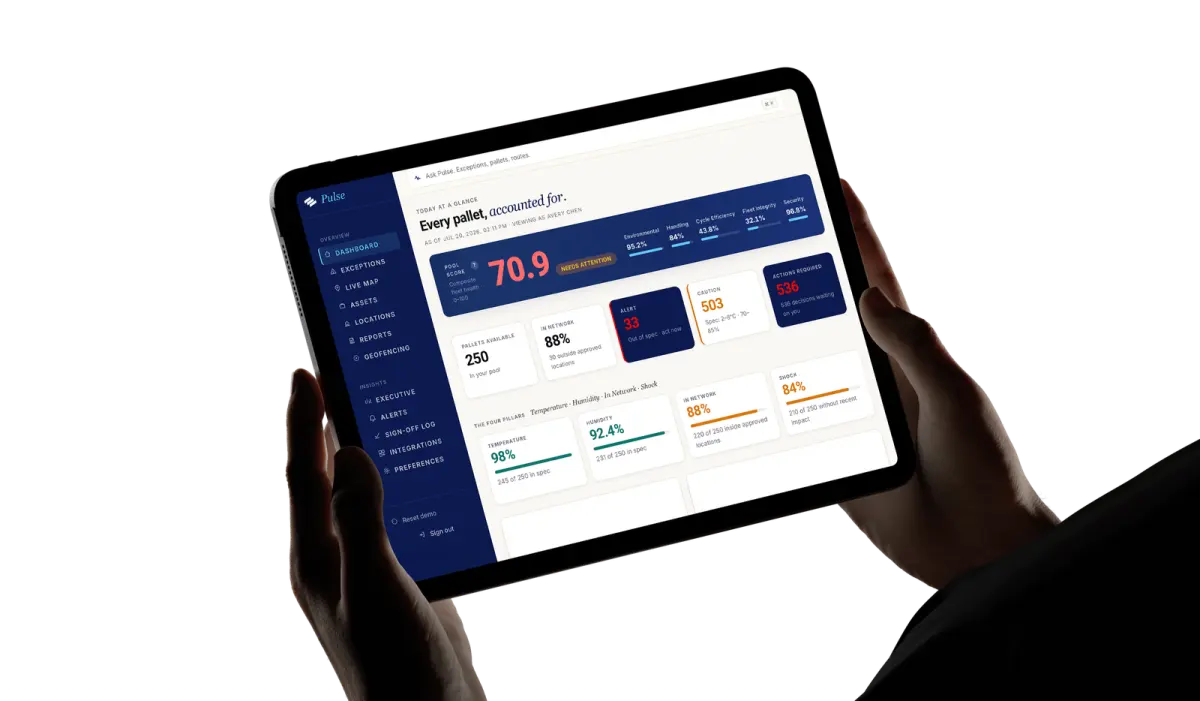
Every APS Smart Pallet ships with a sensor module built into the pallet, not bolted on, that logs temperature, humidity, shock and location. It runs on exception-based reporting: quiet while conditions hold, awake the moment a threshold is crossed, when it writes a timestamped, geolocated event and Pulse routes it to the person who can act. A pharmaceutical load creeping toward 8 degrees Celsius at a loading dock gets flagged at the dock, not three weeks later in a quality investigation. The module and Pulse are described on our Smart Pallet technology page.
Pallet Location Visibility
Where It Is, Not Where It Was Last Scanned
RFID pallets give you location the way a timecard gives you attendance. The pallet was at the Kansas City dock at 2:07 and the St. Louis dock at 9:30 the next morning, and everything in between is inferred. For a pool that is enough. For a shipper whose freight is worth stealing it is not.
APS pallets locate themselves over cellular networks, with no reader, no portal and no carrier cooperation. The pallet logs a timestamped, geolocated event when it moves and builds a chain of custody independent of the carrier's telematics. On a repeating lane that record also becomes dwell time by facility. A pooled RFID pallet can answer where it was last read. A Smart Pallet answers where it is.
Bottom Line
RFID is the wrong tool, not a bad one. iGPS's four-tag, GS1-standard RFID is a serious dock-door system, on what iGPS calls the largest deployed RFID pool in the world. It still goes dark between doors. If the hours on the truck are the hours you care about, the sensor has to ride with the pallet.
Plastic Pallet Hygiene & Food Safety
Both Beat Wood. Here Is Where They Differ
Credit where it is due: on hygiene, iGPS and APS are on the same side, and wood is on the other. HDPE does not absorb a spill, does not harbor mold, and is exempt from ISPM 15. iGPS pallets clean with detergent and water, iGPS began offering a food-contact surface sanitizer in 2017, and in 2025 it won a Top Supply Chain Projects award for an automated inspection and washing system, first rolled out at five of its depots. APS pallets are non-porous and pressure-washable, with no nails and no splinters, built for FSMA, GMP and GDP environments.
Three differences are worth knowing. First, recycled content: every APS pallet is 100 percent recycled HDPE, while iGPS's own 2025 life cycle study assessed both virgin and recycled iGPS pallets. Second, a pooled pallet carried another shipper's load last week. A leased APS fleet carries only your product. Third, the record. A washed pallet proves it was washed. An APS pallet proves the load stayed under 8 degrees from the plant to the dock, because the temperature log traveled with it. That is the record the auditor asks for.
Bottom Line
Hygiene is a tie on material and a win on evidence. Choose either program over wood. Choose APS when the audit wants the thermal history as well as a clean deck.
Best Plastic Pallet Program for Your Operation
Match the Program to the Lanes
Pallet pooling companies and leasing companies are not really fighting over the same lane. The pool wins where you cannot get the pallet back. The lease wins where you can, and where the pallet has something to tell you on the way. Run your numbers on pallet program savings before you pick.
Use the two cards below as a sorting test, not a ranking. If your freight finishes at grocery and club store DCs that collect the pallet for you, the iGPS card describes your operation. If it cycles between plants and DCs you can name, or ships under GDP or FSMA records, the APS card does.
Who APS Is Best For
Closed Loops With Something to Protect
- Cold Chain & Pharma ShippersYou get temperature and humidity logged on the pallet, exception alerts in transit, and a timestamped chain of custody for GDP and FSMA records.
- Plant-to-DC & Automotive LoopsYour lanes repeat between facilities you control and feed ASRS and robotic lines that need a pallet consistent to under 1 percent.
- High-Value & Theft-Exposed FreightFor electronics, spirits and components, a pallet that reports its own location and keeps a chain of custody independent of the carrier is protection the carrier cannot provide.
Who iGPS Is Best For
One-Way Retail at Volume
- Fast-Moving Consumer Goods to GroceryYour loads end at grocery and club store DCs, where iGPS's more than 240 iDepots at retail partner sites collect the pallets.
- 10,000-Plus Pallets a YeariGPS says that is the volume where its savings show up, and a pool's economics improve with scale.
- RFID-Ready FacilitiesYour facilities already run readers at conveyors and dock doors, and you want a serialized, GS1-standard pallet at no extra charge.
APS vs iGPS Pros & Cons
The Honest List
Every program on this page has a cost, and a buyer deserves both lists before a pilot. iGPS brings what it calls the nation's largest plastic pallet pool, four RFID tags on every pallet at no extra charge and no return logistics to run, a strong package for one-way retail freight.
APS brings sensor data that rides with the pallet and one all-inclusive monthly cost, and in return it needs a closed loop and a lease commitment. We wrote the cons for our own column as plainly as the ones for iGPS.
APS
Pros
- Data Rides With the PalletCellular GPS, temperature, humidity and shock are logged on the pallet and routed by Pulse, with no readers.
- One All-Inclusive Monthly CostThe pallet, sensors, exception reporting and visibility come in one number, designed to price at or below a wood program.
- 100 Percent Recycled, Closed-Loop RecoveryEvery pallet is recycled HDPE, the loop has 100 percent retrieval capability, and retired pallets are shredded back into the APS HDPE stream.
- Built for Automation & AuditsPallets hold under 1 percent dimensional variance, are pressure-washable and are ISPM 15 exempt.
Cons
- Needs a Closed LoopIf your pallets leave for receivers you cannot name, a dedicated leased fleet is the wrong shape, and we will tell you so.
- A Lease Is a CommitmentA monthly fleet cost is predictable, and that cuts both ways: you pay it in a slow month too.
iGPS
Pros
- Largest Plastic Pool in North AmericaBy its own count it is North America's largest plastic pallet pooler, with 13 depots, more than 240 iDepots and service across the U.S., Canada and Mexico.
- RFID on Every PalletEvery pallet carries four GS1 Gen 2 RFID tags and a GRAI serial, at no extra charge.
- Plastic Done RightThe pallet is a true 48 by 40 HDPE platform of about 50 pounds, repairable by weld, with automated inspection and washing at five depots so far.
- No Return LogisticsShip it and forget it. The pool, not you, chases the pallet.
Cons
- No Condition or Transit DataNothing on the pallet measures temperature, humidity or shock, and location exists only at read points.
- Usage-Based Pricing With Shrink Built InThere are no published rates, orders arrive in mixed generations unless you pay sortation fees, and attrition is in the price.
- Built for High VolumeiGPS says shippers need 10,000 or more pallets a year to get all of its cost savings, so smaller programs see less of the benefit.
APS vs iGPS FAQ
Questions Buyers Ask Before Switching
These are the three questions buyers raise most often when a pooled RFID pallet and a smart pallet lease are both on the table. The answers are short, and every outside figure traces to the sources listed below.
How Does iGPS Pallet Pooling Work?
You order plastic pallets from the iGPS pool, ship your product on them, and the pallets transfer out of your account at a receiver in the iGPS network, where an iDepot partner inspects and stages them for the next shipper. You never own the pallet or handle its return. Pricing is quoted on volume and usage, and iGPS says its cost savings show up at 10,000 or more pallets a year.
Are iGPS Pallets Tracked in Real Time?
Not in the sense of a live location. iGPS describes its tags as enabling real-time shipment tracking, meaning each read at a dock door, conveyor or gate is recorded as it happens. Between read points the pallet sends nothing. The pallet has no sensor for temperature, humidity or shock. APS Smart Pallets report location and conditions over cellular with no readers at all.
Is Leasing Smart Pallets Cheaper Than Pooling?
It depends on whether your pallets come back. In a closed loop, APS's all-inclusive monthly lease is designed to price at or below a wood pallet program and includes the sensors and reporting, with no per-trip or lost-pallet charges. For one-way shipments into the open retail network, a pool that collects at the receiver is usually the cheaper structure, because you are not paying to recover a pallet you will never see again.
Sources
- iGPS Logistics, "Pallet Spec Sheet," 2025
- iGPS Logistics, "Supply Chain Intelligence With Built-In RFID," 2025
- iGPS Logistics, "FAQs," 2025
- iGPS Logistics, "Why iGPS," 2025
- iGPS Logistics, "Benefits of Pallet Pooling," 2025
- iGPS Logistics, "Market Leader," 2025
- iGPS Logistics, "Pallet Lifecycle Analysis," 2025
- iGPS Logistics, "How Much Does a Plastic Pallet Cost?," 2026
- iGPS Logistics, "iGPS Logistics Earns 'Top Supply Chain Projects' Award for Innovative Pallet Automation Solution," 2025
- iGPS Logistics, "iGPS Logistics Now Offering Direct Food Contact Level Safety for Customers," 2017
- iGPS Logistics / East West Bank, "From Product Innovation to Market Leadership, One Pallet at a Time," 2020
- Pallet Enterprise, "iGPS 2026: Disciplined Growth, Manufacturing Control and Technology Investment," 2026
- Logistics Management, "Pallets and Containers: The Plastic Pool Alternative," 2010
- FreightWaves, "iGPS Adds iDepots to Plastic Pallet Rental System," 2008
- RFID Journal, "iGPS Is First to Incorporate RFID Global Asset-Tracking Codes on Its Entire Fleet of Plastic Pallets," 2007
- GS1, "RFID: EPC/RFID Standards," 2026
- Fastmarkets, "US Pallet Manufacturers Continue to Struggle After Rate Cut," 2024
- Penn State University, "Wooden or Plastic Pallets: Which Are More Eco-Friendly?," 2020
Pallet Comparison Articles
Featured Posts From the APS Blog

What RFID Pallet Tracking Actually Tells You (And What It Doesn't)
What gets packaged and sold as smart pallet technology is, in most cases, a ten-cent sticker on a rickety wooden pallet. Here is what passive RFID can and cannot see.
 Rodrigo CastroCo-Founder & President5 min read

The Pallet Is Costing You More Than You Think
You have invested millions in automation and you track labor, freight and energy to the decimal. Somewhere on your dock, a wooden pallet is about to stop the line.
Rodrigo CastroCo-Founder & President10 min read
Stuck in the 20th Century: Neil Armstrong, iPhones, and Pallets
80% of global goods touch a pallet at some point. How can an asset that fundamental to modern trade have changed so little since 1969?
Rodrigo CastroCo-Founder & President3 min read