
Open a box of Tive trackers and you get a palm-sized cellular device, an adhesive pad and an instruction to stick it on the last pallet facing the trailer door. Press the button a few hours before you pack, create the shipment in the platform, and the load starts talking: location, temperature, humidity, light and shock, as often as every five minutes. We make the opposite bet: instead of adding a device to the shipment, we build the sensor into the pallet and lease the pallet. This post is about which bet fits your lanes.
APS vs Tive Verdict
Which Tracking Model Should You Choose?
Freight goes dark the moment it leaves your dock. Tive and APS both set out to fix that, and we disagree on the cure. Tive answers with a cellular shipment tracker you attach to each load and recover or discard afterward. We answer with a Smart Pallet that carries its own sensor module, built into the pallet, not bolted on, and leased by the month inside your own loop. One is a device you add to the shipment. The other is the shipment's floor.
So the verdict follows the lane. If your product disappears into one-way networks, parcel or air, a tracker like Tive's is the right shape. If your pallets cycle between facilities you control, APS puts the sensor under every load on every trip, with nothing to attach or mail back.
Choose APS If
- Your Pallets Come BackYour loads cycle between plants, DCs and partners you can name, so one leased fleet covers every load with no setup step.
- You Want Every Pallet ReportingThe module is in every Smart Pallet, so the record covers the whole load, not just the pallet a tracker is stuck to.
- You Want One Monthly NumberOne lease covers pallet, sensors, exception reporting and visibility, with no per-tracker fee and no capital purchase.
- You Want an Independent RecordEvery Smart Pallet keeps an independent, timestamped chain of custody at every handoff for GDP and FSMA records, with no device to add.
Choose Tive If
- Your Freight Never Comes BackOne-way, parcel and air lanes are what a per-shipment tracker was built for, and Tive's single-use trackers do not have to come back.
- You Ship by Air OftenTive says its non-lithium trackers are approved for use on most air carriers. Our leased fleets run in closed loops between facilities.
Tive Shipment Trackers vs Smart Pallets by Operation
A Device You Add, or a Pallet That Reports
Tive is a Boston company, co-founded in 2015 by its CEO Krenar Komoni, and it sells what the industry calls a shipment tracker: a palm-sized cellular device with temperature, humidity, light, shock and motion sensors and a cloud platform behind it. Its real-time trackers today are the Solo 5G, the Solo Pro and the lower-cost Solo Lite.
That is a different animal from an asset tracker bolted to a trailer for its working life. Tive's device belongs to the shipment, not the asset. It goes on when the load is built and comes off at delivery. Tive's data sheet says the Solo 5G can be single use or reused, and its Green Program takes trackers back for reuse or recycling.
APS goes the other way. We design and manage custom pallet leasing programs for closed-loop partners, and every Smart Pallet carries an embedded sensor module with cellular GPS, temperature, humidity and shock. The pallet is the device, and it comes back in the loop. Our Smart Pallets guide walks through the hardware. The ratings below are ours. They rest on two questions: does the freight come back, and does every pallet need to talk? Air rates with the one-way lanes, since Tive builds trackers for flights and our program is built for closed loops between facilities.
| Operation | APS | Tive |
|---|---|---|
| Closed-Loop Plant & DC Lanes | Best fit | Workable |
| Repeating Cold Chain & Pharma Lanes | Best fit | Workable |
| High-Value Truckload Freight | Best fit | Workable |
| One-Way & Parcel Lanes | Poor fit | Best fit |
| Air Freight Shipments | Poor fit | Best fit |
Tive Tracker vs APS Smart Pallet Spec Sheet
Two Sensors, Two Places to Put Them
The Tive tracker buyers ask us about is the Tive Solo 5G, a cellular GPS tracker rated from minus 30 to 60 degrees Celsius in its lithium model, IP67, accurate to plus or minus 0.5 degrees, sold in lithium and non-lithium models for air freight. Our module sits inside a 100 percent recycled HDPE pallet and reports over cellular with no readers and no carrier cooperation. Our embedded sensor technology page has the detail.
The sheet then scores both approaches out of ten on cost and lifespan, tracking data, and setup and recovery. Tive is strong on sensing, and the tracking data group shows it. The bigger gaps sit in cost and setup, because a tracker is activated, then recovered or discarded, one shipment at a time.
| Criterion | APS | Tive |
|---|---|---|
| Cost & Lifespan | 8/10 | 2/10 |
| One flat monthly number | YesAll-inclusive lease | NoPer-tracker fee, quoted |
| Sensor included in pallet cost | YesSensor, reporting, visibility in | NoTracker is its own line |
| Sensor on every pallet, every trip | YesWhole fleet, whole year | NoPlaced per shipment |
| Device returns inside your loop | YesClosed loop, 100% retrieval | NoMailed back, or single use |
| Works on one-way lanes | NoNeeds a closed loop | YesSingle use, no return needed |
| Tracking Data | 10/10 | 5/10 |
| Location between facilities | YesCellular GPS in the pallet | YesGPS, Wi-Fi & cellular fixes |
| Temperature & humidity | YesLogged on the pallet | YesSolo 5G & Solo Pro, not Lite |
| Shock events | YesTimestamped & geolocated | YesSolo 5G & Solo Pro, not Lite |
| Sensor built into the pallet | YesEmbedded module | NoAdhesive pad or zip tie |
| In-DC RFID scanning | YesRFID tags on every pallet | NoNot in the tracker spec |
| Covers every pallet in the load | YesEvery pallet reports | NoOnly the pallets you tag |
| Setup & Recovery | 8/10 | 6/10 |
| No per-shipment setup | YesBuilt in, no extra steps | NoSwitch on, attach, create |
| Nothing to retrieve at delivery | YesPallet returns in the loop | NoMail back, or single use |
| No carrier cooperation needed | YesNo scans, no infrastructure | YesReports over cellular |
| Follows freight outside your loop | NoClosed loop only | YesAny lane, any mode |
| Record for a claim | YesTimestamped chain of custody | YesValidated shipment reports |
Scores: two points per Yes, none per No, scaled to 10 where a group has more than five rows. Tive marks follow its published specs and support pages. APS marks follow our program facts.
Pallet Tracker Cost per Trip
Per Shipment, or Per Month
A GPS tracker for shipments is priced like a consumable, even when it is reusable. A leased Smart Pallet is priced like infrastructure, by the month.
Tracker Cost per Shipment
What Tive Charges, in Its Own Words
Tive does not publish a rate card. Its product page points buyers to Contact Sales, and the platform comes in Essential, Plus and Premium tiers. On the record: in 2018 Tive charged a monthly or annual fee per tracker, with platform access and customer service included. In February 2019 it launched the single-use Solo at a one-time fee of $29 per tracker, with a 30-day battery and no return. Those figures are dated, so read them as the shape of the model, not today's quote.
The shape is a charge per tracker, with platform features set by tier. More loads means more trackers to buy, charge, recover or write off. APS has one line: an all-inclusive monthly lease covering the pallet, the sensors, exception reporting and visibility, designed to price at or below a wood pallet program, with no capital purchase and no per-trip charge. Ship a pallet twice this month or six times and the number does not move.
Tracker Battery & Pallet Lifespan
A Charge Cycle Against a Pallet's Working Life
A tracker lives on its battery, and Tive's documents disagree on how long. Its product page rates the lithium Solo 5G at 50+ days on hourly reporting and 100+ days at a six-hour interval, and the non-lithium model at 30+ and 90+ days. Its support table lists 30+ days hourly for the Solo 5G, and a 2024 data sheet lists 60+. Tive also says enabling GPS significantly reduces battery life and that a full recharge typically takes four to six hours. The IATA lithium battery rules allow lithium batteries by air depending on configuration and watt-hour rating, and IATA's 2025 guidance includes guidance on battery-powered cargo tracking devices and data loggers. Tive's answer is the non-lithium Solo 5G, which it says is not classed as dangerous goods under most regulations and is approved for use on most air carriers.
The pallet under an APS sensor is measured in trips. APS pallets run roughly 100 to 200+ trips before recycling, against about 3 to 5 for white wood and about 15 for pooled wood. A retired pallet is shredded back into the APS HDPE stream.
Upfront Tracking Cost
What You Buy Before the First Load Moves
With Tive, the first load needs trackers in hand, charged and activated, a platform account, and a pallet from somewhere else. With APS the pallet and the tracking arrive together under one lease, with no capital purchase and no replacement cost. Replacing wood anyway? The intelligence comes with the pallet.
Bottom Line
A tracker is a per-shipment line. A Smart Pallet is a monthly one. Tive's model scales with the loads you tag. The lease scales with your fleet, and the sensor is already in it.
GPS Pallet Tracking Data
What the Device Sees & What the Pallet Sees
Both products do real freight tracking in transit, over cellular, with no readers at either end. That puts both a generation ahead of a passive RFID tag, and our RFID, IoT & sensor tracking buyer's guide explains why. Coverage is the difference. A Tive tracker covers the pallet it is stuck to, placed by the door for signal, though Tive's Plus tier allows several trackers per shipment. An APS pallet tracker is in every pallet in the fleet, so IoT pallet tracking covers the whole load, and GPS pallet tracking continues on the return leg and the empty leg.
Pallet Condition Monitoring
Temperature, Humidity, Light & Shock
Credit first. Tive's Solo 5G logs temperature, humidity, light, shock and motion, with temperature accurate to plus or minus 0.5 degrees Celsius and a measurement interval from five minutes to twelve hours. The Solo Lite, the lower-cost model, drops humidity and shock. When a threshold is crossed the platform raises an alert, and Tive's 24/7 Live Monitoring team can watch shipments around the clock. For a pharmaceutical shipper that is a serious condition record.
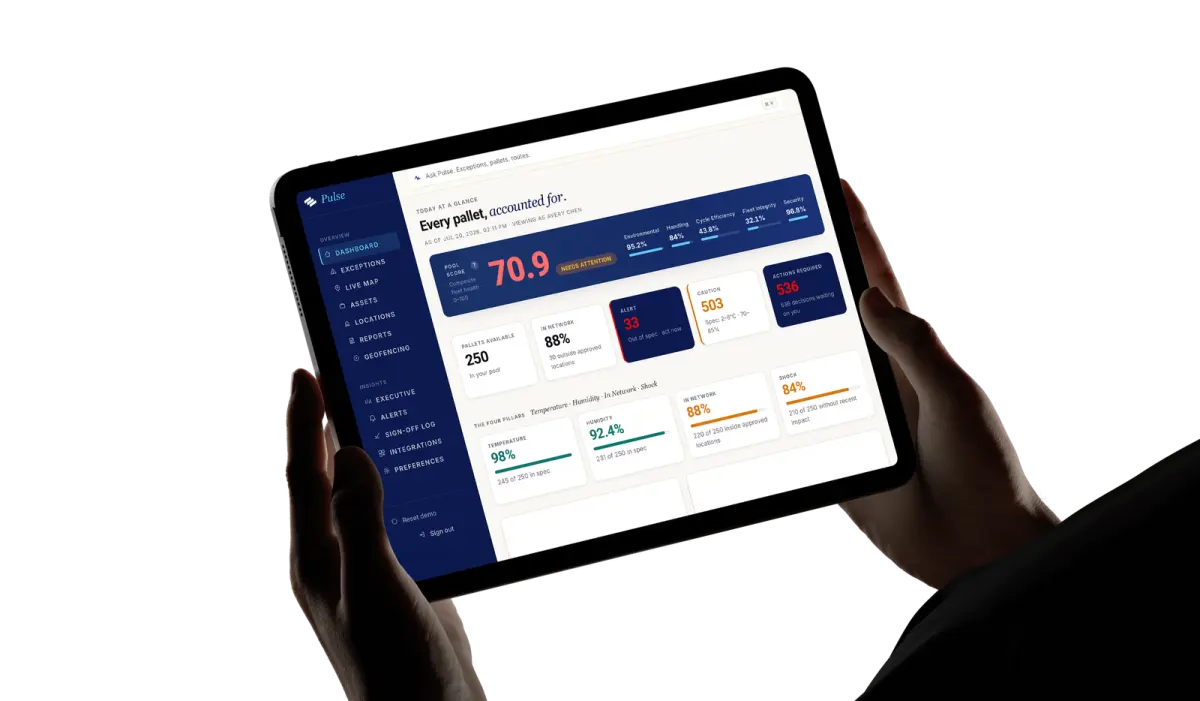
Our module logs temperature, humidity, shock and location on the pallet, and can carry more, light and load state among them. It reports by exception: quiet while conditions hold, awake the moment a threshold is crossed, when it writes a timestamped, geolocated event and Pulse routes it to the right person. The silence is data too. Three quiet days in a DC mean nothing crossed a threshold. Because the record is per pallet, a warm corner of a trailer shows up as the three pallets that got warm, not as one reading from a tracker by the door.
Real Time Pallet Location
Where It Is, on Every Leg
Tive locates the tracker three ways: GPS to about 10 to 20 meters, depending on the model and the document, Wi-Fi geolocation to about 50 meters, and cellular triangulation to about 500 meters, reporting from every five minutes to once a day. That is genuine live location. GPS costs battery, so for ocean freight Tive suggests less frequent reporting and non-GPS tracking.
A Smart Pallet locates itself over cellular GPS with no reader and no carrier cooperation, and because it is the pallet, the record does not end at delivery. It runs through the return leg and the dwell at the receiver, which is how Pulse builds dwell time by facility and lane. A tracker tells you where the shipment went. A fleet of Smart Pallets tells you where your pallets go.
Bottom Line
Both see the truck. Only one sees the fleet. Tive gives you a precise record of the loads you chose to tag. APS gives you every pallet on every trip, including the legs nobody thought to tag.
Tracker Setup & Recovery
Attach, Activate, Create, Retrieve
Here is the step list a cargo tracking device adds to a shipment, from Tive's getting-started guide. Tive advises switching the tracker on a few hours before packing to verify it is transmitting. Attach it with the adhesive pad on the last pallet facing the door, or on the trailer door, for signal. Do not cover it, or the readings may suffer. Create the shipment in the Tive Platform. Trackers cannot be turned off manually, so turning one off is a request to Tive support. None is hard. Each repeats for every load.
Then there is the way back. Tive gives U.S. customers prepaid return labels for any quantity of trackers, and its Rapid Return & Recycle program, launched in the U.S. in October 2024, sends shippers return kits: an envelope with the tracker and a prelabeled return box travels with the cargo, and the receiver drops the box in USPS mail. It is a well-designed loop, and it depends on the receiver, as Tive's returns page acknowledges. Single-use trackers skip the loop by design.
As one of our team puts it, a GPS tracker has to be bolted on and then set up to connect, and ours skips both steps because it is built into the pallet. There is nothing to attach, nothing to create per load and nothing for the receiver to mail. The pallet goes out with the load, comes back with the loop, and the record rides with it.
Bottom Line
A tracker adds steps. A Smart Pallet removes them. Every Tive shipment starts with a device to activate and attach, and ends with one to retrieve or write off. A leased fleet starts and ends with the pallet.
Best Pallet Tracking for Your Operation
Match the Model to the Lane
The honest split is about the lane, not the technology. Tive wins where the freight does not come back. APS wins where it does, and where a record that belongs to the cargo itself is the point, as our cargo theft statistics post argues.
Sort yourself into one of the two cards below by the lane, not the gadget. Loads that end with receivers you cannot name, or that fly, belong on the Tive card. Pallets that return to facilities you control, with every load reporting on every trip, belong on the APS card.
Who APS Is Best For
Closed Loops That Need Every Pallet Talking
- Cold Chain & Pharma LoopsTemperature and humidity logged on every pallet, exceptions routed by Pulse in transit, and a timestamped chain of custody for GDP and FSMA records.
- Plant-to-DC & Automotive LoopsLanes that repeat between facilities you control, where a Smart Pallet consistent to under 1 percent feeds the automated line and reports from it.
- High-Value Freight on TrucksA sensor built into the pallet rather than stuck to the outside of the load, with a location record independent of the carrier's telematics.
Who Tive Is Best For
Shipments That Go One Way
- One-Way & Parcel LanesLoads that end at receivers you cannot name, where a single-use tracker that does not have to come back is the natural fit.
- Air Freight & Ocean ContainersNon-lithium trackers Tive says are approved for use on most air carriers, and reporting intervals you can stretch to once a day for a long sea leg.
- Spot & Project ShipmentsA handful of critical loads a month, where trackers bought per shipment beat standing up a fleet.
APS vs Tive Pros & Cons
The Honest List
Tive does several things very well. The trackers follow freight anywhere, the condition sensing is serious, and the non-lithium models are made for air freight, which a pallet program cannot match.
Its cons are about workflow. Every shipment needs a step, the battery sets the clock, and one device speaks for a whole load. Our own cons are a closed loop and a lease, and we list them just as clearly.
APS
Pros
- Sensor Built In, Not Bolted OnCellular GPS, temperature, humidity and shock ride inside every Smart Pallet, with nothing to activate, attach or recover.
- Every Pallet, Every TripThe record covers the whole fleet on every leg, including returns and dwell, so Pulse can report dwell time by facility and lane.
- One All-Inclusive Monthly CostPallet, sensors, exception reporting and visibility in one number, designed to price at or below a wood pallet program.
- A Better Pallet Underneath100 percent recycled HDPE, consistent to under 1 percent, pressure-washable, ISPM 15 exempt, and good for 100 to 200+ trips.
Cons
- Needs a Closed LoopIf your freight leaves for receivers you cannot name, or moves by air, our closed-loop lease is the wrong shape, and we will say so.
- A Lease Is a CommitmentOne flat monthly cost is predictable, and that cuts both ways: you pay it in a slow month too.
Tive
Pros
- Follows Freight AnywhereThe tracker belongs to the shipment, so it works on one-way, parcel, air and ocean lanes where no pallet comes back.
- Serious Condition SensingTemperature to plus or minus 0.5 degrees Celsius, humidity, light and shock, a dry ice and cryogenic probe option, and up to 25,000 records on the Solo 5G.
- Built for AirLithium and non-lithium models, the latter approved, Tive says, for use on most air carriers.
Cons
- Steps on Every ShipmentTive advises switching each tracker on hours ahead, placing it on the last pallet by the door, and creating a shipment in the platform.
- The Battery Is the ClockTive rates the Solo 5G at 30+ to 100+ days per charge by model and interval, less with GPS on, and a recharge typically takes four to six hours.
- One Device, Not Every PalletEach tracker covers the pallet it is on, more pallets mean more devices, and a reusable one comes back only if the receiver mails it.
APS vs Tive FAQ
What Buyers Ask Before They Choose
Teams weighing a shipment tracker against a sensor built into the pallet usually start with the same three questions. The answers below are brief, and the figures come from the sources that close the post.
Do Tive Trackers Need to Be Recovered After Delivery?
It depends on the model and how you bought it. Tive sells trackers that can be single use, reused or recycled. Reusable Solo 5G and Solo Lite units go back through the Tive Green Program, with prepaid U.S. return labels or a Rapid Return and Recycle kit the receiver drops in the mail. Single-use trackers do not have to come back, though Tive's Green Program also takes them for recycling. An APS Smart Pallet has nothing to recover, because the sensor is part of a pallet that comes back in your loop.
What Is the Difference Between a Shipment Tracker and a Smart Pallet?
A shipment tracker is a battery-powered cellular device you attach to a load for one journey and remove, return or discard at the end. A Smart Pallet is a pallet with the sensor module built in, leased by the month, so location, temperature, humidity and shock are logged on every pallet on every trip with no setup step. The tracker follows freight anywhere, one-way lanes included. The Smart Pallet covers a whole fleet inside a closed loop.
Can a Smart Pallet Track Temperature and Shock?
Yes. Every APS Smart Pallet carries an embedded module with cellular GPS plus temperature, humidity and shock sensing. It reports by exception: quiet while conditions hold, then a timestamped, geolocated event the moment a threshold is crossed, which Pulse routes to the right person. That gives a cold chain or pharma shipper a per-pallet thermal and handling history for GDP and FSMA records without attaching a device to each shipment.
Sources
- Tive, "Real-Time Trackers: Tive Solo Pro, Solo 5G & Solo Lite," 2026
- Tive Support, "Tive Real-Time Trackers," 2026
- Tive Support, "Tive Tracker Batteries," 2026
- Tive Support, "Getting Started With Tive Trackers," 2026
- Tive, "Tive Platform," 2026
- Tive, "Real-Time Trackers," 2026
- Tive, "Why Choose Tive?," 2026
- Tive, "Tive Solo 5G Data Sheet, TT-7000 & TT-7100," 2024
- Tive, "Tive Tracker Returns Center," 2026
- Tive, "Introducing Tive's Rapid Return & Recycle Program: Trading E-Waste for Sustainability," 2024
- Tive, "Eco-Innovation in Action: Inside Tive's Green Program," 2024
- AJOT, "Tive Releases $29 Single-Use Supply Chain Tracker," 2019
- Supply Chain Dive, "Tive Increases Data Visibility Into and Sharing of Supply Chain Data," 2018
- TechCrunch, "Tive Nabs $12M Series A to Track Shipment Conditions in Real Time," 2020
- IATA, "Lithium Batteries," 2026
Pallet Comparison Articles
Featured Posts From the APS Blog

How a Viral Cargo Theft Made the Case for Smart Pallets
Cargo theft losses across the US and Canada surged 60% to nearly $725 million, with food and beverage hit hardest and automotive supply chains increasingly exposed.
 Rodrigo CastroCo-Founder & President5 min read
What RFID Pallet Tracking Actually Tells You (And What It Doesn't)
What gets packaged and sold as smart pallet technology is, in most cases, a ten-cent sticker on a rickety wooden pallet. Here is what passive RFID can and cannot see.
Rodrigo CastroCo-Founder & President5 min read
The $35 Billion Secret Your Pharmacist Doesn't Know About
A vial of insulin leaves Chicago produced to an exacting specification and stored at the right temperature. What happens next is a $35 billion problem.
Rodrigo CastroCo-Founder & President7 min read