
A forklift carries a loaded pallet through dock door 14, and a portal reader logs the case tags before the mast clears the frame. Across the building, a gateway on the ceiling hears a Bluetooth tag on another pallet report that the cooler is holding at 36 degrees. Both systems are doing exactly what they were built to do. Then the second pallet is loaded, the trailer doors close and the truck heads for the interstate. The RFID tags wait for the next reader. The Bluetooth tag keeps talking, and nobody is listening.
Bluetooth vs RFID Verdict for Pallet Tracking
Pick the Radio by Who Starts the Conversation
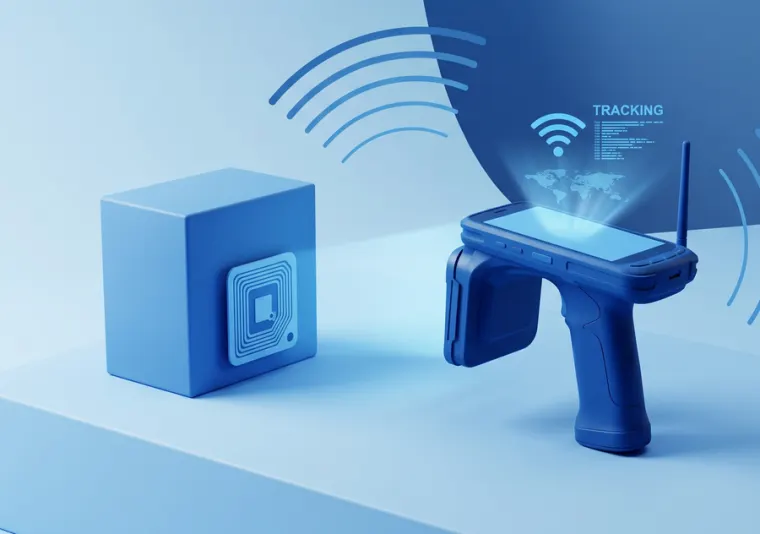
The RFID vs Bluetooth question usually arrives as a feature checklist. On a pallet it comes down to who speaks first. A Bluetooth tag transmits on its own. A passive RFID tag waits for a reader to ask.
In Bluetooth vs RFID tracking for pallets, that single difference decides where each one earns its place.
Choose Bluetooth If
- You Need to Find Pallets IndoorsBluetooth locating systems find pallets inside a building to within meters, and finer with direction finding.
- The Tag Should Speak FirstA Bluetooth tag advertises on a timer, so a gateway or phone hears it without asking.
- You Want Readings Inside the BuildingBluetooth sensor tags report temperature and humidity whenever a listener is in range.
Choose RFID If
- You Count Everything at the DoorPassive UHF RFID reads up to 1,000 items a second without line of sight, by the RAIN Alliance's count.
- You Tag Every Pallet and CaseAt 7 to 15 cents an inlay, every case on every pallet can carry a tag.
- Nobody Wants to Manage BatteriesA passive tag runs on the reader's radio field, with nothing to charge or replace.
So the BLE vs RFID answer for most closed-loop pallet programs is both, at different points. RFID owns the dock door, where cheap tags and fast bulk reads count pallets in and out. Bluetooth owns the building floor, where a tag that speaks first can be found without anyone pointing a scanner at it.
Neither one finds its own way home. Each needs a listener nearby. You can mount a gateway in a trailer you control, but a carrier's truck usually has nothing listening. That gap is where an APS Smart Pallet, with its sensor built in, not bolted on, comes in, and we get to it at the end.
How Bluetooth Tracking & RFID Tracking Work
One Tag Talks, One Tag Answers
Both technologies move data by radio. The difference is power and timing. In Bluetooth tracking, a tag on the pallet, usually battery powered, sends a short message on a schedule to anything listening nearby. In RFID tracking, a reader sends out radio energy and a tag answers with its ID. A passive tag, as the Pentagon's RFID FAQ puts it, "does not have the ability to produce its own radio signal."
| Tag | Power Source | Who Talks First |
|---|---|---|
| BLE beacon | A battery on the tag | The tag, on a timer |
| Passive RFID tag | The reader's radio field | The reader, every time |
| Active RFID tag | A battery on the tag | Either, by design |
Sources: Bluetooth SIG, the Pentagon's RFID FAQ and TechTarget (2022).
Most RFID on pallets is passive UHF, so in the comparisons and scores below, RFID means passive tags unless a line says otherwise.
Bluetooth Low Energy & the BLE Beacon
A Small Battery That Keeps Announcing Itself
Bluetooth is one name for two radios. The Bluetooth SIG's Bluetooth technology overview describes Bluetooth Classic, the standard radio behind wireless speakers and headphones, and Bluetooth Low Energy, which "is designed for very low power operation." LE transmits over 40 channels in the 2.4 GHz band, three of them set aside for advertising, and supports point-to-point, broadcast and mesh connections.
Tracking tags lean on broadcast. A tag sends a short advertising packet on a fixed interval without waiting to be asked: one asset tag datasheet lists a default of one advertisement a second. Gateways, locators and phones set up to listen pass those packets to software.
The SIG says LE now lets one device determine "the presence, distance, and direction of another device." That positioning layer turns a ceiling full of listeners into a locating system.
Passive RFID & Active RFID
Powered by the Reader, or by a Battery
The Pentagon's RFID FAQ draws the line this way: an active tag has its own power source, traditionally a battery, while a passive tag does not have "the ability to produce its own radio signal" and instead passive tags "reflect and modulate a carrier signal received from an interrogator." GS1 says the most broadly implemented tags in its industries are UHF passive tags, also known as RAIN RFID.
Active RFID sits closer to Bluetooth than its name suggests. One active tag built to ISO 18000-7 transmits at 433.92 MHz and is rated to 400 feet outdoors with no obstructions. TechTarget wrote in 2022 that low-energy Bluetooth beacons are "one common implementation" of active tags. We have active vs passive RFID compared tag by tag in an earlier post.
Bottom Line
Bluetooth tags talk. RFID tags answer. Range, battery life and cost all trace back to which side of the radio link carries the power.
Read Range, Gateways & Reader Infrastructure
Every Tag Needs Someone Listening
Ask the Bluetooth SIG how far Bluetooth reaches and it answers: "More than a kilometer. Less than a meter." The longer answer is "it depends," on transmit power, receiver sensitivity, antennas and path loss. One current asset tag is rated at up to 164 feet (50 meters) in open space.
Passive UHF RFID is rated in meters. The RAIN Alliance describes reads from "a few centimeters to several meters," one RAIN chip maker says up to 10 meters, and GS1 says RAIN tags can be read well past 10 meters. Active RFID reaches much further, which is why its maker pitches the tag above for shipping containers and other conveyances.
Range is only half the question. The other half is the listener. A passive RFID read needs a reader and antennas at each point where you want a read. A Bluetooth tag needs a receiver in range, and in the SIG's description of a locating system those are "locators, in fixed locations throughout a facility."
Precision raises the bill. Writing on the SIG's blog in June 2026, a guest author noted that direction finding "needs antenna arrays, more deliberate infrastructure planning, and better calibration discipline." Our pallet technology buyer's guide maps which networks each tracking option depends on.
So after range, ask who owns the listener at each stop. Inside your DC, you do. At a carrier's cross-dock or a customer's dock, you usually do not.
Bottom Line
Range belongs to the pair, not the tag. A tag rated for 50 meters reads at zero meters when there is no gateway or reader in the building.
Battery Life & Tag Cost
Cents at the Door, Years in the Battery
On tag price, passive RFID wins by a wide margin. RFID Journal puts a passive EPC inlay at 7 to 15 cents and active tags generally at $25 and up. TechTarget wrote in 2022 that Bluetooth-based tags cost "as little as one US dollar at the low end."
| Tag | Type | Typical Price |
|---|---|---|
| EPC inlay, chip and antenna | Passive RFID | 7 to 15 cents |
| Hardened or secure passive tag | Passive RFID | A few dollars |
| Bluetooth tag, low end | Bluetooth | About $1 |
| Premium active tag | Active, Bluetooth included | More than $100 |
| Active RFID tag | Active RFID | $25 and up |
Sources: RFID Journal tag cost guide (checked November 2026) and TechTarget (November 2022). Volume, memory and housing move every figure.
Battery life is where Bluetooth pays for speaking first. A passive tag has no battery. A Bluetooth tag's battery sets its working life, and how often it advertises sets the battery. One asset tag datasheet rates the tag at up to 8 years in its default configuration, on two cells that are not replaceable.
Price and battery are two rows of a longer sheet. Below, both are scored out of ten on cost and upkeep, range and infrastructure, and data between reads.
RFID wins cost and upkeep. Bluetooth wins range. Both come up short on data between reads, the group that matters once freight leaves the building.
| Criterion | Bluetooth | RFID |
|---|---|---|
| Cost & Upkeep | 6/10 | 10/10 |
| Tag price in cents | NoAbout $1 at the low end | Yes7 to 15 cents an inlay |
| No battery to replace | NoBattery sets the tag's life | YesPowered by the reader |
| Rugged cased tags sold | YesSold as IP67 | YesHardened, a few dollars |
| Published industry standard | YesBluetooth Core spec | YesGS1 EPC Gen2 |
| Battery-free versions sold | YesEnergy-harvesting tags | YesAll passive UHF tags |
| Range & Infrastructure | 8/10 | 4/10 |
| Rated range past 30 meters | YesRated up to 50 m | NoRated to about 10 m |
| Transmits without a query | YesAdvertises on a timer | NoAnswers when asked |
| Off-the-shelf listeners | YesA gateway or a phone | YesHandheld or fixed readers |
| Longer-range option | YesLE Coded PHY mode | YesBattery-assisted tags |
| No site hardware needed | NoA listener within range | NoA reader at every door |
| Data Between Reads | 6/10 | 4/10 |
| Sensor tags sold | YesTemperature, humidity, light | YesTemperature-sensing inlays |
| Senses with no reader present | YesSenses with no scan | NoOnly when a reader asks |
| Published sensor accuracy | Yes±1.0 C rated | Yes±0.55 C two-point, Magnus S3 |
| Location on the highway | NoOnly if a gateway rides | NoOnly at the next reader |
| In-transit exception alerts | NoSilent when out of range | NoSilent until the next read |
Scoring: two points per Yes, none per No, five rows a group, from the sources cited in this post. Rated ranges are vendors' figures. RFID means passive UHF unless a row says otherwise.
Bottom Line
The cheap tag needs a reader at every door. Passive RFID keeps the tag at cents and puts the hardware at the read point. Bluetooth puts a battery on the pallet and lets gateways listen.
Location Accuracy Inside & Outside the Warehouse
Meter-Level Indoors, Blank on the Interstate
Inside a building, Bluetooth is the stronger locator. The Bluetooth SIG wrote in 2019 that Bluetooth RTLS solutions are used for "locating the position of pallets, forklifts, and workers in a warehouse," at meter-level accuracy from signal strength and "down to centimeter-level" with direction finding. A 2026 guest post on its blog adds that signal strength "drifts because of environmental influence and needs filtering over time."
That makes Bluetooth asset tracking a good fit for which bay or which cooler. The same post says zone-level presence is often enough, citing a returnable container that made it back to the right cell.
RFID locates a pallet by where the reader sits, with tag data captured, in the Pentagon FAQ's words, "at a specific time and place." A portal at door 14 tells you the pallet crossed door 14, and until the next read that is the best answer RFID has.
Outside the building, both go dark for the same reason: the listener stays behind. A Bluetooth tag on a trailer is heard only if a gateway rides along. A passive RFID tag waits for the next reader, which may be two states away. That distance is a job for cellular, such as LTE-M, which the GSMA describes as a low power wide area standard built on the existing LTE network.
The ratings below are ours. They rest on tag cost, rated range, whether a listener is likely to be in range, and whether the tag can sense on its own power.
| Use Case | Bluetooth | RFID |
|---|---|---|
| Dock Door Receiving & Shipping | Workable | Best fit |
| Tagging Every Case on a Pallet | Poor fit | Best fit |
| Finding Pallets Inside a DC | Best fit | Workable |
| Cooler & Facility Monitoring | Best fit | Workable |
| Location & Condition in Transit | Poor fit | Poor fit |
Bottom Line
Each radio answers a different question. RFID answers what crossed this door. Bluetooth answers where it is in this building. Neither answers where the pallet is on the road.
Condition Data From BLE Tags & RFID Tags
Sensing Is Easy. Getting the Reading Out Is Not.
Bluetooth tags can sense between scans. Battery tags run on their own cell, and one maker of battery-free Bluetooth tags says its current generation supports temperature, humidity, light and location sensing from harvested radio energy. The Bluetooth SIG notes that low-power Bluetooth devices can collect "temperature data from cold-chain shipments" and move it into enterprise systems.
One example from the SIG's blog: Steve Statler, CEO of ambientChat.AI, said one of the largest grocery chains in the world uses battery-free Bluetooth tags on pallets moving between its DCs and stores, and found it was "freezing and defrosting strawberries half a dozen times between the distribution center and the store."
RFID can sense too, within the limits of its power. Passive inlays built on the Magnus S3 chip, covered by RFID Journal in 2016, report a temperature "when interrogated by a UHF RFID reader." Battery-assisted passive tags go further: the EU's intellectual property office says their small battery gives them "the ability to run and store information from environmental sensors."
The catch is the same for both. A reading matters only when it reaches someone who can act, so results like the strawberry one depend on listeners along the route. A stored RFID reading waits for the next reader. Our IoT in supply chain statistics post shows how much of today's sensing sits on trailers and containers rather than on the pallet.
Bottom Line
Sensing is the easy half. Getting the reading out is the hard half. A reading that waits for the next dock door can arrive after the strawberries have already thawed.
Dock Door Reads & Where RFID Still Fits
The Dock Door Is RFID's Home Ground
At a dock door, passive RFID is hard to beat. The RAIN Alliance says RAIN systems read up to 1,000 items per second "without direct line-of-sight." RFID Journal's editor wrote in 2009 that UHF tags "provide the read range needed to read a tag on a pallet as it goes through a wide dock door."
The same answer carried a warning. On RF-friendly goods such as apparel, case reads often hit 100 percent. On cases of cans or bottled water, the rate could be about 60 percent, because only tags on the outside of the pallet can be read.
That is RFID doing its own job well, and we use it. APS pallets carry RFID tags for in-DC scanning, as our post on what RFID tracking tells you explains. If a portal at your dock already counts pallets reliably, keep it.
Both technologies do their core job well. The cons below are about scope, not quality.
RFID's strengths cluster at the door and Bluetooth's on the floor. The con they share sits on the highway.
Bluetooth
Pros
- Speaks FirstA tag advertises on a timer, so a listener hears it without a query.
- Finds Pallets IndoorsSignal strength gives meter-level location, and direction finding goes finer.
- Sensors on BoardSensor tags can report temperature and humidity between scans.
Cons
- The Battery Sets the ClockLife runs for years at best, set by the cell and the interval.
- Dollars per TagAbout $1 at the low end, per TechTarget, against cents for a passive inlay.
- Listeners RequiredWith no gateway or phone in range, the tag goes unheard.
RFID
Pros
- Pennies per PalletAt 7 to 15 cents an inlay, every pallet and case can carry a tag.
- Many Reads at OnceUp to 1,000 items a second without line of sight, per the RAIN Alliance.
- Runs on the Reader's FieldNo battery means nothing to charge, swap or dispose of.
Cons
- Meters of RangeRated reads run to 10 meters or a little more, and cans or water can block inner cases.
- Hardware at Every Read PointEach door, conveyor and gate that needs data needs its own reader.
- Quiet Between DoorsA passive tag cannot sense or speak until the next reader powers it.
Bottom Line
Keep RFID where it shines. At the dock door, a cheap tag and a good portal still give the cleanest count. The open question is the hours after the doors close.
Choosing Pallets With Sensors Built In
RFID for the Dock, a Sensor for the Road
This is where we come in, and we have a stake in the answer: APS leases Smart Pallets. Every option above is a tag waiting for a listener you provide. Our answer is to stop depending on that listener.
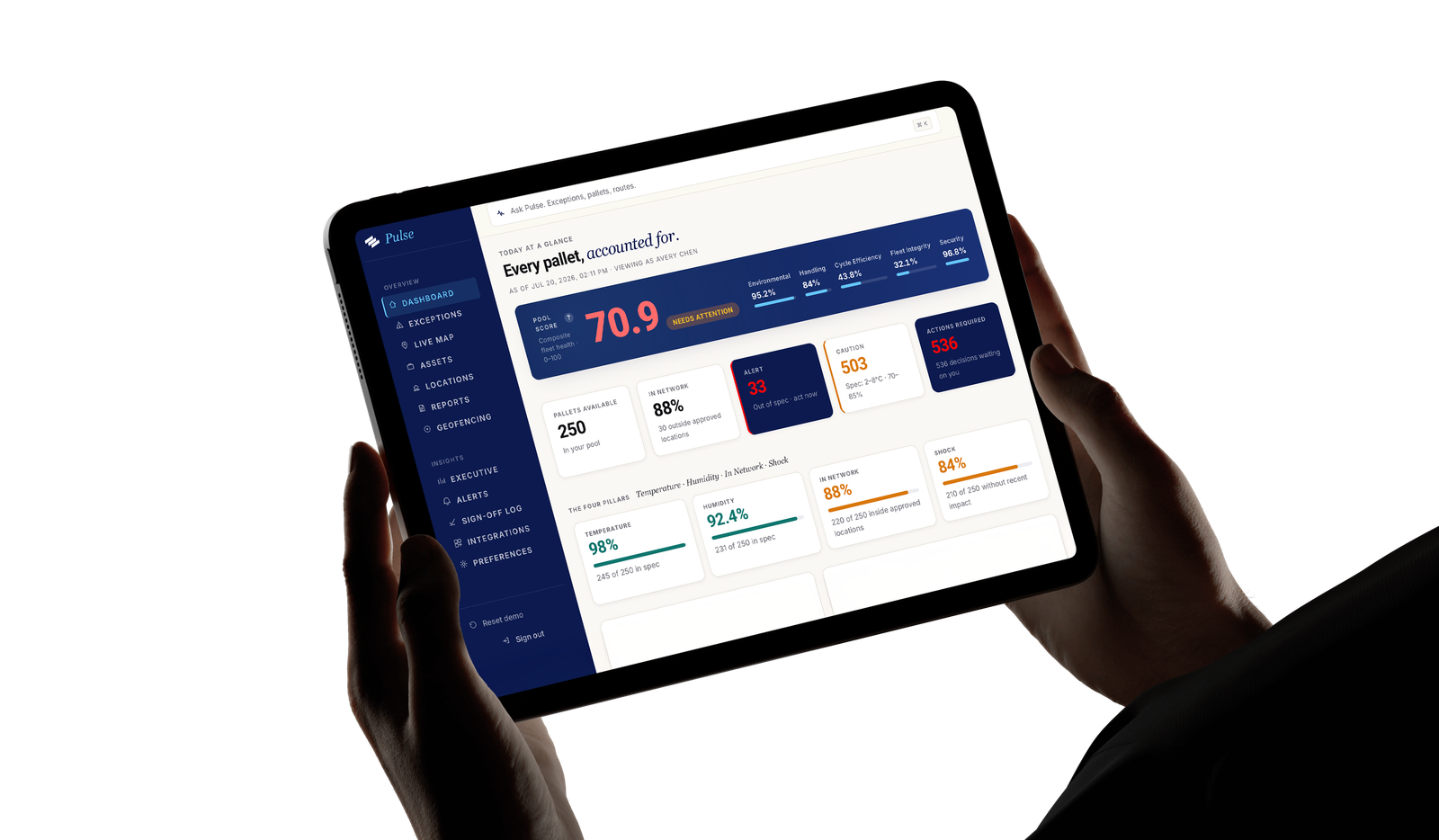
Every APS Smart Pallet carries a sensor built into the pallet, not bolted on, that reports over existing cellular and Bluetooth networks with no fixed readers and no dock hardware. Location, temperature, humidity and shock are the four readings most programs start with, and the module carries more, configured to each program. The pallets also carry RFID tags for in-DC scanning.
The sensor is quiet by design. As we wrote in our Incoterms post, the sensors "don't stream data constantly like a dashcam. They behave more like a smoke detector." When something changes, the pallet reports, and Pulse & the built-in sensor do the rest: Pulse flags the exception and routes it to the right person by push, email or SMS. A missing report is itself a signal, and Pulse flags that too.
When buyers ask how this differs from a tag, our answer is short. RFID gives you an alert or a ping at a read point. A GPS tracker has to be bolted on and set up to connect. A Smart Pallet does condition monitoring out of the box. For iot pallet tracking in a closed loop, this post comes down to four checks:
- Who Listens at Each StopDoes the tag need a reader or gateway at every site, or does it report over networks already there?
- What It Senses on Its OwnWhich readings does it take with no reader present, and what triggers a report?
- What Happens When It Goes QuietA silent tag should raise a flag, or a quiet pallet looks the same as a dead tag.
- How It Is Paid ForWith APS, one flat monthly lease covers the pallet, the sensor and Pulse, with no separate hardware purchase.
Our all-inclusive lease is designed to price at or below what companies are already paying for traditional wood pallet programs, and most partners start with a single lane or a defined pallet count. APS builds programs for closed loops, where pallets cycle between your sites, partners and customers. For freight that never comes back, look for a tracker built for one-way shipments.
Bottom Line
Keep the RFID read. Add what happens between readers. An APS Smart Pallet gives your dock its scan, and reports when something changes between dock doors.
Bluetooth vs RFID FAQ
Quick Answers on Bluetooth & RFID
Three questions come up whenever shippers compare Bluetooth and RFID for pallets. Short answers follow.
Is Bluetooth RFID?
No. Bluetooth is a wireless standard from the Bluetooth SIG in the 2.4 GHz band. RFID is a family of tag and reader standards, with passive UHF tags under GS1's EPC Gen2. They overlap in active tags: TechTarget counts Bluetooth Low Energy beacons as one common type of active RFID.
Is BLE the Same as Bluetooth?
BLE is one of Bluetooth's two radios. The Bluetooth SIG lists Bluetooth Classic, used for audio such as headphones, and Bluetooth Low Energy, designed for very low power operation. Both use the 2.4 GHz band. The SIG says LE is also widely used for device positioning, which is why tracking tags run on it.
How Far Can a Bluetooth Tracker Track?
The Bluetooth SIG puts Bluetooth range anywhere from more than a kilometer down to less than a meter, depending on transmit power, receiver sensitivity and surroundings. One current asset tag is rated at up to 164 feet (50 meters) in open space. Whatever the rating, a Bluetooth tracker is heard only when a gateway or phone is in range, so on the road it reports only where you have put a listener.
Sources
- Bluetooth SIG, "Bluetooth Technology Overview," checked November 2026
- Bluetooth SIG, "Understanding Bluetooth Range," checked November 2026
- Bluetooth SIG, "Bluetooth Direction Finding," checked November 2026
- Bluetooth SIG, "Bluetooth Technology Is Getting Precise With Positioning Systems," 2019
- Bluetooth SIG blog (Lei Liu, Lansitec), "Bluetooth Connectivity in Industrial Facilities: When RSSI Is Enough, When Direction Matters, and When Precise Ranging Pays Off," June 2026
- Bluetooth SIG, "How Battery-Free Bluetooth Tags Help Advance Sustainability Initiatives," September 2026
- Office of the Assistant Secretary of War (Sustainment), "RFID Frequently Asked Questions,," checked November 2026
- GS1, "RFID" (EPC/RFID standards), checked November 2026
- RAIN Alliance, "What Is RAIN," checked November 2026
- Impinj, "How Can RFID Systems Be Categorized?," checked November 2026
- TechTarget, "Active vs. Passive RFID Tags: Which to Choose," November 2022
- RFID Journal, "How Much Does an RFID Tag Cost Today?,," checked November 2026
- RFID Journal, "How Effective Is RFID for Tracking Goods on Pallets?," 2009
- RFID Journal, "SMARTRAC, RFMicron Release Passive RFID Temperature Sensor Technology," 2016
- EUIPO, "Battery-Assisted Passive RFID Tags," Anti-Counterfeiting Technology Guide
- Savi, "Savi License Plate Tag (ST-621) Datasheet," 2018
- Kontakt.io, "Asset Tag 2 Technical Specifications," 2025
- Wiliot, "IoT Pixels," checked November 2026
- GSMA, "Long Term Evolution for Machines: LTE-M," checked November 2026
- Adaptive Pallet Solutions, "Smart Pallet Technology,," checked November 23, 2026
- Adaptive Pallet Solutions, "What RFID Pallet Tracking Actually Tells You (And What It Doesn't)"
- Adaptive Pallet Solutions, "Pallets, Paperwork, and Proof: How Two of the Least Sexy Industries Finally Found Each Other"
Pallet Comparison Articles
Featured Posts From the APS Blog
What RFID Pallet Tracking Actually Tells You (And What It Doesn't)
What gets packaged and sold as smart pallet technology is, in most cases, a ten-cent sticker on a rickety wooden pallet. Here is what passive RFID can and cannot see.
 Rodrigo CastroCo-Founder & President5 min read

Pallets, Paperwork, and Proof: How Two of the Least Sexy Industries Finally Found Each Other
Incoterms decide the exact point where risk transfers from seller to buyer. Almost nobody has the data to enforce what they are supposed to guarantee.
Rodrigo CastroCo-Founder & President6 min read
How a Viral Cargo Theft Made the Case for Smart Pallets
Cargo theft losses across the US and Canada surged 60% to nearly $725 million, with food and beverage hit hardest and automotive supply chains increasingly exposed.
Rodrigo CastroCo-Founder & President5 min read