
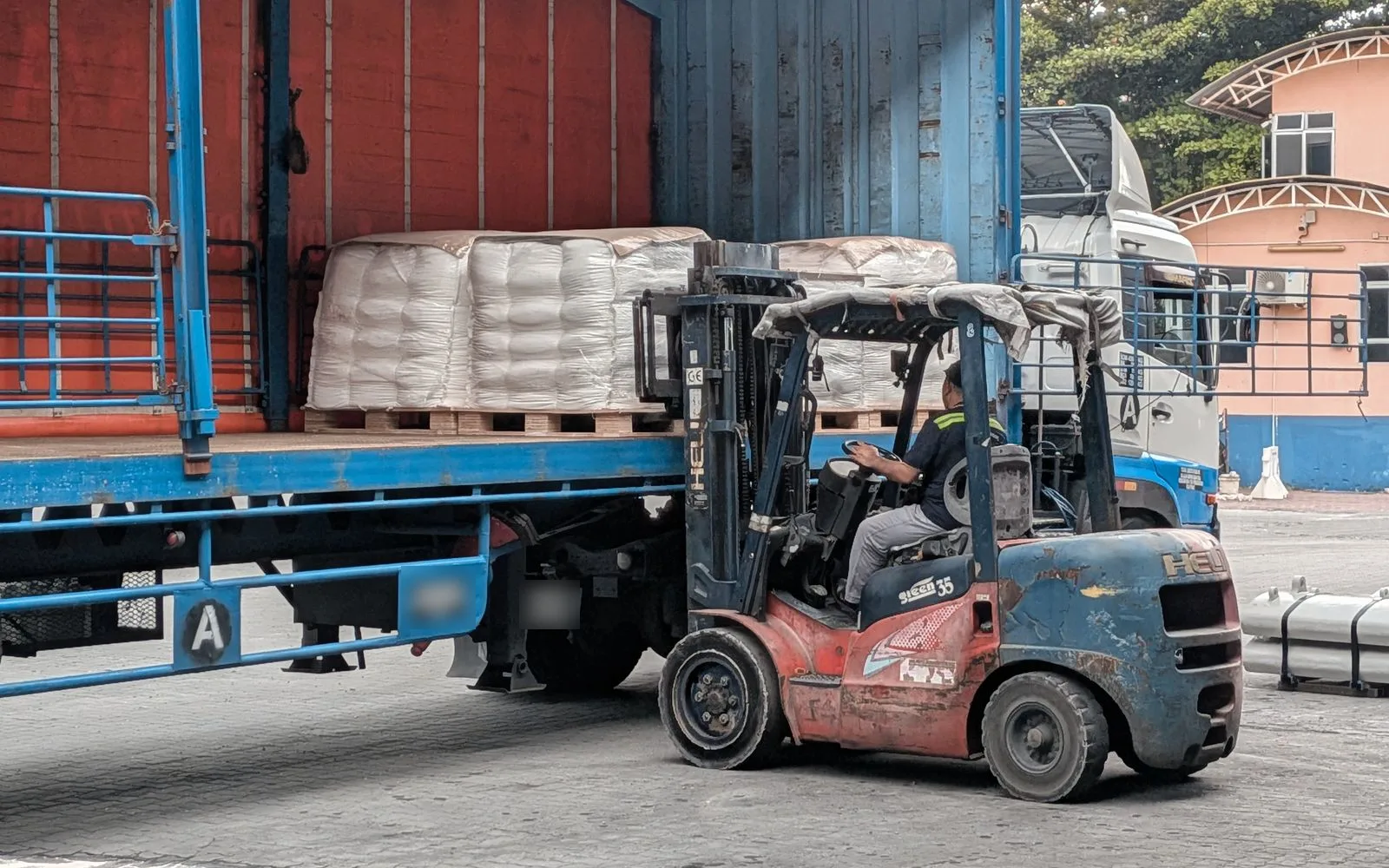
A pallet leaves your dock on a signed bill of lading and arrives two days later with a crushed corner. The receiver says it came in that way. The carrier says it left fine. Your warehouse says it was perfect when it was wrapped. Three parties, one pallet, and nobody holding a record of what happened in between.
That gap is what a chain of custody is supposed to close. In logistics it means a documented, unbroken account of who held a shipment, when, where and in what condition, from the moment it leaves origin to the moment someone signs for it at destination.
This guide walks through the documents that make up that record, the federal rules that decide what happens when a load goes wrong, and the handoffs where custody most often breaks. We make Smart Pallets that report their own condition, so where our product comes up near the end, we say so, and we say what it does not do.
Key Takeaways
- Under the Carmack Amendment, a shipper's case rests on good condition at pickup, damage on arrival and the amount of the loss, as the Supreme Court put it in 1964.
- A damage note on a delivery receipt is not a claim on its own under 49 CFR 370.3. The claim is a separate written demand for a specified or determinable amount.
- Carriers must acknowledge a claim within 30 days and pay, decline or make a firm offer within 120 days (49 CFR 370.5 and 370.9).
- Verisk CargoNet counted 138 fictitious pickups from July through September 2026, about 25% of reported incidents. That is theft at the handoff itself.
- A pallet sensor adds a timestamped condition and location record to the paper chain. It does not replace signatures, seal checks or the bill of lading.
What Is Chain of Custody?
Chain of custody is the chronological record of who controlled something, when they had it and how it passed to the next party. It comes from criminal law, where an unbroken chain is what lets a piece of evidence hold up in court. The standard description of custody records in legal evidence asks for the identity of everyone who handled the item, how long each one held it, and how it was transferred each time it changed hands.
So what is chain of custody when the item is a truckload instead of an evidence bag? Almost nothing changes. A shipment's custodians are the shipper who tendered it, each carrier, cross-dock and warehouse that held it, and the consignee who signed for it. That is the core of chain of custody logistics: every link has to answer who had the load, when control passed, and what condition the freight was in at that moment.
What differs is the question the record has to settle. A court asks whether evidence could have been tampered with. A freight dispute asks something narrower. Where along the route did the loss happen, and whose responsibility was the load at that point? The sales terms and the carrier contract decide who carries the risk at each stage. The custody record decides whether anyone can show which stage the damage happened in.
Key Takeaway
Think of custody as a sequence of handoffs. Each one needs a named party on both sides, a time, a place and a condition, written down at the moment it happens.
Chain of Custody Documentation
It is tempting to picture one document. Chain of custody documentation is really a stack that builds as the load moves: the bill of lading at pickup, seal numbers on the trailer, check-in and scan records at each facility, temperature logs on regulated freight, and the proof of delivery at the end. A chain of custody form ties that stack together, one line per handoff, so anyone reviewing the shipment can follow it without opening five systems.
Federal law sets a modest floor. Under 49 CFR 373.101, a for-hire motor carrier's bill of lading or receipt must show five things: the names of the consignor and consignee, the origin and destination points, the number of packages, a description of the freight, and its weight, volume or measurement where that affects the rate. None of those five fields records condition. None records what happened between origin and destination. That is the space a custody record has to fill.
At the far end sits proof of delivery, the receiver's signature that the load arrived. It closes the chain. It is also where many disputes begin, because a clean signature and a signature with a damage note mean very different things months later.
Chain of Custody Form Fields
A useful form records every handoff the same way, whether it happens at your dock, a cross-dock or a customer's receiving door. These fields cover the questions a claim or an audit will ask:
- Shipment Identity Bill of lading or PRO number, purchase order, and the pallet and piece count tendered. A claim has to contain facts sufficient to identify the shipment, so start there.
- Both Parties The releasing party and the receiving party at each transfer, with the carrier's name and, where your process uses them, driver, tractor and trailer numbers.
- Date, Time & Place When and where control changed hands, with the facility address. A blank in this column is a blank in the chain.
- Seal Number The seal applied at origin, and whether it was found intact or broken at each stop and at delivery.
- Condition at Transfer Pallet count, wrap and visible damage and, for temperature-controlled freight, the reading at the moment of transfer, noted before anyone signs.
- Signatures A signature or electronic acknowledgment from both sides of every handoff.
- Exceptions Any shortage, overage, damage or delay, described in plain words on the document both parties sign.
Proof of Delivery Records
Proof of delivery records are the last link in the chain and the first one a carrier will point to. Under the federal claim framework covered below, the shipper has to show the load arrived damaged. A delivery receipt signed clean, with no exception noted, makes that harder to show for anything that was visible at the door.
A specific exception helps. "Two top-tier cartons crushed on pallet 3, seal intact" tells a claims adjuster far more than "damaged". A note on its own is not a claim, though. Under 49 CFR 370.3(c), notations of shortage or damage on delivery receipts do not, standing alone, meet the minimum filing requirements. The claim is a separate written demand.
Concealed damage is harder still. It surfaces after the driver has left, often after the receiver has signed clean, and the record from the dock door says nothing about it. This is the case where data from inside the trip matters most.
Custody Transfer at Every Handoff
A custody transfer is the moment control of a load passes from one party to another. A pallet moving from a manufacturer to a retailer through a 3PL can change hands at the shipper's dock, a cross-dock, a second carrier and a receiving door. Every one of those moments should capture the same four facts on both sides:
- Count Pallets and pieces counted by both parties, with any difference written down before the signature.
- Condition Wrap, corners and labels checked and, for cold chain loads, a temperature reading taken at the transfer rather than reconstructed later.
- Seal The seal number checked against the bill of lading and recorded as intact or broken.
- Time & Place The date, time and location of the transfer, so the record shows whose custody the load was in at any hour.
The weak spot is the time between handoffs. Paper records what two people saw at a door. It says nothing about six hours on the highway, a night in a drop yard or a delay at a transshipment port. When damage happens in those stretches, the paper chain can show that a load arrived damaged. It cannot show where.
There is also the question of what anyone can actually see. A driver signs for shrink-wrapped pallets, not for the product inside them. As we put it in an earlier post, "The pallet is the one asset in your supply chain that goes everywhere your product goes." On most loads it is also the one asset that crosses every handoff without recording anything.
Where Chain of Custody Breaks
Custody rarely breaks in a dramatic way. It breaks at a handoff nobody wrote down, a signature given in a hurry, or a stretch of road where nothing was recorded. The cost lands in two places: freight claims that cannot be proved, and cargo theft that is discovered too late to act on. For the scale of the second problem, see our cargo theft & pallet loss statistics.
Freight Claims Disputes
Loss and damage claims against interstate motor carriers and freight forwarders run through the Carmack Amendment, 49 U.S.C. 14706, which makes them liable "for the actual loss or injury to the property" they carry under a receipt or bill of lading. The Supreme Court described how such a case is made in Missouri Pacific Railroad Co. v. Elmore & Stahl (1964): the shipper "establishes his prima facie case when he shows delivery in good condition, arrival in damaged condition, and the amount of damages." The burden then moves to the carrier to show it was free from negligence and that the damage came from one of the excepted causes.
Read that test with a custody record in mind. Good condition at pickup comes from the bill of lading and whatever was noted at the shipping dock. Damaged condition at arrival comes from the proof of delivery. The amount comes from invoices. A gap at either end weakens the claim before it is filed.
| Step | Deadline | Rule |
|---|---|---|
| File the claim in writing | Set by the bill of lading, never under 9 months | 49 U.S.C. 14706(e) |
| Carrier acknowledges | Within 30 days of receipt | 49 CFR 370.5 |
| Carrier pays, declines or offers | Within 120 days of receipt | 49 CFR 370.9 |
| Status letters while open | Every 60 days after that | 49 CFR 370.9 |
| Lawsuit window | Never under 2 years from a written denial | 49 U.S.C. 14706(e) |
None of this decides whether a particular claim succeeds. That turns on the bill of lading terms, the carrier's tariff, any limitation of liability and the facts, and your claims counsel is the right person to weigh them. What the rules do decide is what a shipper has to be able to show, and that is a documentation problem long before it is a legal one. As we wrote about Incoterms, "But a framework without evidence is just a starting point for an argument."
Cargo Theft Gaps
Cargo theft has moved toward the handoff itself. Verisk CargoNet estimated cargo theft losses across the United States and Canada at nearly $725 million in 2025, up 60% from 2024, while the average value per theft rose 36% to $273,990. Its outlook for 2026 warned that theft-by-deception groups would focus on "misdirecting shipments tendered to legitimate carriers, sidestepping compliance controls that have traditionally centered on the tendering process itself."
CargoNet describes a fictitious pickup as an incident in which deception is used to obtain a shipment. It counted 138 of them in the quarter, against 147 a year earlier. Through September 2026, estimated losses reached $718.9 million, up 39%, even as reported incidents fell 25%. Thefts are getting fewer and larger. In that quarter, a bigger share of them started at pickup.
A fictitious pickup is a custody transfer to the wrong party. The paperwork can look complete. A driver arrives, signs the bill of lading and leaves, and the chain of custody shows a clean handoff, because on paper it was one. What the paper cannot show is where the load went next. We wrote about one such case, the viral theft that made the case for a pallet that reports its own location.
Keith Lewis, vice president of operations at Verisk CargoNet, put the response plainly: "As the value of the cargo being targeted increases, strong identity verification, shipment visibility and communication across the supply chain become even more important." Identity checks protect the handoff. Visibility covers what happens after it.
Supply Chain Traceability Requirements
Supply chain traceability is the regulated cousin of chain of custody. A custody record follows one shipment. Traceability rules ask a company to follow a product backward and forward through every party that handled it, fast enough to act in an outbreak or a recall. For food and pharma shippers, two US rules set the bar, and one GS1 standard supplies much of the common language.
- FSMA 204 for Food FDA's Food Traceability Rule requires firms handling foods on its Food Traceability List to keep Key Data Elements tied to Critical Tracking Events, including shipping and receiving, and, unless exempt, to give FDA an electronic sortable spreadsheet within 24 hours of a request, or within a reasonable time FDA agrees to, during an outbreak, recall or other public health threat. FDA proposed moving the compliance date from January 20, 2026 to July 20, 2028 (90 FR 38084, August 2025), and Congress then directed FDA not to enforce the rule before that date.
- DSCSA for Prescription Drugs The Drug Supply Chain Security Act outlines steps to achieve, in FDA's words, "an interoperable and electronic way to identify and trace certain prescription drugs at the package level as they move through the supply chain."
- GS1 EPCIS as the Shared Language GS1 describes its EPCIS standard as capturing the "what, when, where, why and how" of products and other assets, with interoperable information about "status, location, movement and chain of custody." Version 2.0 was ratified in June 2022.
What ties these together is speed. A paper chain that takes a week to reassemble does not answer a 24-hour request. For where the industry stands on that, see our logistics visibility statistics.
Be clear about what a pallet sensor does here. It does not read serialized barcodes, generate DSCSA transaction data or create FSMA 204 Key Data Elements, and it does not make a shipper compliant with either rule. What it can add is the physical layer those records leave out: where the pallet carrying a lot was, and what conditions it saw, between the shipping event and the receiving event.
Digital Chain of Custody With Smart Pallets
Going digital keeps the same links as the paper chain and fills in the time between them. This is where our own product comes in, so read this section knowing we make it. APS Smart Pallets are 48 x 40 pallets made from 100% recycled HDPE, with a sensor built into the pallet, not bolted on, leased together with the Pulse platform as one program.
IoT pallet tracking runs from passive RFID reads at a dock door to cellular sensors that travel with the load. RFID is good at what it was built for, confirming that a pallet passed a read point, and APS pallets carry RFID tags for in-DC scanning too. For custody, the open question is what happens between read points.
Our sensors answer it by exception. As we wrote in our Incoterms post, "The sensors embedded in these pallets don't stream data constantly like a dashcam. They behave more like a smoke detector." The pallet stays quiet while conditions are normal and logs a timestamped, geolocated event when it moves, when a reading crosses a threshold, or when a shock exceeds a G-force limit. Location, temperature, humidity and shock are the four readings most programs start with, and the set is configured to the scope of each program. It reports over existing cellular and Bluetooth networks, so there are no fixed readers or dock hardware to install.
APS Pulse exception reporting turns those events into something a team can act on. Pulse flags the exception and routes it to the right person on the right channel, with alerts by push, email and SMS, and connects to the WMS and ERP you already run. If a sensor stops reporting, "A missing report is itself a signal." Pulse flags the gap so someone investigates.
Here is what that adds to a custody record:
- Hours Between Signatures A timestamped, geolocated event whenever a pallet moves or crosses a threshold, so the stretch between two handoffs is no longer blank.
- Condition Tied to Time & Place Temperature, humidity and shock readings recorded with when and where they happened, which is the question a damaged-on-arrival dispute turns on.
- Readings Logged as They Happen Pulse timestamps each reading independently at the moment it happens, rather than having someone enter it after the fact.
- A Record You Can Export As our technology page puts it, "Pulse is your record of custody, condition, and location, available to export or integrate into your own systems at any time."
An illustration from our Incoterms post shows how the pieces fit. A load ships FOB Shanghai, so risk passes to the buyer at loading. The pallet logs stable conditions at departure. Two days later, during a container delay at a transshipment port, it logs a temperature excursion with a time and place. The arrival reading confirms the product is out of spec. Three data points place the excursion after the risk transfer, which tells buyer and seller where the claim belongs.
Honest limits matter here, because custody is a legal idea and a sensor is not a witness. Pulse records sensor exceptions: where a pallet was and what it experienced. It works beside the signatures, driver checks, bill of lading, seal checks and proof of delivery. It does not replace them, and it does not decide a claim. It gives the people deciding one a timestamped condition and location record to set beside the paperwork. And Smart Pallets fit closed loops, where pallets cycle back to you, rather than one-way shipments.
Start With One Lane
Most APS partners start with a single lane or a defined pallet count before scaling. One flat monthly lease covers the pallet, the sensor and Pulse, with no separate hardware purchase and no software license.
Chain of Custody Checklist
Use this list to audit one lane before you change anything. It works with paper, with software or with both.
- Map Every Handoff List each party that takes control of the load between your dock and the customer's, including cross-docks and drop yards you never visit.
- Use One Form Record every transfer on the lane with the same chain of custody form and the same fields at every stop.
- Record Condition Before the Signature Count, check wrap and seal, and write any exception on the document both parties sign.
- Write Exceptions in Plain Words Say what is wrong and where on the load. A vague note helps nobody six months later.
- File POD With the Bill of Lading Keep the signed proof of delivery, exceptions and photos under the shipment number so the whole record comes up in one search.
- Verify the Pickup Confirm the carrier, driver and equipment against what was tendered before the load leaves, given how many thefts now start with a fictitious pickup.
- Cover the Hours in Transit Decide what records the time between handoffs: carrier tracking, a shipment logger, or a pallet that reports its own exceptions.
- Track Claim Deadlines Note the filing window in your bill of lading terms and the carrier's 30-day and 120-day response deadlines for every open claim.
- Test the Record Pick one delivered load and try to answer who had it, when, where and in what condition at every stage. Every blank is a link to fix.
Paper tells you who signed. It cannot tell you what happened in the hours between signatures. An APS Smart Pallet lease adds an independently timestamped condition and location record to every pallet in the program, with the pallet, the sensor and Pulse on one flat monthly lease. If you're curious about what your pallets could be telling you, we'd love to show you.
Chain of Custody FAQ
What Does Chain of Custody Mean in Shipping?
In shipping, chain of custody means a documented, unbroken record of who controlled a load at every point from pickup to delivery, when control changed hands, and what condition the freight was in at each handoff. The bill of lading opens the record, transfer documents and seal checks fill the middle, and the signed proof of delivery closes it.
What Should a Chain of Custody Form Include?
Start with the shipment: the bill of lading or PRO number and the pallet and piece count. For each transfer, a chain of custody form then names the releasing and receiving party and records the date, time, place, seal number and condition. Both parties sign, and any shortage, damage or delay goes on the form before they do.
How Do You Prove Who Damaged a Shipment?
Under the Carmack Amendment, the shipper shows good condition at pickup, damaged condition on arrival and the amount of the loss. The carrier then has to show it was not negligent and that an excepted cause applies. Clean pickup records, a proof of delivery with the exception noted, and timestamped condition data from transit are what a shipper uses to support each step.
Sources
- Wikipedia, Chain of custody
- 49 U.S.C. 14706, Liability of carriers under receipts and bills of lading (Carmack Amendment), Cornell LII
- Missouri Pacific Railroad Co. v. Elmore & Stahl, 377 U.S. 134 (1964), Cornell LII
- 49 CFR 373.101, Motor carrier bills of lading, Cornell LII
- 49 CFR 370.3, Filing of claims, Cornell LII
- 49 CFR 370.5, Acknowledgment of claims, Cornell LII
- 49 CFR 370.9, Disposition of claims, Cornell LII
- Verisk CargoNet, Cargo Theft Losses Surge to Estimated $725 Million in 2025, January 22, 2026
- Verisk CargoNet, Fewer Cargo Thefts, Bigger Losses: Average Theft Value Jumps 72 Percent Year to Date, November 4, 2026
- FDA, FSMA Final Rule on Requirements for Additional Traceability Records for Certain Foods
- Federal Register, Requirements for Additional Traceability Records for Certain Foods: Compliance Date Extension, 90 FR 38084, August 7, 2025
- FDA, Drug Supply Chain Security Act (DSCSA)
- GS1, EPCIS & CBV
- Adaptive Pallet Solutions, Smart Pallet Technology
- Adaptive Pallet Solutions, Pallets, Paperwork, and Proof
- Adaptive Pallet Solutions, California Just Changed the Rules
Featured Posts From the APS Blog
Pallets, Paperwork, and Proof: How Two of the Least Sexy Industries Finally Found Each Other
Incoterms decide the exact point where risk transfers from seller to buyer. Almost nobody has the data to enforce what they are supposed to guarantee.
 Rodrigo CastroCo-Founder & President6 min read

How a Viral Cargo Theft Made the Case for Smart Pallets
Cargo theft losses across the US and Canada surged 60% to nearly $725 million, with food and beverage hit hardest and automotive supply chains increasingly exposed.
Rodrigo CastroCo-Founder & President5 min read
What RFID Pallet Tracking Actually Tells You (And What It Doesn't)
What gets packaged and sold as smart pallet technology is, in most cases, a ten-cent sticker on a rickety wooden pallet. Here is what passive RFID can and cannot see.
Rodrigo CastroCo-Founder & President5 min read