
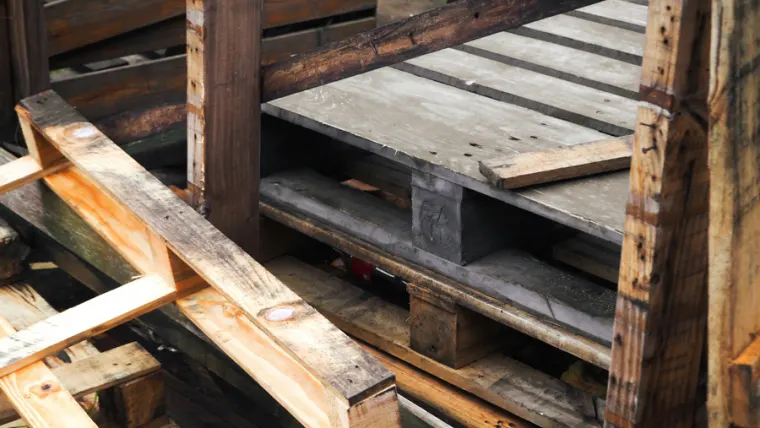
A purchasing manager gets two quotes for recycled 48 x 40 pallets. One says grade A at $25, the other grade B at $20, and the order is for two thousand. Five dollars a pallet is ten thousand dollars, which sounds like an easy call. Then the pallets reach a conveyor, or a customer's receiving dock, or a second trip, and the cheaper grade starts sending back bills of its own.
Grade A vs Grade B Pallets Verdict
Pay for Grade A Only Where It Shows
Grade A pallets and grade B pallets are both recycled 48 x 40 wood pallets. The difference is the repair history: grade A has solid or lightly plated stringers and clean, even deck boards, while grade B has been repaired with plugs or companion stringers and looks it.
The better question is where the pallet goes next: past a customer, into an automated system, or out the door on a one-way trip.
Choose Grade A If
- Customers or Auditors See ItFood, beverage and retail loads where a clean, uniform pallet is part of the delivery.
- Machines Handle ItConveyors, stretch wrappers and automated storage that need consistent boards and stringers.
- It Makes More Than One TripMulti-trip distribution where a stronger starting pallet stays in service longer.
Choose Grade B If
- It Leaves and Never Comes BackOne-way industrial shipments where the pallet is a cost you will not see again.
- It Stays Inside Your WallsInternal moves and floor storage where looks do not matter and a repair does not either.
- Price Is the Deciding LineGrade B lists for less than grade A at the same suppliers, and the gap grows with volume.
For most shippers that makes grade B the default for one-way and internal use and grade A the pick for customer-facing and automated lanes. A third option sits outside the grading system entirely: a durable plastic pallet that does not need grading because it does not get repaired. We cover it after the wood comparison.
Bottom Line
Grade is about history, not size. Both grades are 48 x 40 recycled pallets. You are choosing how much repair you can live with on a given lane.
GMA Pallet Grades Explained
Where the Letters Come From
The GMA pallet is the 48 x 40 inch stringer pallet the Grocery Manufacturers Association standardized for the grocery industry, and it is still the most common footprint in the United States. The pallet history & standards entry on Wikipedia describes it as 48 inch stringers with 40 inch deck boards. For how it compares with other footprints, see our guide to GMA & Euro pallet sizes.
GMA pallet grades are not a federal standard. They are an industry convention for recycled pallets that grew out of the old GMA numbering, and suppliers still use both sets of names. Millwood, one of the largest pallet recyclers, publishes a pallet grading guide that maps its grades straight onto the legacy GMA 1A, 1 and 2 guidelines. That is the closest thing to a common language for grade A vs grade B pallets.
| Legacy GMA grade | Common name | Stringers | Typical use |
|---|---|---|---|
| GMA 1A | Premium, near new | All solid, no repairs | Food, retail, closed loops |
| GMA 1 | Grade A, #1 | Solid or mending plates, no companions | Warehousing, automation |
| GMA 2 | Grade B, #2 | Companion stringers or plugs | One-way and industrial |
Source: Millwood, Pallet Grading Guide, 2026. Grade names and limits vary by supplier.
Treat any pallet grades chart as a starting point. Recyclers set their own tolerances, so a grade A from one yard can look like a grade B from another. Ask for the supplier's written definition before you place a standing order.
What Grade A Pallets Look Like
Little Repair, Even Boards
A grade A pallet, often sold as #1, looks like a used pallet that was built well and treated kindly. In Millwood's guide its stringers are solid or carry mending plates, it has no companion stringer repairs, and its deck boards are uniform and tightly spaced. Millwood's premium tier adds a squareness limit of no more than one inch out of square and at least 60 percent bright wood.
Gruber Pallets, a Minnesota recycler, describes its #1 grade the same way in plainer words: clean, uniform boards, no broken stringers, no visible repairs and minimal wear.
What Grade B Pallets Look Like
Plugs, Companions & Wear
A grade B pallet, often sold as #2, has been fixed. The typical repair is a companion stringer, a new board nailed alongside a cracked one to carry the load, or a plug, a short block fitted against a damaged section. Millwood's grade B allows plugs more than 1 1/4 inches thick and wider deck gaps, with mixed color and visible cosmetic wear.
Suppliers disagree on what the repairs mean for strength. Gruber says both of its grades hold the same load and the difference is looks. Millwood's chart lists the legacy GMA 2 load rating as variable by repair quality and verifies its own grade B for one-way industrial use. If load matters, ask how the supplier rates its grade B.
Bottom Line
The letters describe repairs. Grade A has few or none, grade B has visible ones, and every supplier draws the line in a slightly different place.
Recycled Wood Pallets vs New Pallets
Most 48 x 40s Have Been Around Before
Recycled wood pallets are not a niche. A Virginia Tech and NWPCA study published in BioResources estimated that U.S. companies produced 513 million new wood pallets in 2016 and recovered and sold about 326 million recycled or remanufactured ones. The 48 x 40 dominated the recycled side, at 69 percent of recycled pallets, against 35 percent of new pallets.
New pallets cost more because they are built from fresh lumber to a specific design. Recycled pallets cost less because the lumber and much of the labor are already paid for. The same study found that 38 percent of new wood pallets and 28 percent of recycled pallets were heat treated for export.
| U.S. wood pallets, 2016 | Estimate |
|---|---|
| New wood pallets produced | 513 million |
| Recycled or remanufactured pallets sold | About 326 million |
| 48 x 40 share of new pallets | 35% |
| 48 x 40 share of recycled pallets | 69% |
| New pallets heat treated | 38% |
| Recycled pallets heat treated | 28% |
Source: Gerber, Horvath, Araman and Gething, BioResources, 2020.
So the grade A vs grade B choice is really a choice inside the recycled market, and that market runs on the 48 x 40. If your loads ride on a custom size, you are probably buying new pallets anyway.
Bottom Line
Recycled is the mainstream. Hundreds of millions of 48 x 40 pallets a year are recovered, graded and sold again.
Pallet Prices & Cost per Trip
List Price Is Only the First Line
How much does a pallet cost? It depends on the grade, the quantity and the region, and pallet prices move with lumber markets. There is no free public index for recycled pallet prices, so the clearest picture comes from suppliers that publish list prices.
Upfront Pallet Cost by Grade
Published List Prices
| 48 x 40 pallet | Listed price | Source |
|---|---|---|
| New, heat treated GMA | $49 to $52 each | Uline H-1260 |
| Recycled #1 (grade A) | $27 to $29 each, in 10s | Uline H-750 |
| Recycled #1 (grade A) | $25 each, $12.50 at 260+ | Gruber Pallets |
| Recycled #2 (grade B) | $20 each, $10 at 260+ | Gruber Pallets |
| ISPM 15 stamp on recycled | Plus $3 | Gruber Pallets |
List prices checked November 3, 2026. Delivery not included; truckload quotes are lower.
At list, grade B runs about 20 percent below grade A at the same supplier, and a recycled grade A runs about half the price of a new heat treated pallet. Volume narrows everything: Gruber quotes full truckloads separately and advertises recycled pallets as low as $4.
Repair & Replacement Costs
What a Trip Really Costs
The price per pallet is the smaller number. The bigger one is cost per trip: what you paid, divided by the trips you got before the pallet broke, went missing or failed inspection. A cheaper pallet that breaks sooner can cost more per trip than a better one, and a broken pallet costs more than its replacement when it drops a load or jams a line.
We track those hidden lines, from damaged product to downtime, in hidden costs of wood pallets. By our own figures, white wood pallets last about 3 to 5 trips and pooled wood about 15, which is why repair rate matters as much as purchase price.
Price is one column, so the sheet below scores both grades out of ten on cost, condition and fit for reuse.
The scores are ours, built from the supplier definitions above. Grade B wins on cost, grade A on condition, and neither escapes the repair cycle.
| Criterion | Grade A | Grade B |
|---|---|---|
| Cost | 5/10 | 8/10 |
| Lower list price | No$25 at Gruber, $27 to $29 at Uline | Yes$20 at Gruber |
| Bulk discounts | Yes$12.50 at 260+ | Yes$10 at 260+ |
| Condition & Consistency | 8/10 | 4/10 |
| No companion stringer repairs | YesNone allowed | NoCommon |
| Uniform deck boards | YesTight, even spacing | NoWider gaps allowed |
| Clean appearance | YesBright or mixed wood | NoVisible wear and color |
| Reuse & Compliance | 6/10 | 4/10 |
| Suits multi-trip use | YesWorkhorse for distribution | NoRated for one-way use |
| Export ready by default | NoOnly if ISPM 15 marked | NoOnly if ISPM 15 marked |
| Out of the repair cycle | NoWill be repaired again | NoAlready repaired |
Scores out of 10 are our assessment from Millwood and Gruber grade definitions and list prices, 2026.
Bottom Line
Price per trip beats price per pallet. Grade B saves money up front. Whether it saves money per trip depends on how many trips your lane gets before the next repair.
Used Pallets & Automation Risk
Robots Notice Every Repair
Used pallets were built for forklifts and people, who forgive a lot. Automated systems do not. Conveyors, stretch wrappers, automated storage and robotic depalletizers expect a pallet of known size, flat bottom boards and no protruding nails, and they stop when they get something else.
That is where grade matters most. Millwood lists automated or semi-automated handling among the uses for its grade A, and sets grade B aside for one-way industrial shipping. A companion stringer changes the bottom profile, a plug changes how the stringer sits on a conveyor chain, and a cracked board can catch a roller. By our own figures, wood pallets vary 8 to 10 percent dimensionally, against under 1 percent for our plastic pallets.
| Use Case | Grade A | Grade B |
|---|---|---|
| Conveyors & Automated Storage | Workable | Poor fit |
| Customer-Facing Retail Delivery | Best fit | Poor fit |
| Internal Warehouse Moves | Best fit | Best fit |
| One-Way Industrial Shipments | Workable | Best fit |
| Export Without an ISPM 15 Mark | Poor fit | Poor fit |
The ratings are ours, based on the supplier definitions and the handling issues above. If your building is automating, our checklist on pallet fleet automation prep covers what to measure before the first system goes live.
Bottom Line
Automation narrows the choice. Grade B is a poor bet on a conveyor, and even grade A brings the variation of a repaired wood pallet.
Durable Plastic Pallets as a Third Option
Skip the Grading Altogether
Grading exists because wood pallets degrade and get repaired. Durable plastic pallets take a different path: they are molded to one size, they do not crack, splinter or shed nails, and they are not repaired with mismatched boards, so there is nothing to grade. For the full cost comparison, see our breakdown of plastic vs wood total cost.
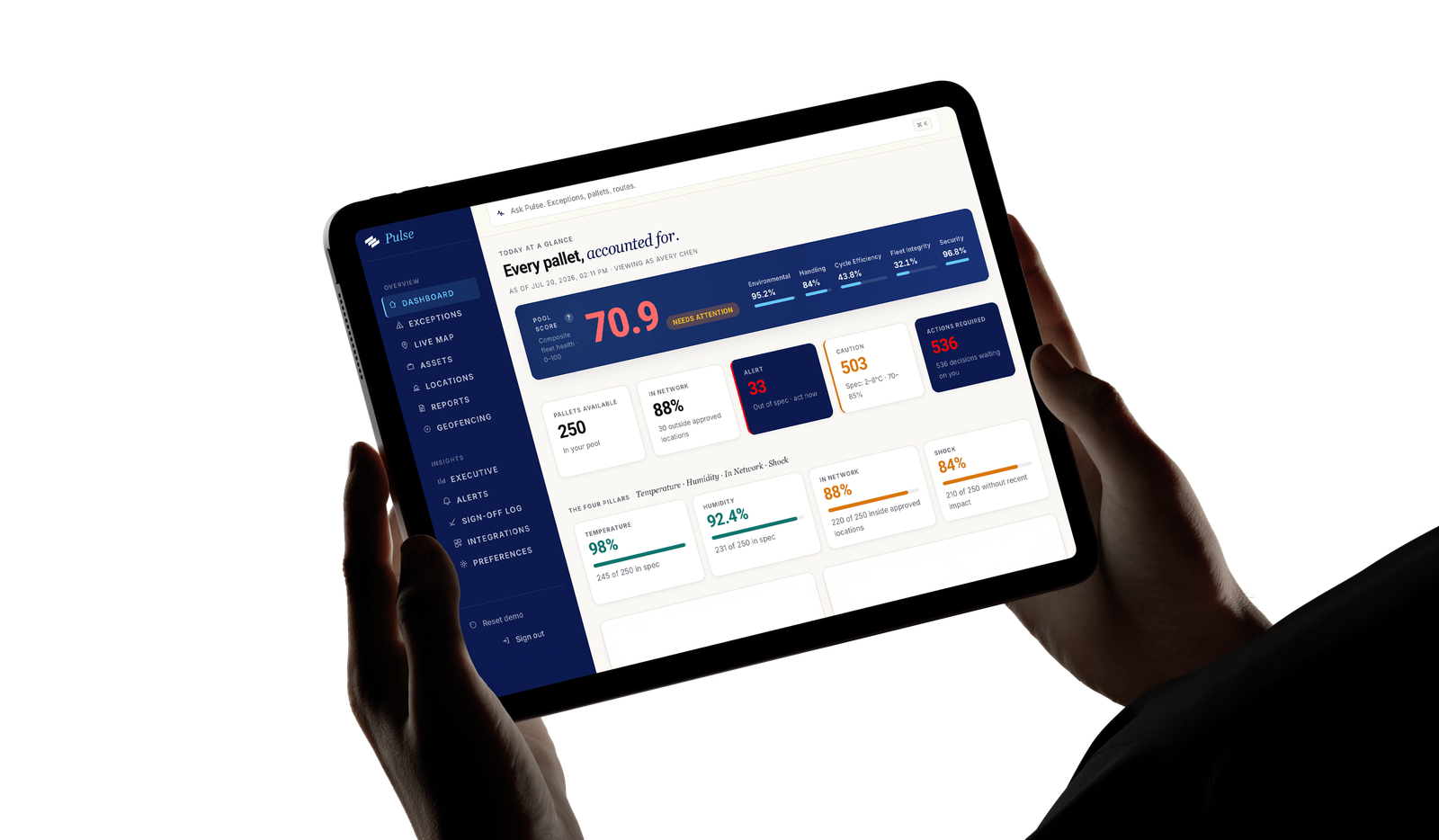
Here is our case, with our own numbers. APS pallets are made from 100 percent recycled HDPE, last roughly 100 to 200 or more trips before recycling, and are dimensionally consistent to under 1 percent. They are ISPM 15 exempt, so export loads need no heat treatment. Each one carries an embedded sensor module with cellular GPS, temperature, humidity and shock, reporting to our Pulse platform. We lease them on an all-inclusive monthly program designed to price at or below what companies pay for wood pallet programs. You can read why APS chose durable plastic pallets on our site.
The honest limit: our pallets run in closed-loop programs. On a one-way lane where the pallet never comes back, a grade B wood pallet is still hard to beat on price.
Bottom Line
No grade, no repair cycle. A durable plastic pallet on a closed loop arrives at trip one hundred the same size and condition it started.
Best Pallet Grade for Your Operation
Match the Grade to the Lane
Both grades do their job. The pros and cons below are about fit, not quality.
Read them against your lanes: who sees the pallet, what handles it and whether it comes back.
Grade A
Pros
- Clean and UniformSolid or plated stringers and even deck boards.
- Suits Automation BetterMillwood lists automated handling among grade A uses.
- Multi-Trip Starting PointFewer repairs at purchase means more life left.
Cons
- Costs MoreAbout 20 percent more than grade B at the same supplier.
- Still WoodIt will crack, splinter and need repair over time.
- Definitions VaryOne yard's grade A is another's grade B.
Grade B
Pros
- Lowest Price$20 each at list, $10 at volume, at one recycler.
- Fine for One WayMillwood verifies its grade B for one-way industrial use.
- Keeps Wood in UseA repaired pallet is a pallet not built from new lumber.
Cons
- Visible RepairsPlugs and companion stringers change the bottom profile.
- Poor Fit for MachinesRepairs and wide gaps raise jam and catch risk.
- Strength VariesLegacy GMA 2 ratings vary with repair quality.
When Grade A Fits
Seen, Scanned or Reused
Choose grade A when the pallet is part of what the customer sees, when it goes through automated handling, or when you expect it to make several trips. Food, beverage and retail distribution are the classic cases.
When Grade B Fits
One Way or Out of Sight
Grade B earns its place on one-way shipments, heavy industrial goods where looks do not matter, and internal storage on the floor. Confirm the supplier's load rating if the loads are heavy.
When Plastic Fits
Lanes That Come Back
Durable plastic pallets make sense when the pallet comes back: closed-loop lanes with regular partners, automated buildings, washdown areas and export lanes where you would otherwise pay for heat treatment every time.
Grade A vs Grade B Pallets FAQ
Quick Answers on Pallet Grades
Three questions come up whenever buyers compare grade A and grade B pallets. Short answers follow.
What Is the Difference Between Grade A & Grade B Pallets?
Both are recycled 48 x 40 wood pallets. Grade A, or #1, has solid or plated stringers, no companion stringer repairs and clean, uniform deck boards. Grade B, or #2, has been repaired with plugs or companion stringers and shows more wear. Grade B costs less; at one Minnesota recycler, $20 against $25 at list.
How Long Does a Grade B Pallet Last?
There is no published trip count by grade. Grade B pallets are usually sold for one-way or internal use, and Millwood verifies its grade B for one-way industrial shipping. By our own figures, white wood pallets in general last about 3 to 5 trips and pooled wood about 15, so a repaired pallet should not be counted on for many more.
Are Grade A Pallets Heat Treated?
Not by default. A recycled pallet is export ready only if it carries a valid ISPM 15 mark, and a 2016 industry study found only 28 percent of recycled pallets were heat treated. Some recyclers add an ISPM 15 stamp for a fee, about $3 at one. Replacing more than about a third of a pallet's parts requires re-treatment under ISPM 15.
Sources
- Millwood, Pallet Grading Guide: Reliable 48x40 Recycled Pallet Standards, 2026
- Gerber, Horvath, Araman and Gething, Investigation of New and Recovered Wood Shipping Platforms in the United States, BioResources, 2020
- Gruber Pallets, Recycled Wood Pallets, list prices checked November 3, 2026
- Uline, Recycled Wood Pallet 48 x 40 (H-750), checked November 3, 2026
- Uline, Heat Treated Wood GMA Pallet 48 x 40 (H-1260), checked November 3, 2026
- IPPC, ISPM 15: Regulation of Wood Packaging Material in International Trade, 2018
- Wikipedia, Pallet
Pallet Comparison Articles
Featured Posts From the APS Blog
The Pallet Is Costing You More Than You Think
You have invested millions in automation and you track labor, freight and energy to the decimal. Somewhere on your dock, a wooden pallet is about to stop the line.
 Rodrigo CastroCo-Founder & President10 min read

Milk Jugs, Snowboards, and Shampoo Bottles: Your Next Pallet Has Had a Past Life
Every APS pallet is 100% recycled HDPE, sourced from across the recovery stream. Bottles, containers, industrial scrap, melted down into a platform that survives a decade of forklifts.
Rodrigo CastroCo-Founder & President3 min read
Stuck in the 20th Century: Neil Armstrong, iPhones, and Pallets
80% of global goods touch a pallet at some point. How can an asset that fundamental to modern trade have changed so little since 1969?
Rodrigo CastroCo-Founder & President3 min read