
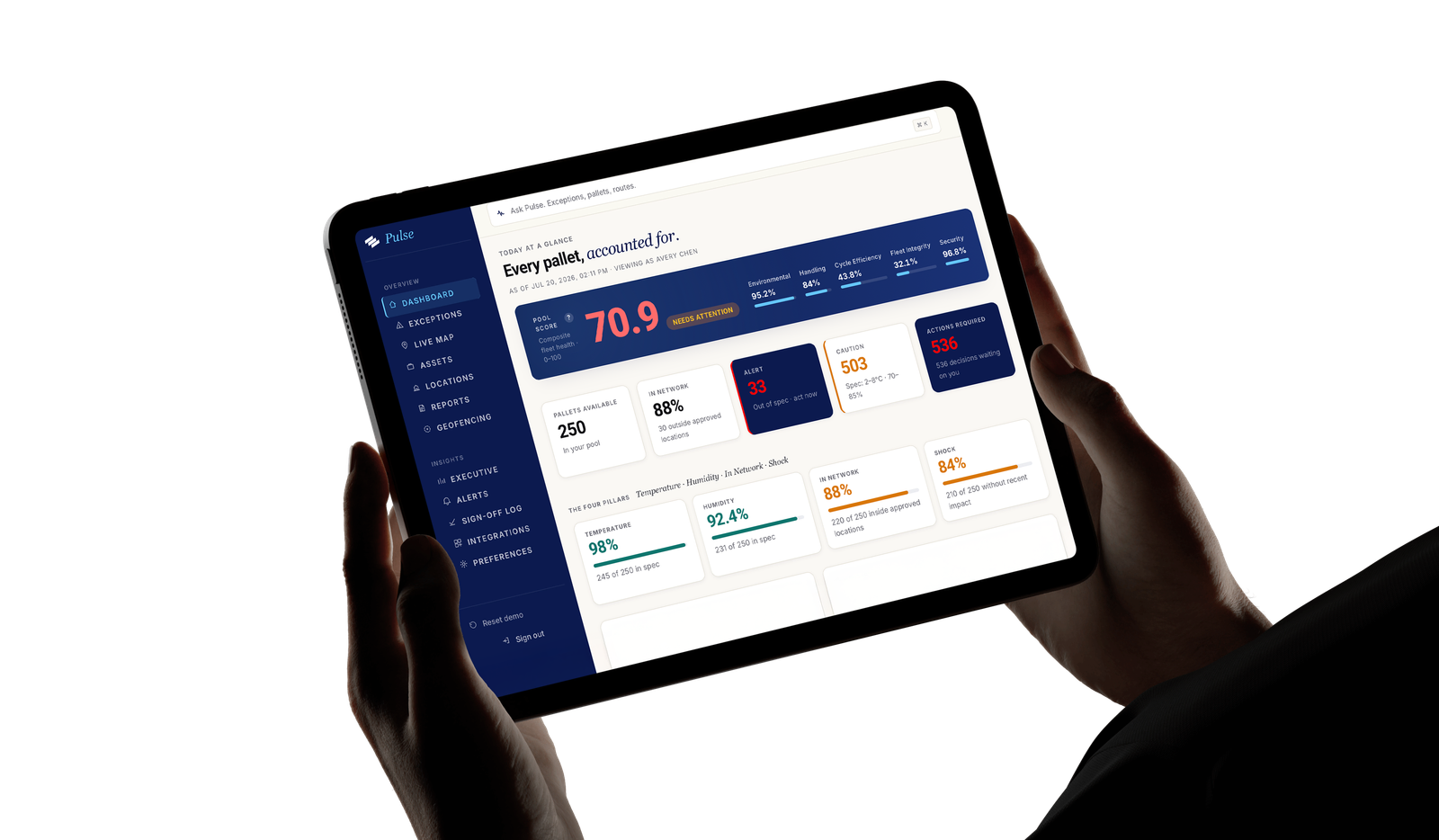
A pallet leaves your plant under a load of finished goods. In an open loop, that is the last you see of it. The receiver keeps it, swaps it or holds it for a pooler. In a closed loop, the same pallet comes back on a return trailer and goes out again. The footprint is identical. The economics are not. The loop decides how many pallets you buy, who pays when one disappears and whether the pallet can ever tell you anything.
Open Loop vs Closed Loop Pallets Verdict
Run the Loop Your Lanes Already Draw
The open vs closed loop pallets decision is really a question about your lanes. Freight that goes one way to thousands of receivers suits an open loop. Freight that cycles between plants, DCs and customers you can name already has a return trip, and a closed loop puts it to work.
We run a closed-loop leasing program, where one flat monthly lease covers the pallet, the sensor and Pulse, so we have a stake in the answer. We show the work, including where an open loop is the better call.
Choose Closed Loop If
- Your Lanes RepeatEmpties can ride back on trucks already making the trip.
- Lost Pallets Have to StopYou want each missing pallet tied to a site, not rebought.
- You Need to Choose the PalletAutomation or washdown sets the spec.
- You Want a RecordYou need condition data from the pallet, and a sensor only pays back on a pallet that comes home.
Choose Open Loop If
- Your Freight Ships One WayLoads go to receivers you cannot name and will never visit.
- Your Volume Is IrregularSeasonal or one-off shipments do not justify a fleet or a return lane.
For repeating lanes, the closed loop wins on what costs money year after year: fewer pallets bought, visible losses, a pallet you specify and data that comes back. The open loop wins on reach. Plenty of networks run both.
Bottom Line
Follow the return trip. If empties already come back to you, a closed loop turns that trip into fewer pallets bought and fewer pallets lost.
What Open Loop & Closed Loop Mean for Pallets
Where the Pallet Goes After Delivery
In an open loop supply chain, pallets travel from one or many shipping points to many destinations, and the shipper does not get the same pallets back. In a closed loop supply chain, pallets cycle between a defined set of sites and return to where they started. The Reusable Packaging Association's 2010 primer puts it in one line: reusable containers and pallets "return empty to their original starting point (reverse logistics) to begin the entire process again."
Closed loop logistics is the work that makes the return happen: collecting, counting, inspecting and repairing empties. Guide, Harrison and Van Wassenhove wrote in Interfaces in 2003 that closed-loop supply chains "differ significantly from forward supply chains in many aspects." For every program model, see our closed-loop pallet program guide.
Open Loop Supply Chain Flows
Many Origins, Many Destinations
Open loops have no fixed return path. A plant ships to a retailer's DC, the load is broken down, and the pallet moves on to the DC's outbound freight, a recycler's yard or a pooler's network. The RPA notes that open-loop shipping systems "often require the assistance of a third-party pooling management company to accomplish the more complex return of empty transport packaging."
So open loops run on shared standards, and the shipper takes whatever an exchange returns or a pool issues.
Closed Loop Supply Chain Flows
Known Sites & a Return Trip
Closed loops have a fixed set of nodes. Pallets go from a plant to a DC, or a supplier to an assembly line, and the empties come back on the return leg. Automotive is the classic case. As our home page puts it, "When the loop breaks, the cost is not a late shipment, it is a stopped line."
The RPA says supporting that return "requires processes, resources and an infrastructure to track, retrieve and clean reusable containers." Some companies build it themselves and others outsource it. Either way, the loop pays only when the pallets come back.
The sheet scores both loops out of ten in three groups.
The open loop takes setup and reach. The closed loop takes the two groups that decide how many pallets you buy each year.
| Criterion | Closed Loop | Open Loop |
|---|---|---|
| Setup & Reach | 2.5/10 | 10/10 |
| Ships to unknown receivers | NoKnown sites | YesGoes anywhere |
| No return lane needed | NoEmpties must come back | YesPallets can end anywhere |
| Little planning to start | NoLanes and fleet sized first | YesOrder pallets and ship |
| Each pallet gets reused | YesSame pallet, many trips | YesReused by pools, too |
| Recovery & Loss | 10/10 | 2.5/10 |
| Pallet returns to the shipper | YesBack to its starting point | NoGoes elsewhere |
| Recovered from known sites | YesSites on your list | NoMany receivers |
| No pallet ledger to balance | YesThe fleet comes home | NoLedger swaps |
| Outside help with collection | YesLessor or you | YesPools collect |
| Pallet & Data | 10/10 | 2.5/10 |
| Shipper sets the pallet spec | YesSpecified for your loop | NoPool or exchange sets it |
| Loss traced to a site | YesFew handoffs to check | NoSpread across many hands |
| Pallet data comes back | YesSame sites every cycle | NoPallet leaves your network |
| Inspected and repaired | YesChecked on each return | YesPools inspect and repair |
Scoring: 2.5 points per Yes, none per No, four rows a group. Marks are our reading of each loop, from the sources in this post. One way pallets are the exception on pallet spec, since the buyer picks them. A specific program can differ.
Bottom Line
The loop is about the return trip. Open loops hand the pallet off at delivery. Closed loops plan for it to come back.
Pallet Exchange, Pallet Pooling & One Way Pallets in an Open Loop
Three Ways to Run an Open Loop
Open loops come in three forms, and many shippers use more than one. In the Pallet Report 2024, a Modern Materials Handling and Peerless Research Group survey of 174 readers, 70% acquired used or core wood pallets, 17% used a pallet pool and 14% used a pallet rental company.
- One Way PalletsYou buy a pallet, ship it and never see it again. The cost is a purchase price on every load.
- Pallet ExchangeYou deliver on a standard pallet and the receiver hands back an equal number of empties. Everyone owns whatever sits in their yard.
- Pallet PoolingA pooler owns a shared fleet. You rent pallets, ship them into its network, and a rental service picks up the empties and returns them "to service centers for inspection and repair," in the RPA's words.
Pallet exchange has a long record of complaints. A 2008 Italian study of seven 3PL operations running one-for-one Euro pallet exchange, reported by Pallet Enterprise, found non-recovered pallets as high as 10% in one case and costs to the 3PL of $1.19 to $1.86 per trip. A 2000 Pallet Enterprise report cited a poultry logistics director who said exchange policy "often is determined by the size and appearance of a truck driver."
Pallet pooling gives the fleet one owner, but the count stays on your desk. Pallet poolers "may charge for pallets that have been lost or stolen," Modern Materials Handling noted in 2010. For how the big pools bill, see our post comparing pallet supply models.
Pallet Loss & Who Pays for It
Every Loop Leaks. The Question Is Where.
Pallets disappear in every system: stolen with loads, kept by receivers, sold to recyclers or lost in a yard. Verisk CargoNet put estimated cargo theft losses across the United States and Canada at nearly $725 million in 2025, a 60 percent increase from 2024, and when a palletized load is stolen its pallets go with it. Our cargo theft & pallet loss statistics collect the wider numbers.
Reusable assets leak too. Keith Schall of a container pooling company wrote in Material Handling & Logistics in 2012 that a Reusable Packaging Association loss survey was seeing loss rates "from single digits in the automotive industry to as high as 40% in other markets."
| Model | Who Absorbs a Lost Pallet | Where It Shows Up |
|---|---|---|
| One way pallets | You, on every load | The purchase price of each shipment |
| Pallet exchange | Whoever comes up short | Replacement buys and ledger disputes |
| Pallet pooling | The account holder, per contract | Lost pallet charges, where the contract has them |
| Owned closed loop | You, as fleet owner | A shrinking fleet count |
| Leased closed loop | Set by the lease | The terms you agreed with the lessor |
Our summary of how each model assigns loss. Contract terms vary, so read your own.
A 2009 Pallet Enterprise article on rental programs put it bluntly: "all rental pallet programs are self-managed with emphasis on the self."
In a closed loop, the sites are known, so a missing pallet has a short list of places to be. That does not make loss disappear. It makes it findable.
Bottom Line
Loss you can see is loss you can fix. A closed loop narrows a missing pallet to a handful of known sites instead of the whole market.
Cost Per Trip in Each Loop
Divide by the Trips You Actually Get
Unit price is the wrong number. The honest unit is cost per trip: the pallet plus recovery and repair, divided by the trips it completes. The Reusable Packaging Association says reusable pallets and containers offer "a lower cost-per-trip than single-use packaging products." That holds only when the trips happen.
The research is less one-sided than either camp admits. Roy, Carrano, Pazour and Gupta compared single-use pallets, buy/sell programs and leased pooling in Transportation Research Part E in 2016. In their base case, "the single-use expendable pallet approach presents the least cost of all strategies," leased pooling beat buy/sell programs on total cost, and the answer shifted with costs, fees and retention rates. Retention is what a closed loop is built to control.
Loss caps the trip count. With a fixed chance of loss on each trip, a pallet can never average more than 1 divided by that loss rate in trips, however many it was built for. The table works it through for reusable pallets built for 100 trips.
| Loss Per Trip | Average Trips Completed | Pallets Left After 100 Trips |
|---|---|---|
| 0.5% | 79 | 61% |
| 1% | 63 | 37% |
| 2% | 43 | 13% |
| 5% | 20 | Under 1% |
| 10% | 10 | Under 0.1% |
Illustration, not data. Our arithmetic for a pallet built for 100 trips, with a constant loss rate per trip and no other retirement. Average trips equal 1 minus (1 minus the loss rate) to the 100th power, divided by the loss rate.
At 10% per trip, a 100-trip pallet averages about 10. The 2008 exchange study's worst case was 10% of pallets not recovered, though the report does not say over what period. By our own figures, white wood lasts about 3 to 5 trips and our recycled HDPE pallets roughly 100 to 200 or more. That life only lowers cost per trip inside a loop that keeps the pallets.
Bottom Line
Durability is only worth what you keep. A pallet built for 100 trips and lost after 10 costs like a pallet built for 10.
Tracking & Pallet Recovery
You Cannot Recover What You Cannot Find
Pallet recovery means collecting empties, sorting and counting them, and repairing what is damaged. Modern Materials Handling noted in 2010 that for companies with their own pallet pools, an accurate count reduces spending on new pallets.
Counting starts with identity. The GS1 returnable asset identifier, or GRAI, is built for this. GS1 calls it "especially suitable for the management of reusable transport items" and says it can identify returnable assets "by type and if needed also individually for tracking and sorting purposes." An ID tells a reader which pallet passed. It cannot say where the pallet went next.
In an open loop, an identified pallet leaves your network, so its reads happen at someone else's doors, if at all. In a closed loop, the same pallets pass the same sites every cycle, so every missing read means something. Schall's 2012 article gives the practical version: an alert that "reusable pallets have been sitting at a supplier's site for 90 days" lets you give the supplier 10 days to return them before they are billed for loss.
Our pallets carry RFID tags for in-DC scanning plus a sensor built into the pallet, not bolted on, that reports over existing cellular and Bluetooth networks. RFID confirms a pallet passed a reader. The sensor covers the hours between readers, and "a missing report is itself a signal," so a pallet that stops reporting gets flagged for you to investigate.
Bottom Line
Every read counts in a closed loop. The same pallets pass the same sites, so a missing one shows up long before the audit.
Returnable Packaging & Reverse Logistics
The Return Trip Is a Supply Chain Too
Pallets in a closed loop are one kind of returnable packaging. The RPA sets four requirements for packaging to count as reusable. One is that "during its useful life, the packaging is repeatedly recovered, inspected, repaired if necessary, and reissued into the supply chain for reuse."
The work that moves empties back is reverse logistics. Rogers and Tibben-Lembke defined it in the Journal of Business Logistics in 2001 as the flow of materials, goods and information "from the point of consumption to the point of origin for the purpose of recapturing or creating value or proper disposal."
For pallets, that flow has a price: the backhaul, the sort, the repair bench and the count. A closed loop pays it on purpose and gets its pallets back. An open loop pays part of it through pool fees or exchange ledgers and loses the rest as shrink. Our reusable packaging recovery statistics show how recovery rates vary by system.
Where an Open Loop Still Fits
Honest Cases for Letting Pallets Go
For some networks, the open loop is the right answer. If your freight goes one way to thousands of stores or distributors, a pool, an exchange or a one way pallet does recovery work you cannot do yourself.
Low or irregular volume points the same way. A closed loop needs a fleet sized to your cycle time, and a few loads a quarter will not keep it busy. One-off export loads are open loop by nature. ISPM 15 heat treatment and stamping apply to wood packaging material, and plastic pallets sit outside that regime.
The ratings are ours. They rest on two questions: will empties come back to a site you control, and must the shipper choose the pallet?
| Network | Closed Loop | Open Loop |
|---|---|---|
| One-Way Retail Distribution | Poor fit | Best fit |
| Low-Volume or Seasonal Lanes | Poor fit | Best fit |
| Plant-to-DC Repeating Lanes | Best fit | Workable |
| Just-in-Time Parts Loops | Best fit | Poor fit |
| Washdown & Cold Chain Lanes | Best fit | Workable |
Neither loop is a mistake. Each suits a different shape of network.
Read the cons as limits of fit. The closed loop's two are why a program starts with an assessment of your lanes.
Closed Loop
Pros
- Pallets Come BackYou stop buying pallets for every load.
- Loss Narrows to Known SitesA missing pallet has a short list of places to be.
- You Choose the PalletOne pallet spec, picked for your automation and washdown, on every trip.
- Data Comes HomeAny tag or sensor on the pallet keeps coming back through your sites.
Cons
- Needs Return LanesWithout regular returns, the fleet drains away.
- A Fleet to Size & RunSomeone plans size, collection and repair, in-house or via a lessor.
Open Loop
Pros
- Reach Without RecoveryFreight goes anywhere, and the receiver or pool handles the empty.
- Little SetupNo fleet to size and no return lane to plan.
- Cheapest in Some CasesA 2016 study found single-use pallets cheapest in its base case.
Cons
- Shrink Nobody OwnsNon-recovered pallets reached 10% in one of seven cases in a 2008 exchange study.
- Quality You Do Not ChooseYou take whatever pallet comes back.
- Ledgers & Lost Pallet ChargesExchange runs on pallet ledgers, and poolers may charge for lost pallets, as Modern Materials Handling noted in 2010.
Bottom Line
Split networks are normal. Put repeating lanes in a closed loop and leave one-way freight to an open one.
Leasing Durable Plastic Pallets for a Closed Loop
A Closed Loop Without Owning the Fleet
Every closed loop has one hard part: someone has to own the fleet, run recovery and replace what breaks. APS designs and manages custom pallet leasing programs for closed-loop partners. One flat monthly lease covers the pallet, the sensor and Pulse. Retrieval, repair and recycling stay on our side of the fence, including at sites you do not operate directly.
- The PalletThe APS 48 x 40 Smart Pallet is 100% recycled HDPE. Its spec sheet rates it at 30,000 lbs static, 5,000 lbs dynamic and 2,800 lbs racked, and lists it as ISPM 15 exempt with a 10x longer lifespan than wood.
- The SensorBuilt into the pallet, not bolted on. Most programs start with location, temperature, humidity and shock, configured to the scope of your program.
- The ReportingThe pallet reports the moment something changes, and Pulse flags the exception and routes it to the right person.
- The End of LifeIn our words on the Why Plastic page: "When a pallet reaches end of life, we take it back. That is not a sustainability claim. It is a contractual commitment baked into how we operate."
Durable plastic pallets earn their keep here for the reason the cost table shows. For the material case, read why APS uses durable plastic pallets. Our all-inclusive leasing model is designed to price at or below what companies are already paying for traditional wood pallet programs, and most partners start with a single lane or a defined pallet count before scaling.
Bottom Line
Lease the loop and keep the control. You choose the lanes and see the exceptions. We own, recover and retire the fleet.
Open Loop vs Closed Loop Pallets FAQ
Quick Answers on Open & Closed Loop Pallets
Three questions come up whenever shippers compare open and closed loop pallets. Short answers follow.
What Is the Difference Between Closed Loop & Open Loop?
In a closed loop, pallets cycle between a defined set of sites and return to where they started, so the same pallets carry load after load. In an open loop, pallets travel to many destinations and the shipper does not get the same ones back.
What Is an Open Loop Supply Chain?
An open loop supply chain moves products or packaging from one or many origins to many destinations with no fixed return path to the sender. For pallets, that means one way pallets, pallet exchange or a rental pool. The Reusable Packaging Association notes that open-loop systems often need a pooling company to handle the return of empties.
Which Is Better, Open Loop or Closed Loop?
Neither is better everywhere. A closed loop is usually stronger when most freight repeats between sites you can name, because pallets come back and losses narrow to known sites. An open loop fits one-way freight and irregular volume. Many shippers run both, and APS leases closed-loop fleets for the repeating lanes.
Sources
- Reusable Packaging Association, "Reusables 101: Defining Reusable Transport Packaging and Its Applications," 2010
- Reusable Packaging Association, "What Is Reusable Packaging?," 2020
- GS1, "Global Returnable Asset Identifier (GRAI)," checked November 2026
- Guide, Harrison and Van Wassenhove, "The Challenge of Closed-Loop Supply Chains," Interfaces, 2003
- Roy, Carrano, Pazour and Gupta, "Cost-Effective Pallet Management Strategies," Transportation Research Part E, 2016
- NC State Supply Chain Resource Cooperative, "The Increasing Necessity for Reverse Logistics" (citing Rogers and Tibben-Lembke, Journal of Business Logistics, 2001), 2004
- Modern Materials Handling / Peerless Research Group, "The Pallet Report 2024: Exploring the Options," 2024
- Modern Materials Handling (Bob Trebilcock), "Getting the Most From Your Own Pallet Pool," 2010
- Pallet Enterprise, "Markets in Transition: Lost in Translation," 2008
- Pallet Enterprise, "Pallet Exchange: How Big, Ugly, Is Your Truck Driver?," 2000
- Pallet Enterprise, "Pallet User Education Series: Smart Management Techniques to Avoid Lost Pallet Charges," 2009
- Material Handling & Logistics (Keith Schall), "Make Reusable Assets Show Returnable Value," 2012
- Verisk, "Cargo Theft Losses Surge to Estimated $725 Million in 2025, Verisk CargoNet Analysis Reveals," 2026
- Adaptive Pallet Solutions, "The Adaptive Pallet, Model 48x40" spec sheet, 2026
- Adaptive Pallet Solutions, "Smart Pallet Technology," checked November 2026
- Adaptive Pallet Solutions, "Why Plastic," checked November 2026
- Adaptive Pallet Solutions, home page and FAQ, checked November 2026
- IPPC, "ISPM 15: Regulation of Wood Packaging Material in International Trade," checked November 2026
- Adaptive Pallet Solutions, "Sustainability," checked November 2026
- Adaptive Pallet Solutions, "Automotive" industry page, checked November 2026
- Adaptive Pallet Solutions (Rodrigo Castro), "The Pallet Is Costing You More Than You Think"
Pallet Comparison Articles
Featured Posts From the APS Blog
The Pallet Is Costing You More Than You Think
You have invested millions in automation and you track labor, freight and energy to the decimal. Somewhere on your dock, a wooden pallet is about to stop the line.
 Rodrigo CastroCo-Founder & President10 min read

How a Viral Cargo Theft Made the Case for Smart Pallets
Cargo theft losses across the US and Canada surged 60% to nearly $725 million, with food and beverage hit hardest and automotive supply chains increasingly exposed.
Rodrigo CastroCo-Founder & President5 min read
What RFID Pallet Tracking Actually Tells You (And What It Doesn't)
What gets packaged and sold as smart pallet technology is, in most cases, a ten-cent sticker on a rickety wooden pallet. Here is what passive RFID can and cannot see.
Rodrigo CastroCo-Founder & President5 min read