
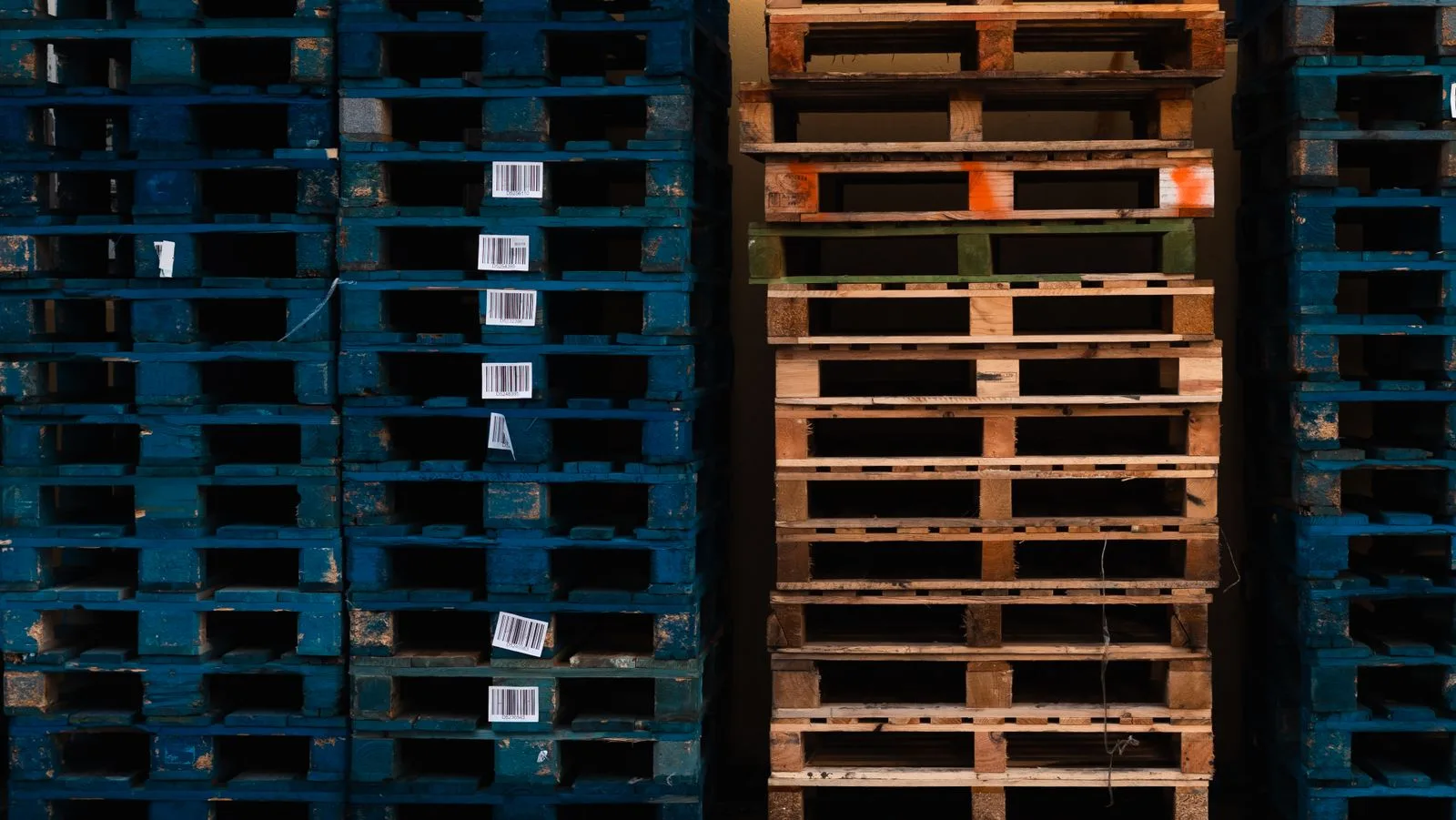
A shipping clerk builds a quote for a load of bottled water. The product weight is exact to the pound. The pallets go in as a round guess, 26 of them at whatever number someone remembered, and the truck scales over the limit at the first weigh station.
Pallet weight is one of those numbers everyone uses and few people check. This guide collects published empty weights for wood, pooled and plastic pallets, explains what static, dynamic and racking capacity actually mean, and shows where pallet weight turns into freight cost.
We make plastic pallets, so where our own figures appear we say so. Everything else comes from manufacturer specifications and public sources you can check.
Key Takeaways
- Published weights for real 48 x 40 pallets run from 14 pounds for a light plastic pallet to about 64 pounds for a CHEP block pallet. A heat treated GMA wood stringer pallet is listed at 40.
- Design matters as much as material: a 48 x 40 block pallet can weigh nearly half again as much as a stringer pallet of the same size.
- Every capacity is tied to a support condition. One plastic pallet is rated at 30,000 pounds on the floor but 2,000 in a rack.
- Plan storage around the racking rating, the lowest of the three, and handling around the dynamic rating.
- Pallet weight is dead weight on every trip. On heavy truckloads under the 80,000 pound federal limit, it displaces product.
Standard Pallet Weight by Material
There is no single standard pallet weight. A 48 x 40 inch pallet, the most common footprint in North America, can weigh anywhere from about 14 pounds to more than 60 depending on what it is made of and how it is built. Material sets the range, design sets where a pallet lands inside it, and for wood, moisture moves it again.
The numbers below come from published manufacturer and supplier specifications, so they describe real pallets you can buy or rent, not averages pulled from thin air. For the background on how pallet types and footprints came to be, the pallet standards reference on Wikipedia is a reasonable starting point.
Wooden Pallet Weight
Wooden pallet weight depends on three things: the design, the species and the water in the wood. A stringer pallet, with three long boards running the length of the pallet, uses less lumber than a block pallet, which stands on nine blocks with boards top and bottom. That is why Uline lists its heat treated 48 x 40 GMA stringer pallet at 40 pounds and its heat treated 48 x 40 block pallet at 59 pounds. A pressed wood 48 x 40 pallet, molded from wood fiber, comes in at 39 pounds.
Moisture is the variable nobody prints on the spec sheet. Freshly cut lumber can carry a large share of its weight in water, and a wood pallet left in the rain gains weight it will lose again on a dry dock. Heat treatment and kiln drying both drive water out, which is one reason two pallets of the same design can weigh noticeably different amounts. When freight weight matters, weigh a sample of your own pallets rather than trusting a catalog figure.
Weight also matters to the people who move empty pallets by hand. NIOSH's revised lifting equation starts from a 51 pound load constant under ideal conditions and lowers the recommended limit as the reach, twist and frequency get worse. A 59 or 64 pound block pallet is over that starting point before anything else is counted, which is why block pallets are usually moved with a jack or a forklift, never by one person.
Plastic Pallet Weight
Plastic pallet weight swings even more widely, because plastic pallets range from thin nestable shipping pallets to heavy rackable ones. Across three 48 x 40 plastic pallets in Uline's catalog, the listed weights are 14 pounds for a light nestable pallet, 22 pounds for a rackable export pallet and 50 pounds for a heavy rackable pallet. The light ones are built for one-way shipping. The heavy ones are built to span racking beams for years.
So plastic is not automatically lighter. A heavy rackable plastic pallet can outweigh a basic wood stringer pallet. The useful comparison is between pallets built for the same job, which is where a well designed plastic pallet usually wins on weight. APS pallets are up to 30 percent lighter than wood, by our own figures, while matching wood's load-bearing capacity.
CHEP Pallet Weight
The blue pallets you see on grocery docks are pooled CHEP pallets, rented rather than bought. CHEP's published specification for its U.S. standard 48 x 40 wood block pallet gives an average weight of 29 kg, about 64 pounds, with external dimensions of 48 x 40 x 5.6 inches. That makes the CHEP pallet weight one of the heavier figures in this guide, the trade-off for a block design built for many trips through a pooling network.
CHEP rates the same pallet to carry 2,800 pounds of uniformly distributed load in normal operation, to be block stacked up to five unit loads high but not past 10,000 pounds, and to be racked under its outside blocks. Its North American specification says the wood is mostly kiln-dried Southern Yellow Pine.
Key Takeaway
Quote pallet weight from the spec sheet of the pallet you actually use. Across real 48 x 40 pallets, the published figures run from 14 pounds to about 64.
Average Pallet Weight by Size
People search for an average pallet weight because they need one number for a quote or a load plan. The honest answer is a range per footprint and design, and the table below gives the published figures for the sizes and designs that come up most often. If you need a single planning figure for the average weight of a pallet in a mixed wood fleet, use your own weighed sample.
| Pallet | Footprint | Published weight |
|---|---|---|
| GMA wood stringer, heat treated | 48 x 40 in | 40 lb |
| Pressed wood | 48 x 40 in | 39 lb |
| Wood block, heat treated | 48 x 40 in | 59 lb |
| CHEP pooled wood block | 48 x 40 in | 29 kg (about 64 lb) |
| EUR (EPAL) wood block | 1200 x 800 mm | About 25 kg (about 55 lb) |
| Nestable plastic | 48 x 40 in | 14 lb |
| Rackable plastic export | 48 x 40 in | 22 lb |
| Heavy rackable plastic | 48 x 40 in | 50 lb |
The standard pallet size and weight pairing most U.S. shippers work with is the 48 x 40 inch GMA pallet at roughly 40 pounds in wood. Outside North America, the most common footprint is the 1200 x 800 mm EUR pallet, which Wikipedia's EUR-pallet entry puts at about 25 kg with a safe working load of 1,500 kg. ISO 6780 recognizes six footprints for international use, from 1200 x 800 mm to 48 x 40 inches.
Larger decks weigh more for the same design, and smaller ones less, but footprint matters less than construction. A 48 x 40 block pallet can weigh nearly half again as much as a 48 x 40 stringer pallet. For the full list of footprints and where each is used, see our pallet sizes & dimensions guide.
Watch Out
Catalog weights are often shipping weights for a new, dry pallet. A used wood pallet that has been repaired or rained on can weigh more than its listing.
How Much Weight Can a Pallet Hold?
How much weight can a pallet hold? It depends on how the pallet is supported, and that matters more than most buyers expect. The same pallet can carry many times more sitting flat on a floor than it can spanning a pair of rack beams. Every published capacity is a rating for a specific support condition with an evenly spread load.
Look at real listings and the spread is obvious. Uline's heavy rackable plastic pallet is rated at 30,000 pounds on the floor, 5,000 pounds on forks and 2,000 pounds in a rack. Its rackable export pallet is rated at 6,000, 3,000 and 1,500 pounds for the same three conditions. The rack figure is the one that limits what you can store overhead.
Overhang is the quiet capacity killer. A load that hangs past the pallet edge puts weight where the deck has no support beneath it and crushes the bottom cases of a stack. A load that sits well inside the edge wastes cube. Matching the case pattern to the deck, and the deck to the rack, protects the rating you paid for.
Static, Dynamic & Racking Load Capacity
Three ratings cover most of what you need to know, and suppliers do not always use the same names for them.
- Static Capacity The load a pallet can hold sitting still on a flat, solid floor, sometimes listed as the floor rating. It is the highest number and the least useful on its own, because loaded pallets rarely stay on the floor.
- Dynamic Capacity The load a pallet can hold while it is moving on forklift tines or a pallet jack, sometimes listed as the fork rating. The pallet flexes as it is lifted and carried, so this number is lower.
- Racking Capacity The load a pallet can hold while spanning open rack beams with nothing under its middle. It is almost always the lowest rating, and it depends on whether the pallet spans the 48 inch or the 40 inch side.
Those ratings assume the load is spread evenly across the deck. A concentrated load, such as a single heavy machine part on the center of the pallet, can fail a pallet well below its rated capacity. Wood pallet designs in the U.S. are often rated with the Pallet Design System, the tool CHEP says it used to rate its own 48 x 40 block pallet at 2,800 pounds.
Stacking adds its own limit. CHEP allows its pallets to be block stacked five unit loads high as long as the stack stays under 10,000 pounds. The bottom pallet carries everything above it, so the stack, not the single unit load, is what you check.
Key Takeaway
Plan storage around the racking rating, plan handling around the dynamic rating, and treat the static rating as a ceiling you should rarely approach.
Plastic Pallet Weight Capacity
Plastic pallet weight capacity follows the same three ratings, with one material difference: plastic can slowly deflect, or creep, under a load that sits on it for a long time, especially when the room is warm. That is why rack ratings on plastic pallets come with conditions about supports and decking, and why plastic pallets meant for racking are built heavier.
| 48 x 40 plastic pallet | Floor | Fork | Rack | Weight |
|---|---|---|---|---|
| Nestable, light duty (H-990) | 3,500 lb | 1,200 lb | Not rated | 14 lb |
| Rackable export (H-8164) | 6,000 lb | 3,000 lb | 1,500 lb | 22 lb |
| Heavy rackable (H-1211) | 30,000 lb | 5,000 lb | 2,000 lb | 50 lb |
Read the table left to right and the pattern is clear. Doubling the rack rating cost more than doubling the weight. A light nestable pallet saves freight but cannot go in a rack at all. Picking a plastic pallet means picking which rating your operation actually depends on, then accepting the weight that comes with it.
Plastic does have advantages that do not show up in the rating columns. A molded pallet holds its dimensions and its strength from trip to trip, where a wood pallet loses strength each time a board cracks or a nail works loose. Our pallets are dimensionally consistent to under 1 percent, against 8 to 10 percent variance for wood, by our own figures. For load ratings by pallet type and grade, see our plastic pallet load ratings guide.
Pallet Weight & Freight Costs
The weight of a pallet is dead weight. You pay to move it on every trip, and it uses up payload you could have filled with product. On a single shipment it is easy to ignore. Across a fleet it adds up.
Truckload is where the ceiling shows. Federal rules in 23 CFR 658.17 cap gross vehicle weight on the Interstate System at 80,000 pounds, and heavy loads such as beverages, paper and building materials often hit that limit before they fill the trailer. Every pound of pallet on those loads is a pound of product left behind. A 53 foot trailer floor holds 26 standard 48 x 40 pallets in a single layer, two across, so pallet weight is multiplied by 26 before it reaches the scale.
Less-than-truckload freight is priced differently, and pallet weight still matters. The National Motor Freight Classification moved many items to density-based classes in July 2025, as carriers such as Old Dominion explain, so the weight and size of the whole handling unit, pallet included, feed straight into the freight class.
A quick worked example shows the scale. Swap 26 pooled block pallets at about 64 pounds each for 26 GMA stringer pallets at about 40 pounds and the trailer carries roughly 620 fewer pounds of pallet. Run that lane five times a week and it is more than 160,000 pounds of wood a year that never needed to move. The same math works in reverse if a heavier pallet buys you fewer damaged loads or a longer life, which is why weight is only one input.
By our own figures, APS pallets are up to 30 percent lighter than wood, about 2,200 pounds less dead weight per truckload, which we estimate cuts fuel use by 1 to 2 percent per trip. Weight is one line in the full cost of a pallet program, along with purchase, repair, loss and disposal, and our comparison of plastic vs wood total cost puts them side by side. To see how the lease model handles that cost, read about APS pallet program savings.
Why It Matters
Pallet weight is a freight cost you pay on every trip, forever. It rarely shows up as its own line, which is exactly why it is worth measuring once.
Choosing Durable Plastic Pallets by Load
Choosing durable plastic pallets starts with the load, not the pallet. Work through these questions in order and the right weight and rating usually picks itself.
- Know the Unit Load Weigh a typical and a maximum loaded pallet, and note whether the load is spread evenly or concentrated.
- Find the Limiting Condition If the load goes into racking, the rack rating rules. If it stays on the floor or moves on conveyors, the floor and fork ratings matter more.
- Check the Span Confirm which side of the pallet spans the beams and whether the racks have decking or front-to-back supports.
- Match the Lane One-way export lanes favor light, nestable pallets. Closed-loop lanes favor heavier, longer-lived pallets that come back.
- Price the Weight On heavy truckloads, multiply the weight difference by the pallets per load and by trips per year.
- Check the Environment Warm rooms, freezers, washdowns and automation all change which material and design will hold up.
| Situation | Usually the better fit |
|---|---|
| Heavy loads in selective racking | Rackable plastic or block wood rated for the span |
| One-way export shipments | Light nestable plastic or heat treated wood |
| Closed-loop lanes with a regular partner | Durable plastic pallets in a managed program |
| Food, pharma or washdown areas | Non-porous plastic |
| Automated handling and conveyors | Pallets with tight dimensional consistency |
This is where we fit, and where we do not. Our pallets are made from 100 percent recycled HDPE, match wood in load-bearing capacity and last roughly 100 to 200 or more trips before recycling, against about 3 to 5 for white wood and about 15 for pooled wood, by our figures. They are built for closed-loop programs on a flat monthly lease, so they make the most sense on lanes where pallets come back. For a one-way shipment to a customer you will never see again, a light nestable pallet may be the better buy.
Every APS pallet also carries an embedded sensor module, so the same pallet that saves weight reports its location, temperature and shock along the way. If you are weighing materials, our page on durable plastic pallets vs wood lays out the case in full.
Choose the pallet for the rating you depend on, then pay only for the weight that rating needs.
Pallet Weight FAQ
How Much Does a Standard Wood Pallet Weigh?
A standard 48 x 40 inch GMA wood stringer pallet weighs roughly 40 pounds, the listed weight of a heat treated example from Uline. Block designs weigh more: a heat treated 48 x 40 block pallet is listed at 59 pounds, and CHEP gives an average of 29 kg, about 64 pounds, for its pooled block pallet. Wet or repaired pallets weigh more than their listings.
How Much Does a Plastic Pallet Weigh?
Most 48 x 40 plastic pallets weigh between about 14 and 50 pounds. Light nestable pallets built for one-way shipping sit at the low end, and heavy rackable pallets built to span rack beams sit at the high end. Compare plastic and wood pallets built for the same job, not the lightest plastic against the heaviest wood.
How Much Weight Can a Plastic Pallet Hold?
It depends on how the pallet is supported. Published 48 x 40 plastic pallets range from 3,500 to 30,000 pounds on the floor, 1,200 to 5,000 pounds on forks, and up to about 2,000 pounds in open racking, or more with rack supports or decking. Always use the rating for the support condition you actually have, with the load spread evenly.
Sources
- Wikipedia, Pallet
- Wikipedia, EUR-pallet
- CHEP, US Wooden Pallet (48 x 40 inches) specification, 2026
- CHEP USA, Pooled Wood Block Pallet, 2026
- Uline, Heat Treated Wood GMA Pallet 48 x 40 (H-1260), 2026
- Uline, Pressed Wood Pallet 48 x 40 (H-1032), 2026
- Uline, Block Pallet 48 x 40 (H-4793), 2026
- Uline, Plastic Pallet 48 x 40 (H-990), 2026
- Uline, Rackable Export Pallet 48 x 40 (H-8164), 2026
- Uline, Rackable Plastic Pallet 48 x 40 (H-1211), 2026
- eCFR, 23 CFR 658.17, Weight
- Old Dominion Freight Line, NMFTA Resource Page: Navigating the NMFC Changes
- ISO, ISO 6780: Flat pallets for intercontinental materials handling
- NIOSH, Applications Manual for the Revised NIOSH Lifting Equation, 1994
Featured Posts From the APS Blog
The Pallet Is Costing You More Than You Think
You have invested millions in automation and you track labor, freight and energy to the decimal. Somewhere on your dock, a wooden pallet is about to stop the line.
 Rodrigo CastroCo-Founder & President10 min read

Stuck in the 20th Century: Neil Armstrong, iPhones, and Pallets
80% of global goods touch a pallet at some point. How can an asset that fundamental to modern trade have changed so little since 1969?
Rodrigo CastroCo-Founder & President3 min read
Milk Jugs, Snowboards, and Shampoo Bottles: Your Next Pallet Has Had a Past Life
Every APS pallet is 100% recycled HDPE, sourced from across the recovery stream. Bottles, containers, industrial scrap, melted down into a platform that survives a decade of forklifts.
Rodrigo CastroCo-Founder & President3 min read