
Search for fiberglass pallets and the results split three ways: block-machine boards sold by the container, plastic pallets with fiberglass rods inside, and a handful of fiberglass-and-resin pallets built for stone, metal and other very heavy freight. That last group is strong. It also comes from few makers, by one distributor's 2021 account. For most shippers the better question is which pallet comes back, carries a record of the trip and stays an operating cost. We make recycled HDPE Smart Pallets, so where our own figures appear, we say so.
Plastic vs Fiberglass Pallets Verdict
Fiberglass Is Stiffer. Plastic Fits the Loop.
Fiberglass vs plastic pallets is a narrower contest than it looks. Fiberglass is a glass-fiber composite, far stiffer than HDPE, and the one fiberglass shipping pallet we found with published ratings, from 2016, is rated well above plastic. Plastic pallets, and recycled HDPE in particular, are molded to the standard 48 x 40 footprint, wash clean and are built to make many trips.
Among pallet alternatives to wood, both materials skip ISPM 15 heat treatment and neither rots. The split is load weight and what the program around the pallet does between docks: fiberglass for very heavy, dense freight and block plants, plastic for repeating lanes that want a monthly cost and a record of every trip.
Choose Plastic Pallets If
- Your Pallets Run Repeating LanesPlants, DCs, 3PLs and customers you can name, where a closed loop brings the fleet back and every extra trip lowers the cost per trip.
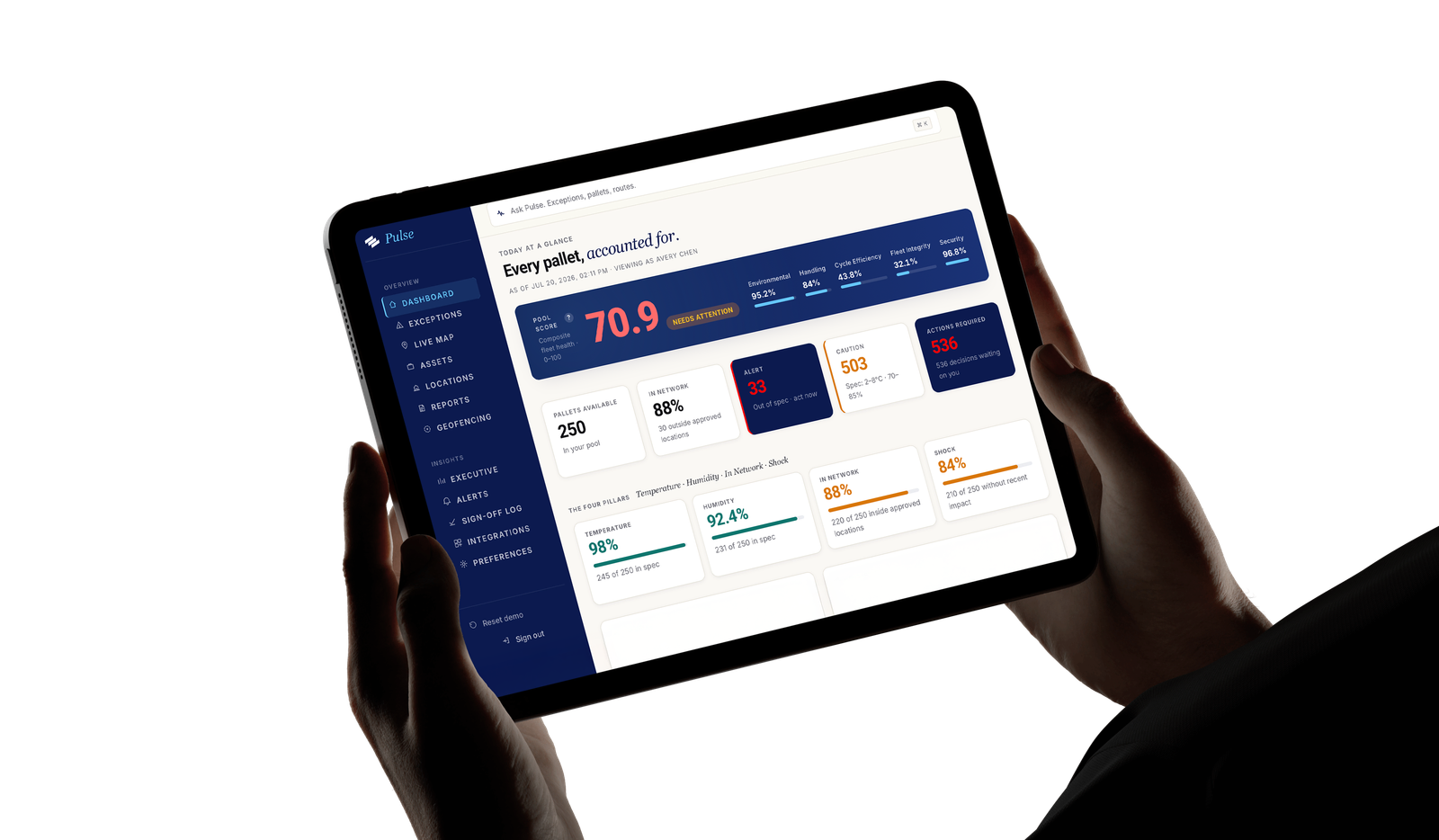
- You Need to Know What Happened in TransitAn APS Smart Pallet has a sensor built in that reports location, temperature, humidity and shock by exception, and Pulse routes the alert to a person.
- You Want an Operating Cost, Not a PurchaseOne flat monthly lease covers the pallet, the sensor and Pulse, designed to price at or below what wood pallet programs cost today.
- Your Loads Fit Standard RatingsThe APS 48 x 40 is rated 30,000 lb static, 5,000 lb dynamic and 2,800 lb in the rack on its spec sheet.
Choose Fiberglass Pallets If
- Very Heavy, Dense FreightStone, masonry, metal and tooling, where one fiberglass-and-resin pallet was rated by its maker in 2016 at 60,000 lb static and 6,500 lb in the rack.
- Block-Machine Production BoardsConcrete block plants use glass-fiber boards as the bottom mold while blocks form and cure, a job a shipping pallet is not built for.
For a shipper moving ordinary unit loads between sites, the verdict is plastic, and the case for an APS Smart Pallet lease rests on the data and the loop around the pallet as much as on the resin. Keep fiberglass for extreme loads and production machines.
Bottom Line
Fiberglass is a specialist's pallet. Plastic is the pallet that fits a closed loop, and APS adds the sensor, the lease and the take-back.
How Plastic Pallets & Fiberglass Pallets Are Built
Molded Polymer vs Glass in Resin
Plastic pallets are molded from a polymer such as HDPE or polypropylene, sometimes with steel or fiberglass rods in the runners for racking strength. Fiberglass pallets start from a different material: glass fibers set in resin. Wikipedia's fiberglass material reference calls fiberglass a common type of fiber-reinforced plastic, also known as glass-reinforced plastic or fiberglass reinforced plastic (FRP), with a matrix most often based on thermosetting polymers such as epoxy, polyester or vinyl ester.
That difference decides most of what follows. HDPE is a thermoplastic, and Wikipedia's entry on thermoplastics notes that, unlike thermoset composites, thermoplastics can be melted and reshaped multiple times. Composite pallets built on a thermoset are stiff, and hard to turn back into raw material.
Plastic Pallets From HDPE
Recycled Bottles, Molded Into a Pallet
HDPE is the plastic in milk jugs, bleach bottles and cutting boards. Wikipedia notes that HDPE is commonly recycled and carries resin identification code 2. Every APS pallet is made from 100% recycled HDPE, post-consumer and post-industrial, sourced from across the recovery stream: bottles, containers and industrial scrap.
The APS Smart Pallet, Model 48x40, is a 5-runner, 8-rod design measuring 48 x 40 x 5.9 inches and weighing 55.75 lb. Our spec sheet rates it at 30,000 lb static, 5,000 lb dynamic and 2,800 lb in the rack, from -20°F to 140°F, and lists it as 4-way entry, stackable, conveyable and rackable. The pallets and the technology are made in the U.S.A.
Our pallets will not absorb water, rot or harbor bacteria under normal use, and they are spray-down ready with little drying time. HDPE is also a flexible polymer, which matters once the comparison reaches racking.
Fiberglass Reinforced Plastic & Composite Pallets
Three Products Share One Name
Fiberglass shows up in pallets in three ways, and buyers mix them up.
- Plastic Pallets With Fiberglass RodsOne U.S. distributor lists a 48 x 40 HDPE rackable with five fiberglass rods, added to increase racking capacity. It is still a plastic pallet.
- Glass-Mat Block-Machine BoardsBoards of continuous glass-fiber mat in a recycled polypropylene or polyethylene matrix, 30 to 40% fiber by weight, per one maker's 2026 guide. They are the bottom mold while concrete blocks form and cure.
- Fiberglass-and-Resin Shipping PalletsIn 2016 Modern Materials Handling covered one that its maker said feels like steel but is made of fiberglass and resin, aimed at stone, masonry, metal and tooling.
Only the third is a fiberglass shipping pallet in the sense most buyers mean, and it has the fewest makers. A plastic pallet distributor's 2021 materials guide says only a few manufacturers in the world have the resources and capability to produce fiberglass pallets. One maker we found says it runs its composite pallets as a rental pool, issuing and retrieving more than 1.5 million a year through over 30 service facilities. The same guide lists automotive, medical, aerospace and food processing users and an average weight over 50 pounds.
Bottom Line
Most fiberglass in pallets is reinforcement. Full fiberglass shipping pallets exist, but a 2021 distributor guide counts only a few makers worldwide.
Load Capacity & Heavy Duty Plastic Pallets
Three Ratings, Read in the Right Order
Plastic pallet weight capacity is published as three numbers: static, at rest on a flat floor, dynamic, moving on forks, and racking, spanning open beams. The racking number is almost always the smallest, and it is the one that matters if loads go into selective racking. Our guide to plastic pallet types & load ratings explains how each one is tested.
| Pallet | Weight | Static | Dynamic | Racking |
|---|---|---|---|---|
| APS Smart Pallet, recycled HDPE | 55.75 lb | 30,000 lb | 5,000 lb | 2,800 lb |
| HDPE rackable, 5 fiberglass rods | 64 lb | 25,000 lb | 5,000 lb | 2,800 lb |
| Fiberglass-and-resin composite | 49 lb | 60,000 lb | 9,800 lb | 6,500 lb |
Published figures: the APS spec sheet (2026), a U.S. distributor listing checked November 23, 2026, and the composite maker's figures as reported by Modern Materials Handling in April 2016, with its weight from a June 2017 AT&T case study (22.2 kg).
Read that way, the composite is the heavy duty champion. Its maker put its racking load at 6,500 lb, against what the same article calls a 2,800 lb edge-racking specification for a 48 x 40 GMA pallet, and listed a -40°F to 176°F range. The article also notes that the strength-to-weight ratio of plastic pallets generally is not high enough for ultra-heavy loads while staying light enough to handle.
Most heavy duty plastic pallets are not trying to carry granite. Test against your own freight: your heaviest racked unit load against the racking rating, your forklift moves against the dynamic rating. If both clear a plastic pallet's numbers, extra capacity in fiberglass is capacity you never use.
| Use Case | Plastic Pallets | Fiberglass Pallets |
|---|---|---|
| Closed-Loop Lanes Between Sites | Best fit | Workable |
| Cold Chain & Food Lanes | Best fit | Workable |
| Exception Alerts in Transit | Best fit | Workable |
| Stone, Masonry & Metal Loads | Workable | Best fit |
| Block Machine Production Boards | Poor fit | Best fit |
These ratings are ours, based on the published figures, listings and data features in this post, with the APS Smart Pallet as the plastic example. On cold chain and food lanes, plastic gets the edge for humidity readings, Pulse alert routing and spray-down washing, though the composite's maker-stated -40°F to 176°F range is wider. A specific product can beat its category.
Bottom Line
Fiberglass wins the heaviest loads. For standard unit loads, a rated plastic pallet does the job and the extra capacity goes unused.
Pallet Racking Capacity & Stiffness
Why Plastic Pallets Carry Rods
Pallet racking capacity has two halves. The rack's half comes from its design under ANSI MH16.1-2023, the American National Standard for industrial steel storage racks. The pallet's half is its racking rating, the load it carries across the beams with nothing underneath. A rack integrator's 2024 guide adds a detail buyers miss: the maximum permissible load on a rack's drawings includes the pallets and packaging.
Stiffness is where the materials part ways. Wikipedia's table of Young's modulus lists HDPE at 0.97 to 1.38 GPa and glass-reinforced polyester at 17.2 GPa, roughly 12 to 18 times stiffer. A stiffer deck sags less across an open span. That is why plastic rackable pallets add rods to the runners, and why the distributor listing above says its five fiberglass rods are there to increase racking capacity.
Rods inside a plastic rackable are common, in steel or fiberglass, and they work. The APS 48 x 40 is a 5-runner, 8-rod design rated 2,800 lb in the rack on our spec sheet. For how HDPE stacks up against the stiffest pallet materials, see our breakdown of HDPE vs aluminum & steel.
Bottom Line
Stiffness is the fiberglass edge. Plastic pallets borrow it with rods in the runners, so compare racking ratings rather than materials.
Cost, Service Life & Repair
What a Trip Costs, Not What a Pallet Costs
Public prices for fiberglass shipping pallets are rare. The one 2026 price list we found covers block-machine boards, $25 to $35 each in the maker's guide, and those are production molds. The 2021 distributor guide quoted earlier says fiberglass pallets carry the highest price tag of the materials it covers, because of the difficult production process.
Plastic is easier to price. The HDPE rackable with five fiberglass rods in our load table listed at $75.99 each for 1 to 99 units on November 23, 2026. An APS program has no sticker price. One flat monthly lease covers the pallet, the sensor and Pulse, and our all-inclusive leasing model is designed to price at or below what companies are already paying for traditional wood pallet programs.
Service life is where cost per trip is won or lost. We estimate our recycled HDPE pallets at roughly 100 to 200 or more trips before recycling, about 10 times the service life of wood, and our plastic pallet lifespan statistics post gathers the outside test data. Trip figures for fiberglass come from one maker. In November 2016 Modern Materials Handling reported its third-generation pallet as designed to last well over 100 pallet trips, and a June 2017 AT&T case study used 162 lifetime trips in a life cycle assessment done for that maker. We found nothing newer. The block-board maker claims an 8 to 10 year service life in production.
Repair is the line buyers forget. In an APS lease, retrieval, repair and recycling stay on our side of the fence, including at sites you do not operate directly. By its own listing, the one composite maker we found rents its pallets from a pool it retrieves. If you buy fiberglass outright instead, ask who repairs it and how.
Cost per trip only means something next to everything else a pallet does, so the sheet below scores both materials out of ten in three groups.
The plastic column scores the APS 48 x 40 Smart Pallet as leased. The fiberglass column scores one composite maker's pooled pallet, as published, with block-board notes where marked.
| Criterion | Plastic Pallets | Fiberglass Pallets |
|---|---|---|
| Load & Handling | 8/10 | 10/10 |
| Rated for open racking | Yes2,800 lb | Yes6,500 lb |
| Dynamic load over 5,000 lb | No5,000 lb | Yes9,800 lb |
| Resists moisture & rot | YesNon-porous HDPE | YesResists moisture |
| ISPM 15 exempt | YesNo treatment | YesNo treatment |
| Standard sizes available | Yes48 x 40 | YesCustom sizes |
| Service Life & Recovery | 10/10 | 6/10 |
| Service life stated in trips | Yes100+ trips | Yes162 in 2017 |
| Made from recycled resin | YesRecycled HDPE | YesSome boards |
| Resin melts for reuse | YesThermoplastic | NoOften thermoset |
| Take-back in the contract | YesContractual | YesPool retrieves |
| Repair handled for you | YesLease covers | NoNot stated |
| Data & Alerts | 10/10 | 6/10 |
| Temperature data | YesBuilt in | YesMaker-listed |
| Humidity data | YesBuilt in | NoNot stated |
| Shock events logged | YesTimestamped | YesMaker-listed |
| ID scanning in the DC | YesRFID tags | YesRFID optional |
| Exceptions reach a person | YesPulse alerts | NoNot stated |
Two points per Yes, none per No, five rows a group. Plastic is the APS 48 x 40 as leased. Fiberglass load figures are one maker's own, as reported in April 2016. Fiberglass is that maker's pooled pallet, as published, with notes from its undated spec page, its RPA member listing, a November 2016 trade report, a June 2017 case study and a 2026 block-board guide, read November 23, 2026. Repair terms are not stated in the maker's listing. Thermoset is Wikipedia's description of fiberglass in general. Trips are APS's estimate, roughly 100 to 200+.
Bottom Line
Plastic is the pallet you can price per trip. Fiberglass may last as long, but its trip figures date to 2016 and 2017 and come from one maker, and no shipping pallet price is public.
Recycling & Recycled Plastic Pallets
Plastic Melts Down. Most Fiberglass Does Not.
Recycled plastic pallets close a loop that most fiberglass cannot. HDPE is collected and reprocessed at scale. The EPA's material data puts the 2018 recycling rate for HDPE natural bottles at 29.3%, and bottles are part of the raw material for pallets like ours.
APS and its manufacturing partner recycle and reprocess 60 million pounds of plastic a year, with capacity to grind 240,000 pounds in 24 hours. At end of life, the commitment is written into the program: “When a pallet reaches end of life, we take it back. That is not a sustainability claim. It is a contractual commitment baked into how we operate.” A retired pallet goes back into the APS HDPE stream, with recovery and recycling data available for your Scope 3 reporting.
Resin makes fiberglass a harder case. Most fiberglass uses a thermoset matrix, and Wikipedia's entry on thermosetting polymers notes that once hardened, a thermoset cannot be melted for reshaping, which usually prevents recycling for the same purpose except as filler. The U.S. Department of Energy, working on wind turbine recycling, says the bulk of the turbine material that goes unrecycled is fiber-reinforced composites, carbon fiber and fiberglass.
There are exceptions. Glass-mat block boards use a thermoplastic matrix that their maker says can be reground and remolded two to three times before the fibers degrade. The 2016 composite could be recycled by regrinding, its maker said, but the material has no aftermarket value: it essentially returns to silica sand.
Bottom Line
HDPE goes back into pallets. Fiberglass can be ground down, but most of it cannot be melted into the next pallet.
Tracking & Condition Data Built Into the Pallet
A Pallet That Reports Back
Resin does not decide the data. Wikipedia describes fiberglass as transparent to electromagnetic radiation. The gap is what ships inside the pallet.
The 2016 composite came with tracking through its maker's asset management system, and its spec page lists RFID and barcode as options. Later that year Modern Materials Handling reported a third-generation model with a cellular track-and-trace unit built into the pallet, and the maker's member listing with the Reusable Packaging Association says its platform captures location, temperature, shock and event data. So a sensor inside the pallet is not unique to plastic. What the listing does not state is humidity, or how an alert reaches a person. On APS Smart Pallets, the sensor is built into the pallet, not bolted on, and reports over existing cellular and Bluetooth networks, with no fixed readers and no dock hardware. Location, temperature, humidity and shock are the four readings most programs start with, and the set is configured to the scope of your program.
The model is exception-based. You do not monitor 100,000 pallets, you see only what needs your attention. When a reading crosses a threshold, Pulse & the built-in sensor flag the exception and route it to the right person by push, email or SMS, every reading independently timestamped. A missing report is itself a signal. APS pallets also carry RFID tags for in-DC scanning.
Bottom Line
Fiberglass can carry a tracker too. An APS Smart Pallet lease puts four readings, Pulse and the alert routing into one monthly fee.
Choosing Durable Plastic Pallets for a Closed Loop
Start With the Lane, Then the Load
Durable plastic pallets pay back when they come back. A closed loop between your plants, DCs, 3PLs and customers is where a pallet reaches its hundredth trip and a record of each handoff adds up. That is the program APS designs and manages. Our page on why APS uses durable plastic pallets lays out the full case.
Choose fiberglass in two places: freight so heavy and dense that its higher ratings earn their price, and block plants where the board is part of the machine. Otherwise, ask what a fiberglass pallet adds on your lanes that a rated HDPE pallet does not. Most APS partners start with a single lane or a defined pallet count before scaling, so the answer can come from your own freight.
A fiberglass pallet is built to hold more. A Smart Pallet is built to come back and tell you how the trip went.
Both materials do real work, so the pros and cons below are about fit for a shipper's loop, not overall quality.
The plastic side is the APS 48 x 40 Smart Pallet under a lease, the fiberglass side the pallets in the sources we read, as published.
Plastic Pallets
Pros
- Rated for Standard Unit Loads30,000 lb static, 5,000 lb dynamic and 2,800 lb in the rack.
- Sensor Built InLocation, temperature, humidity and shock, reported by exception through Pulse.
- One Monthly LeasePallet, sensor and Pulse in one fee, designed to price at or below wood programs.
- Recycled & Taken Back100% recycled HDPE, recovered and recycled again at end of life.
Cons
- Needs a Closed LoopA leased fleet fits lanes you can name, not one-way shipments.
- Lower Ceiling Than CompositesIts 2,800 lb racking rating sits under one composite's maker-stated 6,500 lb.
Fiberglass Pallets
Pros
- Very High Published RatingsOne composite was rated 60,000 lb static and 6,500 lb racking by its maker in 2016.
- Very Stiff MaterialGlass-reinforced polyester is roughly 12 to 18 times stiffer than HDPE by Young's modulus.
- Non-Porous & ISPM 15 ExemptResists moisture and skips export heat treatment.
- Built for Block PlantsGlass-mat boards serve as the bottom mold in block machines.
Cons
- Few MakersA 2021 distributor guide says only a few makers worldwide produce them.
- Little Current DataNo public shipping pallet price, and the trip figures we found date to 2016 and 2017.
- Hard to RecycleMost fiberglass uses thermoset resin, which cannot be melted again.
Plastic vs Fiberglass Pallets FAQ
Quick Answers for Buyers
Buyers weighing fiberglass against plastic ask about strength, lifespan and recycling first. Short answers follow, with every outside figure listed under sources.
Are Fiberglass Pallets Stronger Than Plastic Pallets?
Usually, by the numbers that exist. Glass-reinforced polyester is roughly 12 to 18 times stiffer than HDPE by Young's modulus, and one fiberglass-and-resin pallet was rated by its maker in 2016 at 60,000 lb static, 9,800 lb dynamic and 6,500 lb in the rack. The APS 48 x 40 Smart Pallet is rated 30,000, 5,000 and 2,800 lb. Plastic rackables close part of the gap with rods in the runners.
How Long Do Fiberglass Pallets Last?
Published figures are few. In 2016 one maker described its fiberglass composite pallet as designed to last well over 100 trips, and a 2017 life cycle assessment done for that maker used 162 trips. One block-board maker claims an 8 to 10 year service life in production. For comparison, we estimate our recycled HDPE pallets at roughly 100 to 200 or more trips, about 10 times the service life of wood.
Can Fiberglass Pallets Be Recycled?
Some can, with limits. Most fiberglass uses a thermoset resin that cannot be melted and reshaped once cured, so recycling usually means grinding it into filler. Glass-mat boards with a thermoplastic matrix can be reground and remolded two to three times, their maker says. HDPE melts down again, and APS pallets are recovered and recycled back into the HDPE stream at end of life.
Sources
- Adaptive Pallet Solutions, "The Adaptive Pallet | Model 48x40" spec sheet, 2026
- Adaptive Pallet Solutions, "Smart Pallet Technology," 2026
- Adaptive Pallet Solutions, "Sustainability," 2026
- Adaptive Pallet Solutions, "Why Plastic," 2026
- Adaptive Pallet Solutions, "Food & Beverage" program FAQ, 2026
- Adaptive Pallet Solutions, "Milk Jugs, Snowboards, and Shampoo Bottles: Your Next Pallet Has Had a Past Life"
- Wikipedia, "Fiberglass," read November 23, 2026
- Wikipedia, "Thermosetting polymer," read November 23, 2026
- Wikipedia, "Thermoplastic," read November 23, 2026
- Wikipedia, "High-density polyethylene," read November 23, 2026
- Wikipedia, "Young's modulus" (table of approximate values), read November 23, 2026
- U.S. EPA, "Plastics: Material-Specific Data," last updated March 13, 2026
- U.S. Department of Energy, "Wind Turbine Recycling," last updated May 22, 2026
- Modern Materials Handling, Sara Pearson Specter, "Packaging Corner: New pallet on the block," April 2016
- Modern Materials Handling, Josh Bond, "Pack Expo: RM2 to participate in the AT&T LTE-M network pilot for the Internet of Things," November 11, 2016
- Reusable Packaging Association, Reusables Marketplace member listing: RM2, read November 23, 2026
- AT&T, 10x case study on connected, reusable pallets, June 27, 2017 (hosted by GSMA)
- Supply Chain 24/7, "BLOCKPal USA Specification Sheet" (RM2), read November 23, 2026
- One Way Solutions, "40 x 48 Heavy Duty Rackable Plastic Pallet w/ 5 Fiberglass Reinforcing Rods," checked November 23, 2026
- Rhinos Pallet, "Complete Guide to Glass Fiber Pallets in Block Making," August 26, 2026
- Plastic Pallet Pros, Sam Dunham, "Plastic Pallet Material Types," April 8, 2021
- ANSI Blog, "Industrial Steel Storage Rack Safety: ANSI MH16.1-2023," November 16, 2023
- Cisco-Eagle, "It's Critical: Pallet Rack Load and Application Drawings," June 18, 2024
Pallet Comparison Articles
Featured Posts From the APS Blog

Milk Jugs, Snowboards, and Shampoo Bottles: Your Next Pallet Has Had a Past Life
Every APS pallet is 100% recycled HDPE, sourced from across the recovery stream. Bottles, containers, industrial scrap, melted down into a platform that survives a decade of forklifts.
 Rodrigo CastroCo-Founder & President3 min read
The Pallet Is Costing You More Than You Think
You have invested millions in automation and you track labor, freight and energy to the decimal. Somewhere on your dock, a wooden pallet is about to stop the line.
Rodrigo CastroCo-Founder & President10 min read
What RFID Pallet Tracking Actually Tells You (And What It Doesn't)
What gets packaged and sold as smart pallet technology is, in most cases, a ten-cent sticker on a rickety wooden pallet. Here is what passive RFID can and cannot see.
Rodrigo CastroCo-Founder & President5 min read