
The bill of lading says 12 skids. The receiving dock counts 12 pallets. Nobody argues, because in everyday shipping the two words mean the same thing. Then the load has to go into a rack, or onto a conveyor, or under another load, and the difference between a platform with a bottom deck and one without starts to matter. Here is where the line sits and what it costs you.
Skid vs Pallet Verdict
The Bottom Deck Decides It
Skid vs pallet comes down to one feature. A skid is a platform with a top deck on runners or legs and nothing underneath. A pallet adds a bottom deck, which lets it spread weight, stack and sit in a rack.
In everyday shipping the words blur, and plenty of carriers write skid on a bill of lading for what is really a pallet. Pallet vs skid still matters when you are buying, racking or automating, because the bottom deck changes what the platform can do.
Choose Skid If
- Heavy Goods That Stay PutMachines and equipment that sit on one platform and move only by forklift or pallet jack inside one building.
- You Need to Nest ThemLegged plastic skids stack inside each other when empty, saving space on the return trip.
- Light Loads on the FloorFloor storage and short moves where nothing sits on top and nothing goes in a rack.
Choose Pallet If
- Loads Go Into RacksSelective racking needs a bottom deck or a rated base to carry the load across the beams.
- Loads Get StackedA bottom deck spreads the weight of the load above, where skid legs or runners concentrate it.
- It Rides a ConveyorAutomated equipment works best with flat bottom boards running in both directions.
For most shippers the answer is a pallet. Skids still earn their place for heavy machinery, single-building moves and nestable plastic returns, and both come in wood and plastic. The sections below cover the definitions, handling, designs, materials and costs, then when each one fits.
Bottom Line
No bottom deck, it is a skid. Add a bottom deck and it becomes a pallet that can stack, rack and run on more equipment.
What Is a Skid?
A Platform With Nothing Underneath
The short answer to what is a skid: a single-deck platform, boards or a molded deck fixed to runners, blocks or legs, with no bottom deck. Skids are older than pallets. Wikipedia notes that skids for moving heavy blocks go back to ancient Egypt and Mesopotamia, and that the earliest modern patent in the pallet's lineage may be a 1924 U.S. patent for Howard T. Hallowell's Lift Truck Platform, a skid.
Modern skids come in two common forms. The wooden skid is a set of deck boards nailed across two or three heavy runners, often built to the size of one machine and bolted to its base. The plastic skid is a molded deck on short legs, usually nine, so a forklift or pallet jack can enter from any side. Wikipedia's own photo of one carries the caption that it is commonly called a pallet but, since it has no bottom, it is technically a skid.
Because a skid has no bottom deck, its full weight and the load's weight press down through the runners or legs. That is fine on a solid floor. It is a problem on rack beams, on top of another load, or on roller conveyors that need a flat bottom to ride on.
Bottom Line
Skids are built for floors. Runners and legs carry weight well on concrete and poorly on anything that needs a flat base.
What Is a Pallet?
Two Decks and a Standard Footprint
The short answer to what is a pallet: a platform with a top deck and a bottom deck joined by stringers or blocks, sized so forklifts, pallet jacks and racks can handle it. Wikipedia's entry on pallet definitions & history opens by saying a pallet is also called a skid, which tells you how loosely the words are used. In the industry, the bottom deck is what makes a pallet a pallet.
Pallets are everywhere in U.S. shipping. A 2020 study in BioResources estimated that U.S. companies produced 513 million new wood pallets in 2016, and cited survey work finding that 93 percent of material handling companies used wooden pallets. The most common footprint is the 48 x 40 inch GMA pallet. Our standard pallet sizes guide covers it alongside Euro and custom sizes.
| Feature | Skid | Pallet |
|---|---|---|
| Bottom deck | None | Yes |
| Typical base | Runners or legs | Stringers or blocks plus bottom boards |
| Stacking loaded units | Limited | Designed for it |
| Selective racking | Usually not rated | Rated models available |
| Nesting when empty | Legged plastic models nest | Generally no |
General comparison. Ratings depend on the specific model; check the maker's floor, fork and rack ratings.
Bottom Line
The pallet is the default. Most U.S. freight rides on two-deck pallets, and most of those are 48 x 40.
Skids vs Pallets for Handling & Storage
Where the Difference Shows Up
Skids vs pallets is mostly a handling question. Both move on forks. The differences appear when you try to stack them, rack them or run them through automated equipment, and when you count which sides the forks can enter from.
Pallet Jack & Forklift Access
Which Sides the Forks Enter
Fork access is described by the number of sides a truck can enter. A basic stringer pallet is a two-way pallet: forks go in from the two ends between the stringers. Notches cut into the stringers let a forklift enter from the sides as well, though lifting by the stringers is more secure. Block pallets go further, since a pallet jack can be used from any side, which makes them the classic 4 way pallets.
Legged plastic skids are also four-way, because there is open space between every leg. A wooden skid on runners is usually two-way unless the runners are notched. For a pallet jack, the open base of a legged skid is an advantage. For a forklift, both work.
Stacking & Racking
Where a Bottom Deck Earns Its Keep
Stacking and racking are where pallets pull ahead. A bottom deck spreads the load above it over a wider area, so loaded pallets can be stacked and set on rack beams. Legs and runners concentrate the weight, which is why many legged plastic skids carry no rack rating at all. Uline's light nestable 48 x 40 plastic model, for example, is rated for 3,500 lb on the floor, 1,200 lb on forks and not rated for racking.
Automation adds another layer. Wikipedia notes that stringer pallets have unidirectional bases and that automated equipment often runs faster when bottom boards run in both directions. If your building is adding conveyors or automated storage, our guide to pallets for warehouse automation covers what the equipment expects.
| Task | Skid | Pallet |
|---|---|---|
| Floor Storage of Heavy Equipment | Best fit | Workable |
| Pallet Jack Moves Inside One Building | Best fit | Workable |
| Selective Racking | Poor fit | Best fit |
| Stacking Loaded Units | Poor fit | Best fit |
| Conveyors & Automated Storage | Poor fit | Workable |
The ratings are ours, based on the handling differences above and typical maker ratings. A specific model can beat its category, so check its floor, fork and rack ratings before you commit.
Bottom Line
Racks and stacks favor pallets. Skids win on simple floor moves and nesting. Anything that sits on beams or under another load needs a bottom deck.
Stringer Pallet vs Block Pallet Designs
Two Ways to Build the Base
Once you choose a pallet, the next choice is the base. A stringer pallet uses three or more parallel boards, the stringers, running the length of the pallet, with deck boards nailed across them. It is simple, cheap to build and the most common design in North America. The 48 x 40 GMA pallet is a stringer pallet.
A block pallet usually sits on nine blocks, with stringer boards running both ways between them. It costs more to build and weighs more, but a pallet jack can enter from any side and it tends to stand up better to heavy handling. Costlier block and plastic pallets, Wikipedia notes, usually carry a deposit and go back to the sender or get resold, so they suit return programs.
| U.S. wood pallets, 2016 | Share |
|---|---|
| Stringer pallets | 76% |
| Block pallets | 21% |
| Skids and other designs | 3% |
Source: Gerber, Horvath, Araman and Gething, BioResources, 2020.
Plastic pallets follow the same families, plus the legged skid. For how molded designs compare by type, grade and load rating, see our plastic shipping pallet types guide.
Bottom Line
Stringer is the U.S. standard. Block pallets cost more and handle better, and skids are a small share of wood production.
Wooden Skid vs Plastic Skids
Same Shape, Different Lifespan
A wooden skid is easy to build to size, easy to bolt a machine to and cheap to throw away. That makes it the standard base for crated equipment and one-off heavy loads. Its weaknesses are the same as any wood platform: it can splinter, shed nails, soak up moisture and needs ISPM 15 treatment and marking to ship internationally.
Plastic skids are molded, usually on nine legs, and most are built to nest. A stack of empty nestable plastic pallet skids takes a fraction of the space of the same count of wood pallets, which is the main reason shippers use them on return trips. They are also light. Uline's nestable 48 x 40 model weighs 14 lb, and a Minnesota recycler, Gruber Pallets, lists 48 x 40 nestable plastic pallets at $70 each and $35 in bulk.
The trade-off is strength and racking. Light plastic skids are often not rated for racks at all, and plastic can deflect under a long-standing load. Heavier rackable plastic models exist, but they add runners or a bottom deck, which makes them pallets rather than skids.
| 48 x 40 platform | Weight | Ratings or price | Source |
|---|---|---|---|
| Nestable plastic skid, 9 legs | 14 lb | 3,500 lb floor, 1,200 lb fork, not rack rated | Uline H-990 |
| Nestable plastic pallet | Not listed | $70 each, $35 in bulk | Gruber Pallets |
| Recycled wood pallet, #1 | 40 lb | 2,500 lb, $27 to $29 each | Uline H-750 |
Listings checked November 3, 2026. Uline weights are shipping weights.
Bottom Line
Plastic skids nest, wood skids bolt. Pick wood for crated equipment, and plastic for light loads that need to come back empty.
Skid vs Pallet Costs Over Time
Price per Trip, Not per Platform
Upfront, skids are usually cheaper than pallets of the same material because they use less of it. A wooden skid has no bottom boards, and a light plastic skid uses less resin than a rackable plastic pallet. For reference, Uline lists a new heat treated 48 x 40 GMA wood pallet at $49 to $52 and a recycled #1 at $27 to $29.
Over time, the math changes. The real cost of any platform is what it costs per trip: purchase price divided by the trips it makes before it breaks, goes missing or fails inspection, plus the damage it causes on the way. By our own figures, white wood pallets last about 3 to 5 trips and pooled wood about 15, while our plastic pallets last roughly 100 to 200 or more.
Cost per trip is the column that matters, so the sheet below scores skids and pallets out of ten on cost, handling and reuse.
The scores are ours, built from the maker listings and handling differences above. Skids win on upfront cost and nesting, pallets on storage and reuse.
| Criterion | Skid | Pallet |
|---|---|---|
| Upfront Cost | 8/10 | 6/10 |
| Less material per platform | YesNo bottom deck | NoTwo decks |
| Easy to build to custom size | YesRunners cut to fit | YesCustom sizes common |
| Storage & Handling | 4/10 | 8/10 |
| Rated for selective racking | NoLight models often not rated | YesRated models available |
| Stacks loaded units | NoLegs concentrate weight | YesBottom deck spreads it |
| Nests when empty | YesLegged plastic models | NoGenerally no |
| Reuse & Lifespan | 5/10 | 7/10 |
| Suits deposit or lease programs | NoMostly one-way or in-house | YesBlock and plastic models |
| Fits automated equipment | NoNo flat bottom | YesBest with two-way bottom boards |
| Available in durable plastic | YesNestable models | YesRackable models |
Scores out of 10 are our assessment from Uline and Gruber listings, Wikipedia and BioResources, 2026.
Bottom Line
Cheap up front is not cheap per trip. A platform that makes more trips without damage costs less over its life, whatever its shape.
When Each One Fits
Choose by the Job, Then the Material
Both platforms do real work. The pros and cons below are about fit for the job, not overall quality.
Read them against what happens to the load: whether it sits on the floor, goes in a rack, gets stacked or comes back empty.
Skid
Pros
- Less MaterialNo bottom deck means a lower build cost.
- Nests When EmptyLegged plastic skids stack inside each other.
- Bolts to EquipmentWooden skids are the standard base for machinery.
Cons
- Poor for RackingLight plastic skids are often not rack rated.
- Poor for StackingLegs and runners concentrate the weight above.
- Harder to AutomateNo flat bottom for conveyors and wrappers.
Pallet
Pros
- Racks & StacksA bottom deck spreads the load.
- Industry StandardMost U.S. freight rides on 48 x 40 pallets.
- Built for Return TripsBlock and plastic pallets suit deposit and lease programs.
Cons
- More MaterialTwo decks cost more to build than one.
- HeavierA recycled 48 x 40 wood pallet ships at about 40 lb.
- No NestingEmpties take full space on the way back.
When a Skid Fits
Floors, Machines & Nesting
Use a skid for heavy equipment that ships bolted to its base, for loads that stay on the floor inside one building, and for light goods on nestable plastic skids that need to come back empty in a small footprint.
When a Pallet Fits
Racks, Stacks & Networks
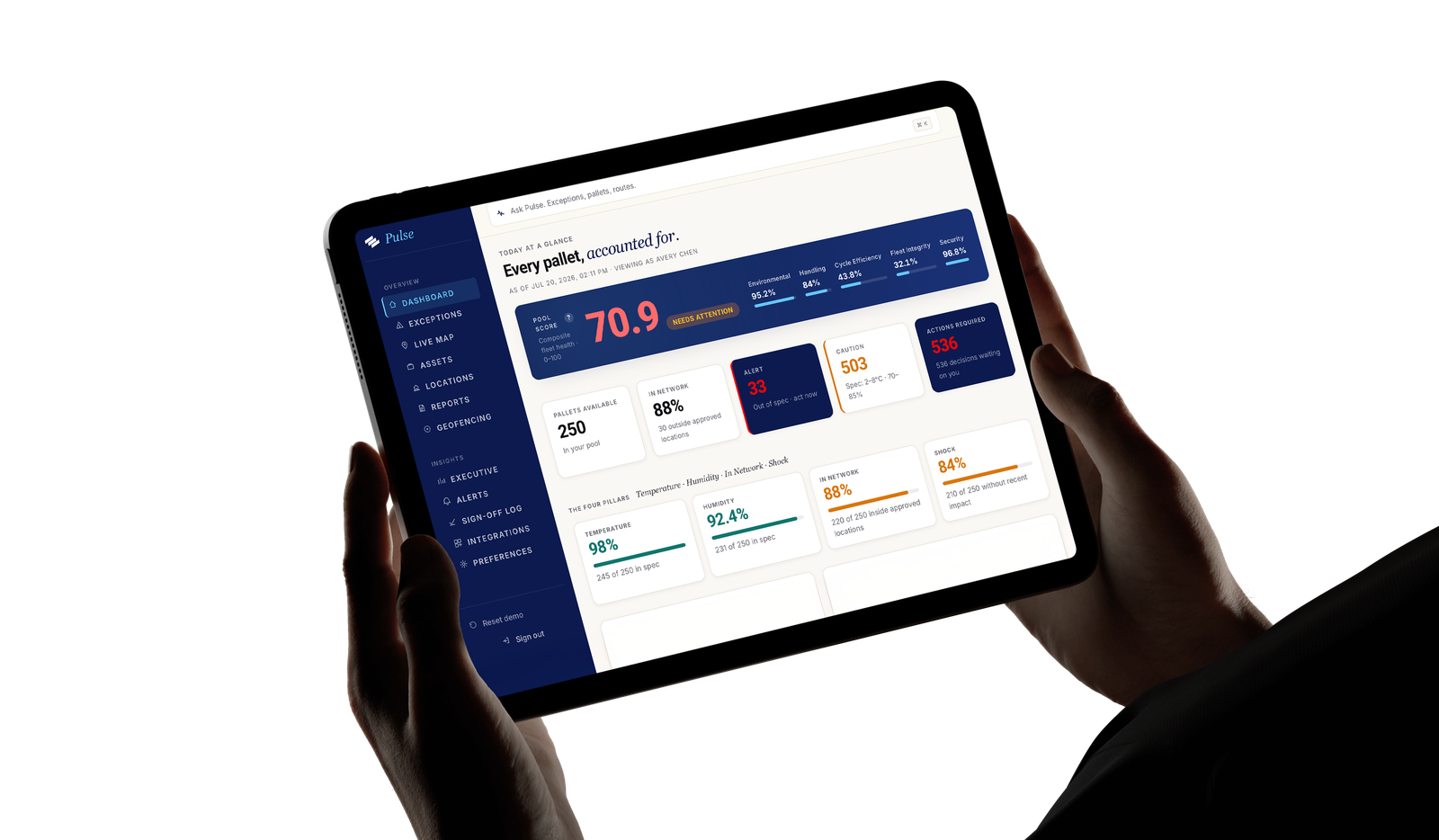
Use a pallet for anything that goes into racks, gets stacked, rides automated equipment or travels through a distribution network. For multi-trip lanes, durable plastic pallets add consistency on top of that. APS pallets are made from 100 percent recycled HDPE, are ISPM 15 exempt and carry an embedded sensor with cellular GPS, temperature, humidity and shock, reporting to our Pulse platform. We lease them on a closed-loop monthly program designed to price at or below wood. Read durable plastic pallets explained for the full case.
Bottom Line
Skid for the floor, pallet for the network. If the load leaves the building, gets stacked or goes in a rack, it belongs on a pallet.
Skid vs Pallet FAQ
Quick Answers on Skids & Pallets
Three questions come up most when people compare skids and pallets. Short answers follow.
Is a Skid the Same as a Pallet?
Not technically. A skid has a top deck on runners or legs and no bottom deck. A pallet has both decks. In daily shipping the words are used interchangeably, and Wikipedia's entry on pallets opens by saying a pallet is also called a skid. The difference matters when you rack, stack or automate.
Why Do Shippers Say Skid Instead of Pallet?
Skids came first. Wooden skids were used to move heavy goods long before the two-deck pallet, and the earliest modern patent in the pallet's lineage, from 1924, describes a skid. The word stuck in freight and trucking, so many shippers and carriers still say skid for any platform a forklift picks up.
Are Plastic Skids Worth It?
They are for light loads that come back empty. Legged plastic skids nest, weigh little and do not splinter. They are a poor fit for racking or heavy stacking, since many are not rack rated. For multi-trip lanes that need racking or automation, a durable plastic pallet with a full base is usually the better buy.
Sources
- Wikipedia, Pallet
- Gerber, Horvath, Araman and Gething, Investigation of New and Recovered Wood Shipping Platforms in the United States, BioResources, 2020
- Uline, Plastic Pallet 48 x 40 (H-990), checked November 3, 2026
- Uline, Recycled Wood Pallet 48 x 40 (H-750), checked November 3, 2026
- Uline, Heat Treated Wood GMA Pallet 48 x 40 (H-1260), checked November 3, 2026
- Gruber Pallets, Recycled Wood Pallets and nestable plastic pallets, checked November 3, 2026
Pallet Comparison Articles
Featured Posts From the APS Blog
The Pallet Is Costing You More Than You Think
You have invested millions in automation and you track labor, freight and energy to the decimal. Somewhere on your dock, a wooden pallet is about to stop the line.
 Rodrigo CastroCo-Founder & President10 min read

Milk Jugs, Snowboards, and Shampoo Bottles: Your Next Pallet Has Had a Past Life
Every APS pallet is 100% recycled HDPE, sourced from across the recovery stream. Bottles, containers, industrial scrap, melted down into a platform that survives a decade of forklifts.
Rodrigo CastroCo-Founder & President3 min read
Stuck in the 20th Century: Neil Armstrong, iPhones, and Pallets
80% of global goods touch a pallet at some point. How can an asset that fundamental to modern trade have changed so little since 1969?
Rodrigo CastroCo-Founder & President3 min read