
Warehouse Safety Statistics
Warehouse Safety Statistics: Forklift, Pallet & Material Handling Injuries
Warehouse workers get hurt at about twice the private industry rate, and forklifts, pallets and lifting drive much of it. Here is what BLS, OSHA and our own analysis of severe injury reports show.
Key findings
- Warehousing and storage recorded 4.8 injury cases per 100 full-time workers in 2024, about twice the private industry rate of 2.3, and 4.1 of those involved lost or restricted work.
- 84 workers died in forklift-related incidents in 2024, up from 67 in 2023, even as total U.S. work deaths fell 4.0 percent.
- Powered Industrial Trucks was OSHA's 8th most cited standard in fiscal year 2025, with 2,150 violations.
- In our analysis of 105,996 OSHA severe injury reports, skids and pallets were a source in about 1,200, and 56 percent were fractures. Tripping over an object was the top pallet event.
- Overexertion involving outside sources, mostly manual material handling, costs U.S. employers $13.7 billion a year, the largest share of a $58.8 billion total.
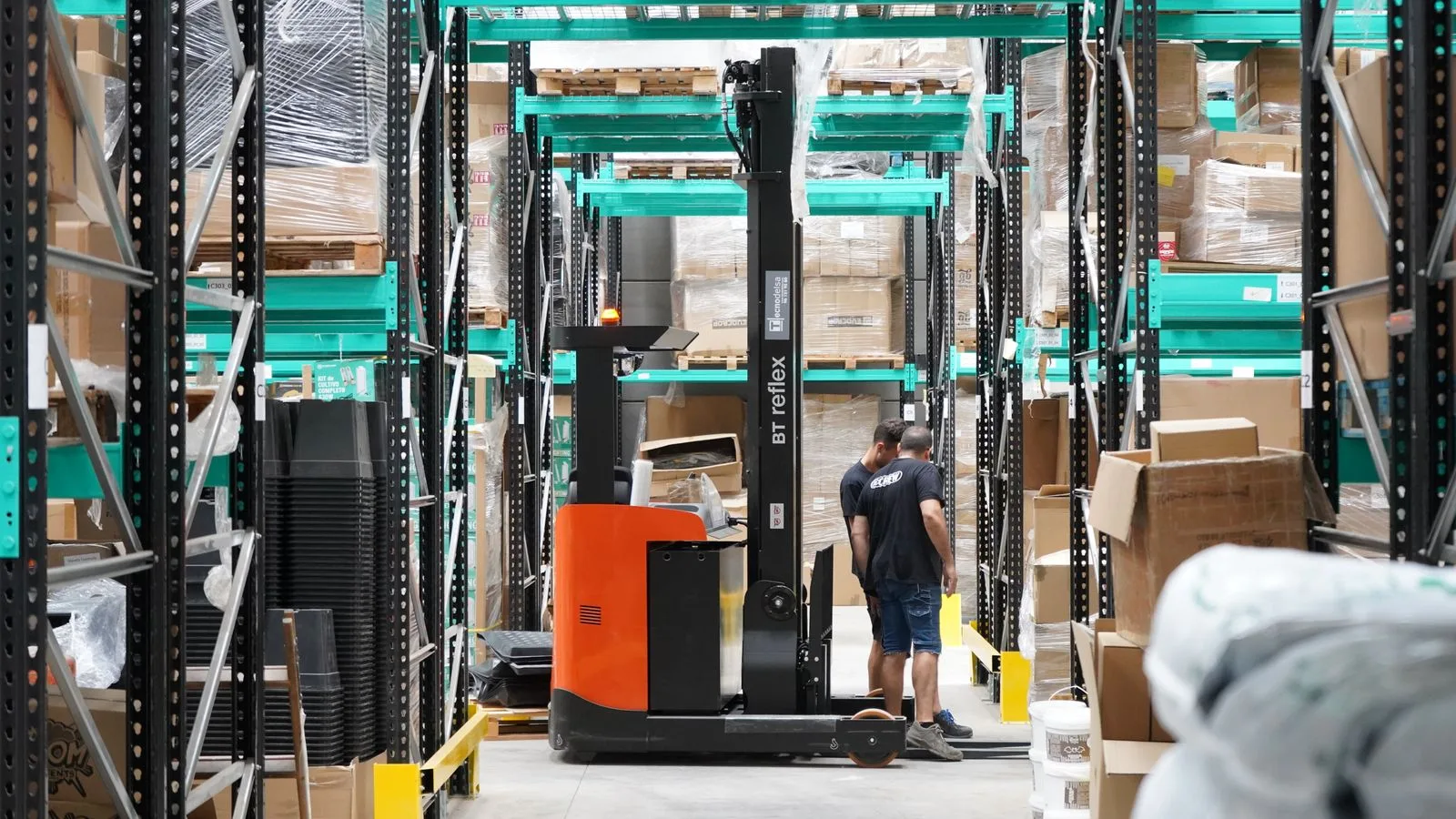
Walk a busy distribution center at shift change and you can see the risk before you can measure it. A reach truck backs out of an aisle as someone cuts behind it. An empty pallet sits half in a walkway. A picker bends for the tenth time in a minute to pull a case off the bottom of a stack.
These warehouse safety statistics put numbers on that scene. We pulled the latest BLS injury and fatality data, OSHA's citation counts and its renewed warehouse emphasis program, insurer cost estimates, and our own analysis of more than 105,000 OSHA severe injury reports to see where forklifts, pallets and material handling actually hurt people.
One caution before the numbers. BLS changed how it classifies injuries starting with 2023 data and now publishes detailed nonfatal counts every two years, so some comparisons across years are rougher than they look. We say so where it matters.
Warehouse Injury Rates
Start with the rate, because it is the number that compares fairly across industries. In 2024, warehousing and storage (NAICS 493) recorded 4.8 injury and illness cases per 100 full-time workers, according to the Bureau of Labor Statistics industry profile. All private industry came in at 2.3, the lowest rate since 2003 per the BLS employer-reported injury release. A warehouse worker is roughly twice as likely to have a recordable injury as the average private sector employee.
The second number matters more for warehouse safety. Of those 4.8 cases, 4.1 were serious enough to involve days away from work, job restriction or a transfer. That is about 85 percent of all recordable cases. Warehouse injuries are rarely the kind you bandage and forget. They take people off their normal job.
Restricted duty outweighs time off. The same BLS profile puts the days away rate at 1.5 and the job transfer or restriction rate at 2.6, so most injured warehouse workers stay on site on lighter work. That keeps lost time numbers low and hides real capacity loss. Across private industry in 2023 and 2024, the median case kept a worker away for 8 days and on restricted duty for 15.
OSHA's own math is starker. When it renewed its National Emphasis Program for warehousing in July 2026, the agency averaged five years of BLS data, 2020 through 2024, and set warehouse industries beside all private employers.
| Industry | Total case rate | DART rate |
|---|---|---|
| All private industry | 2.6 | 1.6 |
| General warehousing and storage | 5.2 | 4.4 |
| Refrigerated warehousing | 4.6 | 3.8 |
| Farm product warehousing | 3.2 | 2.6 |
| Couriers and express delivery | 8.6 | 6.9 |
| Local messengers and delivery | 6.1 | 4.9 |
The exposure keeps growing. The same directive counts 882,100 warehousing workers in December 2015 and 1,836,200 in December 2025, more than double in a decade. Even a flat injury rate on a workforce that size means far more injured people each year.
Why It Matters
General warehousing runs a DART rate almost three times the private industry average. A rate that high is a staffing problem as much as a safety one.
Forklift Accident Statistics
Forklifts are where warehouse injuries turn fatal. MHEDA's 2026 National Forklift Safety Day statistics, citing the National Safety Council and BLS, report that 84 workers died in incidents involving forklifts, order pickers or powered platform trucks in 2024, up from 67 in 2023. That rise came in a year when total U.S. work deaths fell 4.0 percent to 5,070, per the Census of Fatal Occupational Injuries.
Nonfatal forklift accident statistics now arrive every two years. For 2021 and 2022 combined, BLS estimated 24,960 cases involving forklifts, order pickers and platform trucks that caused days away, job restriction or transfer, and 15,480 that caused days away from work. Workers aged 25 to 34 had the most cases, and about 4 percent involved women.
To see what a serious forklift accident looks like, we analyzed OSHA's Severe Injury Reports, every amputation, eye loss and in-patient hospitalization employers reported under federal OSHA from January 2015 through November 2025. Of 105,996 reports, a forklift, order picker or powered platform truck was the primary source in 4,600, or 4.3 percent, and a primary or secondary source in 5,618. In 782 of those primary forklift reports, or 17.0 percent, the worker lost part of a body. The data excludes states that run their own OSHA plans, so treat it as a floor.
Severe injury reports with a forklift as the primary source, by year
The rules that govern all of this sit in one standard. The OSHA powered industrial truck rules at 29 CFR 1910.178 cover design, maintenance, operation and the training every operator needs.
Forklift Accident Causes
The severe injury narratives answer how. The single most common event, in 781 forklift reports, was part of a worker's body caught between the truck and another object, usually a leg or foot pinned against racking, a dock edge or another vehicle. Pedestrians came next. Reports coded as a pedestrian struck by a forklift, unspecified, backing up or moving forward, total 1,148, about one in four forklift reports.
| Forklift event | Severe injury reports |
|---|---|
| Body caught between vehicle and object | 781 |
| Pedestrian struck, unspecified | 605 |
| Pedestrian struck by a backing vehicle | 374 |
| Collision with a stationary object | 184 |
| Pedestrian struck by a forward-moving vehicle | 169 |
Tip-overs are rarer but deadlier. NIOSH's forklift alert found that overturns caused about 25 percent of forklift deaths. That analysis is from 2001, so read it as a long-standing pattern, not a current count.
OSHA Forklift Citations
The OSHA forklift standard is one of the most cited rules in the country. In OSHA's final data for fiscal year 2025, as reported by Safety+Health in April 2026, Powered Industrial Trucks (1910.178) ranked eighth with 2,150 violations. Fall Protection, General Requirements led for the 15th straight year with 6,992.
Most of those citations trace back to training and inspection. The standard requires formal instruction, hands-on training and an evaluation of each operator in the workplace, repeated at least once every three years, plus an examination of each truck before it is placed in service.
Material Handling Injuries
Forklifts get the headlines, but most injured warehouse workers are hurt by their own bodies. Across private industry in 2023 and 2024, BLS counted 946,290 cases with days away, restriction or transfer caused by overexertion, repetitive motion and bodily reaction, more than any other event type. Contact with objects and equipment followed with 860,050. That is the cost of material handling done by hand: lifting, pushing, pulling and twisting thousands of times a shift.
The fatal side points the same way. Of the 5,070 work deaths in 2024, transportation incidents caused 1,937, or 38.2 percent, and workers in transportation and material moving occupations suffered 1,391 deaths, per the 2024 fatality census.
OSHA lists the hazards it hunts for in warehouses: powered industrial vehicles, struck-by and caught-in-between hazards, slips, trips and falls, blocked aisles and exits, heat and ergonomics. Most of them come back to how loads move through a building.
Automation changes that mix rather than erasing it. Robots take over the repetitive lifting, people move to supervising and clearing jams, and the equipment needs inputs that behave the same way every time. Our warehouse automation statistics show how fast that shift is moving and what it asks of the pallet.
Key Takeaway
The largest injury category is not a dramatic accident. It is a back, a shoulder or a wrist worn down by repetitive material handling.
Pallet Handling Injuries
Pallets sit under almost every load in a warehouse, yet no headline federal table counts the injuries they cause. So we built a count from the same OSHA severe injury data. Skids and pallets were the primary or secondary source in about 1,200 reports from January 2015 through November 2025, and the primary source in 467.
The pattern is clear. Fractures were 56 percent of those pallet handling reports, and 183 involved an amputation. About 30 percent, or 360, were trips or slips, and the single most common event, in 249 reports, was a fall on the same level from tripping over an object. In practice that is an empty pallet left in an aisle or a broken board on the floor.
Pallets show up far beyond the source code. 4,277 severe injury narratives, 4.0 percent of all reports, mention a pallet. In warehousing and storage alone, 25.8 percent of the 2,235 reports mention one, and 35.6 percent involve a forklift. Pallet safety and forklift safety are mostly the same problem seen from two sides.
The hazard leaves the warehouse too. Penn State researchers Judd Michael and Serap Gorucu, writing in the Journal of Safety Research, estimated 30,493 emergency department visits for non-occupational pallet injuries from 2014 to 2018. About 14 percent, or 3,964, happened in retail stores, where tripping over a pallet at floor level caused 51 percent of the injuries.
Splinters, Nails & Broken Boards
Severe injury reports undercount these by design, since a splinter or a nail puncture rarely puts someone in the hospital. Even so, 79 narratives mention a pallet together with nails or splinters, often a nail through a boot, a board that gave way underfoot or an infected puncture. Each one is the visible tip of many minor cuts that never leave the first aid log.
Wood is the reason. A wood pallet is boards held together with nails, and every trip through a dock loosens a few. Our pallets are made from 100 percent recycled HDPE with no nails and no splinters, which removes that failure point instead of managing it. We explain why plastic beats wood in more detail on our site.
Manual Lifting Strain
Empty pallets get lifted by hand far more often than any procedure admits. In 235 severe injury narratives, the worker was lifting, carrying or stacking pallets when they were hurt. NIOSH's revised lifting equation starts from a load constant of 51 pounds under ideal conditions and cuts the recommended limit as the reach, twist and frequency get worse, and a pallet pulled off a stack is rarely ideal.
Weight is part of the fix. APS pallets are up to 30 percent lighter than wood, by our own figures, and durable plastic pallets keep a consistent size and weight from trip to trip. That makes a two-person lift or a dispenser rule easier to set and enforce.
Pallet Rack Safety Data
Here the data is thinnest, and we would rather say so than invent a number. No federal source counts rack collapses nationally. OSHA has no rack-specific standard and uses its material storage rule, which requires stored tiers to be stable and secure against sliding or collapse, along with the General Duty Clause. The design standard most operators follow is ANSI MH16.1 from the Rack Manufacturers Institute.
The severe injury narratives fill in part of the picture. 815 of them name pallet racking or storage racking. Sorted by what happened, 314 involved a worker caught or crushed, 112 a fall from height and 97 a worker struck by a falling object. Only 10 described a rack actually collapsing.
That shifts the focus of pallet rack safety. The rack itself rarely fails. The danger sits in the space around it: a leg pinned between a truck and an upright, a carton sliding off a high beam, a worker climbing a bay to reach stock. The pallet in the bay matters too. A pallet with a cracked deck board or an out of square footprint is more likely to hang up on a beam or shed its load.
Dimensional consistency helps here. Our pallets hold their dimensions to under 1 percent, against 8 to 10 percent variance for wood by our figures, which is one reason they suit automated storage. Our durable plastic pallets guide covers load ratings for racked use.
Watch Out
A small number of rack collapses does not mean racking is safe. It means most rack injuries happen to people working around a standing rack, which is where inspections and aisle rules should focus.
Cost of Warehouse Injuries
The bill is large and lopsided. The 2025 Liberty Mutual Workplace Safety Index, reported by Insurance Journal, puts the direct cost of serious workplace injuries, those keeping a worker out more than five days, at $58.8 billion a year, based on 2022 data. The top 10 causes account for $50.87 billion, or 86 percent.
Direct cost of serious workplace injuries by cause, billions
The top line, overexertion involving outside sources, is mostly manual material handling. Same-level falls, the category where pallet trips land, are second. Both are core warehouse risks.
Then there are penalties. OSHA did not raise its civil penalty amounts in 2026, so the maximum for a serious violation stays at $16,550 and the maximum for a willful or repeated violation at $165,514, per the OSHA penalty schedule. A single inspection rarely stops at one citation.
The OSHA warehouse emphasis program is where those penalties concentrate. In its first 18 months, OSHA says, inspections under the program found more than 1,700 violations and removed about 37,410 workers from hazards. The 2026 revision runs for five more years, and every inspection under it is a comprehensive safety inspection, not a narrow complaint check.
Warehouse Safety Tips the Data Supports
Every tip below comes from a number earlier in this post. If the data does not support a step, it is not on the list.
- Separate People From Trucks About one in four severe forklift reports involved a pedestrian. Marked walkways, physical barriers and no-go zones around docks do more than any reminder.
- Train for Pinch Points Caught-between events were the top forklift injury. Forklift safety training should cover where legs and feet end up when a truck backs toward racking or a dock.
- Get Empty Pallets Off the Floor Tripping over an object was the most common pallet event. The Penn State team recommends not leaving unused pallets on floors and covering floor-level pallets in bright material.
- Pull Damaged Pallets From Service Broken boards and protruding nails show up in the narratives. A quick check at receiving keeps them out of racks and aisles.
- Cut Manual Pallet Lifts Hundreds of reports began with someone lifting or stacking pallets. Dispensers, two-person rules and lighter pallets all reduce that load.
- Keep Operator Evaluations Current The forklift standard is one of OSHA's most cited. Evaluations at least every three years, and after any incident, are the floor.
These are warehouse safety tips about the pallet layer, and the pallet you choose shapes several of them at once. A nail-free, splinter-free HDPE pallet removes one hazard outright, a consistent footprint makes racking and automated handling more predictable, and a closed-loop program keeps damaged wood from drifting back into the fleet. If you are planning conveyors or robots, our checklist to prepare pallets for automation walks through it.
Most warehouse injuries are not freak accidents. They repeat, which means they can be designed out.
Warehouse Safety FAQ
How Many Forklift Accidents Happen Each Year?
In 2024, 84 U.S. workers died in incidents involving forklifts, order pickers or powered platform trucks, according to the National Safety Council and BLS, up from 67 in 2023. BLS now reports nonfatal cases every two years: 24,960 forklift cases with days away, restriction or transfer in 2021 and 2022 combined. Federal OSHA also received roughly 370 to 480 severe forklift injury reports a year from 2015 to 2024, a count that leaves out state-plan states.
What Is the Most Common Warehouse Injury?
Overexertion is the most common serious injury across private industry: lifting, pushing, pulling and repetitive motion caused 946,290 cases with days away, restriction or transfer in 2023 and 2024, per BLS. Among the most severe warehouse injuries reported to OSHA, the top event is a worker caught between a forklift and another object, such as racking or a dock edge.
How Do Pallets Cause Warehouse Injuries?
Mostly through trips, falling loads and lifting. In OSHA severe injury reports from 2015 to 2025, about 30 percent of pallet injuries were trips or slips, 56 percent were fractures, and tripping over an object on the floor was the single most common event. Nails, splinters and broken boards add puncture wounds, and lifting or stacking empty pallets by hand causes strains.
Sources
- U.S. Bureau of Labor Statistics, Warehousing and Storage: NAICS 493, Industries at a Glance, 2026
- U.S. Bureau of Labor Statistics, Employer-Reported Workplace Injuries and Illnesses, 2023-2024, 2026
- U.S. Bureau of Labor Statistics, National Census of Fatal Occupational Injuries in 2024, 2026
- OSHA, CPL 03-00-026, National Emphasis Program on Warehousing and Distribution Center Operations, revised 2026
- MHEDA, 2026 National Forklift Safety Day Statistics, 2026
- Safety+Health, OSHA reveals final Top 10 data for FY 2025, 2026
- OSHA, Severe Injury Reports, January 2015 to November 2025 (our analysis)
- OSHA, Penalties, 2026
- OSHA, Powered Industrial Trucks (Forklifts)
- eCFR, 29 CFR 1910.178, Powered Industrial Trucks
- eCFR, 29 CFR 1910.176, Handling Materials, General
- Insurance Journal, Workplace Injuries Costs Near $60B Per Year, Liberty Mutual Workplace Safety Index, 2025
- NIOSH, Preventing Injuries and Deaths of Workers Who Operate or Work Near Forklifts, 2001
- NIOSH, Applications Manual for the Revised NIOSH Lifting Equation, 1994
- Michael and Gorucu, Non-occupational injuries caused by transport packaging: Residential and retail hazards, Journal of Safety Research, 2021
Featured Posts From the APS Blog
The Pallet Is Costing You More Than You Think
You have invested millions in automation and you track labor, freight and energy to the decimal. Somewhere on your dock, a wooden pallet is about to stop the line.
 Rodrigo CastroCo-Founder & President10 min read

Stuck in the 20th Century: Neil Armstrong, iPhones, and Pallets
80% of global goods touch a pallet at some point. How can an asset that fundamental to modern trade have changed so little since 1969?
Rodrigo CastroCo-Founder & President3 min read
Milk Jugs, Snowboards, and Shampoo Bottles: Your Next Pallet Has Had a Past Life
Every APS pallet is 100% recycled HDPE, sourced from across the recovery stream. Bottles, containers, industrial scrap, melted down into a platform that survives a decade of forklifts.
Rodrigo CastroCo-Founder & President3 min read