
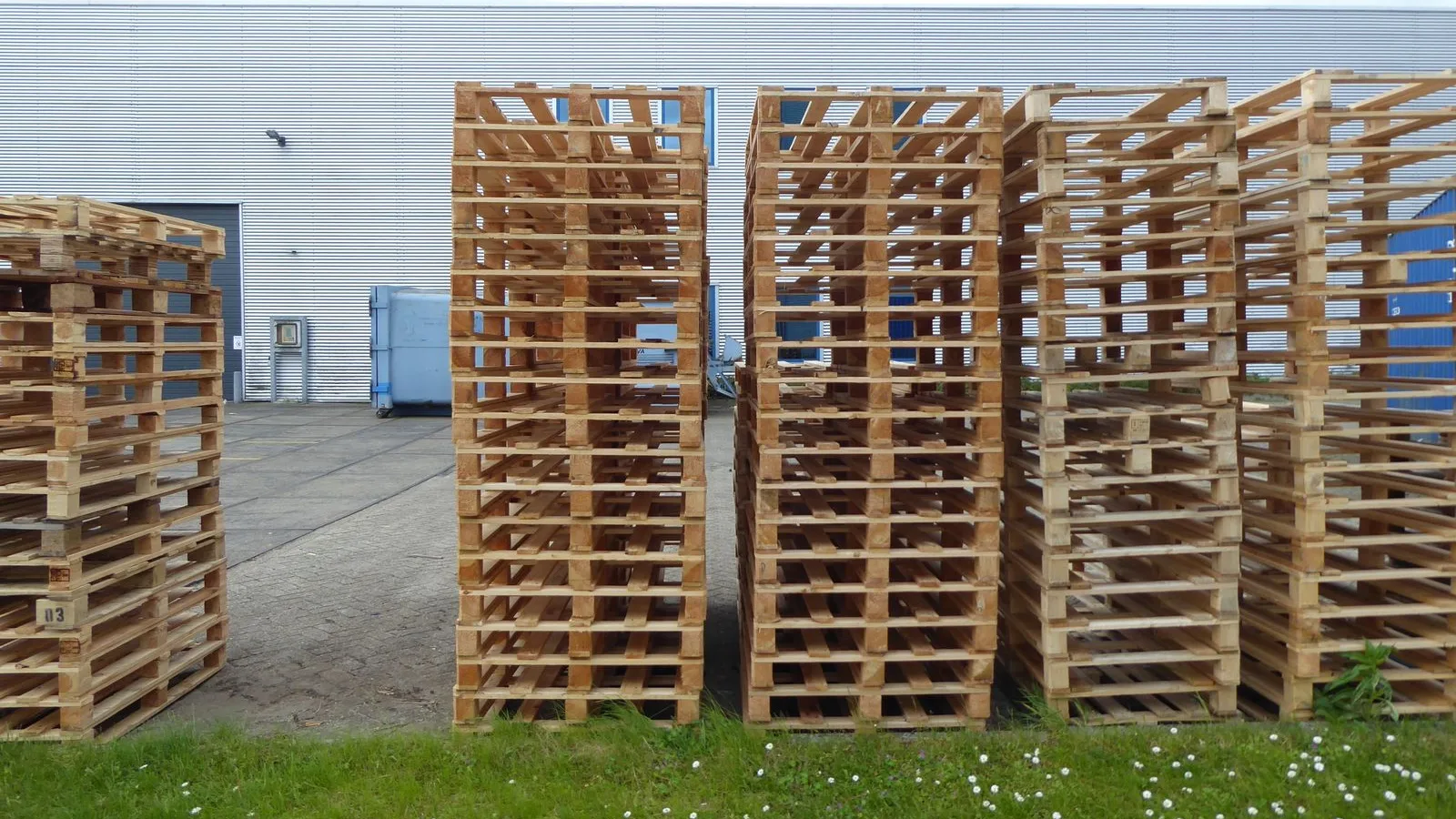
Ask 129 Modern Materials Handling readers what their product rides on, and wood comes in at 92%. That is the 2025 Pallet Report from Peerless Research Group. Plastic came next at 28%, then wood composite at 15%, cardboard or corrugated at 11% and metal at 7%. The shares add up to well over 100%, so plenty of operations run more than one type.
When we started Adaptive Pallet Solutions, the thing that caught our attention was how little the pallet had changed. As I wrote in an earlier post: "Interestingly, the pallets used to transport the parts used in NASA's computers are identical to the pallets on which our iPhones are delivered to the Apple store today." Nine of the ten types below sort pallets by what they are made of and how they are built. The tenth sorts them by whether they report back.
We lease one of these types, a recycled HDPE Smart Pallet, so where our own figures appear we say so. Everything else comes from the surveys, standards and carriers named in the text.
Key Takeaways
- Wood still dominates: it came in at 92% in the 2025 Pallet Report, against 28% for plastic and 7% for metal.
- Stringer pallets made up an estimated 77% of new US wood pallets in 2021 and block pallets 19%, yet more facilities report block pallets moving on their handling systems.
- A good spec sheet lists three ratings. On the APS 48 x 40 they run from 30,000 lb on the floor to 2,800 lb in a rack, so spec storage against the rack number.
- ISPM 15 regulates pallets made from raw wood. Plastic, metal, cardboard and presswood pallets sit outside its treatment and marking rules.
- A pallet's material and build set its limits. A sensor built into the pallet is what reports how the load fared on the way.
How the Types of Pallets Differ
The different types of pallets used in shipping differ on three things: what they are made of, how they are built, and whether they carry any technology. The material sets the weight, the hygiene and the export paperwork. The build sets how forks get in and where a loaded pallet can sit. Any technology on board is what lets the pallet report on the trip.
Those three axes give the ten types of pallets in this guide: five materials, four designs and one technology. They overlap. A block pallet can be wood or plastic, a rackable pallet can be plastic or metal, and an APS Smart Pallet is a recycled HDPE pallet with a sensor built in. Most shipping pallets in the US are still wood, and most new ones are stringer pallets, as the survey numbers show.
Footprint is a separate choice from type. In the same Pallet Report, 72% of respondents used the 48 x 40 in the past year, and it was the most common new wood pallet size in 2021 at 29% of production. Our pallet sizes & dimensions guide covers footprints in full, and the pallet reference on Wikipedia is a fair starting point for the history and the international standards.
| Type | Axis | Built For | ISPM 15 Status |
|---|---|---|---|
| Wood pallets | Material | Low cost, easy repair | Treatment and mark for export |
| Plastic pallets | Material | Reuse and washdown | Outside the standard |
| Metal pallets | Material | Heavy, abusive handling | Outside the standard |
| Presswood pallets | Material | Nesting, one-way export | Exempt as processed wood |
| Cardboard pallets | Material | Light one-way loads | Outside the standard |
| Stringer pallet | Design | Low-cost two-way entry | Follows its material |
| Block pallet | Design | True four-way entry | Follows its material |
| Nestable pallets | Design | Cheaper empty returns | Follows its material |
| Rackable pallets | Design | Open-beam storage | Follows its material |
| Smart Pallets | Technology | Reports from the pallet | Follows its material |
Types of Pallets by Material
Material is the first fork in the road. It decides what a pallet weighs, whether it can be washed, whether it needs a stamp to cross a border and whether anyone will bother to send it back. Most US pallets are still wood pallets, and plastic pallets come second in the 2025 Pallet Report. Metal, presswood and cardboard each fill a narrower job.
Wood Pallets
Wood pallets are the default because they are cheap, familiar and easy to repair. The US wood pallet industry made an estimated 919 million new wood pallets in 2021, about 75% more than in 2016, and repaired or remanufactured another 280 million, according to Hobbs, Horvath and Gething in BioResources (2025). Softwood supplied 81% of the lumber. The same survey found 78% of the used pallet cores recyclers took in were repaired and sold, the highest share in 30 years.
That repair loop is wood's quiet strength. On an automated line, it is also the weak spot.
Terry Crew, our Director of Customer Engagement, calls pallets cobbled together from old, mismatched boards "Frankenstein Pallets," and they have no business near an automated line. In the 2025 Pallet Report, 75% of respondents rated broken or damaged components extremely important to how well their automated systems run, and 63% said the same of protruding nails.
Wood also carries export paperwork. Under ISPM 15, raw wood packaging in international trade must go through an approved treatment, most often heat treatment to at least 56°C (about 133°F) through its core for 30 continuous minutes, and then carry the mark. Our plastic vs wood cost comparison runs the numbers per trip.
Plastic Pallets
Plastic pallets are molded rather than nailed together. They resist weathering, rot, chemicals and corrosion, clean easily and do not splinter. Grand View Research splits the market by resin into HDPE, LDPE, polypropylene and others, and reports that HDPE held the largest revenue share in 2025, in a global plastic pallet market it values at USD 8.5 billion.
Ours is one of them.
The APS 48 x 40 Smart Pallet is 100% recycled HDPE, made in the USA, weighs 55.75 lb and is rated for 30,000 lb static, 5,000 lb dynamic and 2,800 lb in a rack, per our spec sheet. We rate it at 10x the service life of wood, roughly 100 to 200+ trips before it is recycled, by our own estimate.
There are trade-offs. Plastic pallets cost more up front than wood, and some can creep under heavy loads stored for long periods, which is why the rack rating and the return trip matter. That is the purchase price of a bought fleet. We lease ours, and the lease is designed to price at or below what companies are already paying for traditional wood pallet programs. A durable pallet earns its keep over many trips, so on a one-way lane it is an expensive gift. Our plastic shipping pallet types guide covers nestable, stackable and rackable designs, resins and load ratings in detail.
Metal Pallets
Metal pallets are the permanent option. Metal is used mainly in captive or closed-loop operations where durability and product protection come first, and steel pallets in general are strong and stiff. Metal came in at just 7% in the 2025 Pallet Report. The three metals do different jobs:
- Carbon Steel The cheapest metal option, and the one that can rust. Steel pallets in general are used for heavy loads, high stacks and abusive handling, and often for military ammunition.
- Stainless Steel Needs no paint coating and is the usual choice in clean rooms. It costs more than carbon steel.
- Aluminum Lighter than steel and resistant to weather, rot, creep and corrosion. It shows up in air freight, long-term outdoor storage and military transport.
The common drawbacks are a higher purchase price, significant weight and low friction on forks and racks. Our comparison of HDPE vs aluminum & steel puts published weights and ratings side by side.
Presswood Pallets
Presswood pallets are molded from wood fiber and resin under heat and pressure. They come out nestable and nail-free, and they sit outside the ISPM 15 treatment rules. A presswood maker quoted in Modern Materials Handling in 2012 described the mix as recycled wood and damaged lumber fibers with a thermo-set resin, "precision-molded under high heat and 1,200 tons of pressure," and said nearly three times as many nest in a stack as traditional wood pallets. That stacking figure is the maker's own.
The standard backs the export point. ISPM 15 exempts wood packaging "made wholly of processed wood material, such as plywood, particle board, oriented strand board or veneer that has been created using glue, heat or pressure, or a combination thereof," and USDA APHIS lists plywood or pressboard among the products not subject to its wood packaging rules. Strength is the trade-off. FedEx Freight's pallet packing guide does not recommend pressed block-style and molded pulp pallets, saying they "lack the sturdiness, stiffness, and strength of natural-wood pallets."
Cardboard Pallets
Cardboard pallets, made from corrugated board, are the light end of the market. They are often used for light loads, though heavier-duty designs increasingly carry loads that compare with wood. They suit lanes where easy recycling and disposal matter, and they sit outside ISPM 15.
Moisture is the limit.
FedEx Freight does not recommend corrugated pallets for its freight because they are "easily damaged and especially susceptible to moisture damage" and "often not reusable." Cardboard or corrugated came in at 11% in the 2025 Pallet Report.
Key Takeaway
Wood is the cheapest to buy and the easiest to repair. Plastic and metal outlast it when they come back. Presswood and cardboard skip the ISPM 15 treatment rules and give up strength in return.
Types of Pallets by Design
Design is how the deck is held up. It decides how forks get in, how hard the pallet is to repair and where it can be stored. Every pallet falls into one of two broad classes, stringer or block. Two more design choices matter once loads reach a warehouse: whether empties nest, and whether a full pallet can sit on open beams.
Stringer Pallet
A stringer pallet stands on three or more parallel boards, the stringers, with deck boards fixed across them. Notches cut into the stringers allow four-way entry, though lifting by the stringers is more secure. The GMA pallet, the familiar North American 48 x 40, is a stringer pallet with 48 inch stringers and 40 inch deck boards.
It is also the US default.
Stringer pallets made up an estimated 77% of new wood pallets in 2021, block pallets 19% and skids and other designs 4%, according to Hobbs, Horvath and Gething. That share barely moved from the 76% Gerber and colleagues measured for 2016. Of the used cores recyclers received in 2021, 74% were 48 x 40 stringer pallets.
If a stringer pallet only ever gets lifted from its ends, unnotched stringers add rigidity and strength. FedEx Freight suggests a pallet with an extra stringer when a load needs more stiffness.
Block Pallet
A block pallet sets its deck on blocks instead of continuous stringers, so a pallet jack can enter from any side. That is why it is also called a four-way pallet. Hobbs and colleagues tie a 2016 spike in block pallet production to the rise of pallet pooling, and note that in Europe the block pallet, not the stringer, is the most common class.
Use inside the four walls looks different from production. Asked which pallet designs move on their materials handling systems, respondents put block pallets first: "Block wooden pallets are at the top of the list in 55% of facilities," the 2025 Pallet Report found, with stringer pallets "also popular at 46%." Block pallets are harder to fix. Hobbs and colleagues report they are repaired at lower rates and cite Pallet Enterprise's estimate that a block pallet can take up to 50% longer to dismantle than a stringer pallet.
For automated lines, check the bottom deck. All stringer pallets and some block pallets have bottom boards running in one direction only, and automated equipment often runs faster and more effectively when bottom boards run both ways.
Nestable Pallets
Nestable pallets are molded so that empties stack inside one another, which means a return truck or a storage bay holds more of them. Grand View Research defines them as pallets that "can be nested into each other, due to which they occupy less space during transportation," and reports that nestable designs held the largest share of the plastic pallet market in 2025. Presswood pallets nest too.
Nesting buys cheaper empty returns. Before a nestable pallet goes anywhere near a rack, read the rack capacity line on its spec sheet, and if there is none, treat it as a floor and conveyor pallet.
The published APS model, the 48 x 40, is not a nestable design. It is a 5-runner, 8-rod pallet that our spec sheet lists as stackable, conveyable and rackable. If the cost you are fighting is hauling empties back, look for a nestable pallet with a published rack rating.
Rackable Pallets
Rackable pallets are built to carry a full load across open rack beams with nothing under the middle. Virginia Tech's Center for Packaging and Unit Load Design calls the result of that test the Rack Capacity. It is one of three ratings a good spec sheet lists, each tied to a support condition: floor support for static capacity, fork tine support for dynamic capacity and rack support for racking capacity.
The three numbers can be far apart. These are the published ratings for our own 48 x 40:
Sag counts as much as breaking strength. The Virginia Tech white paper notes that the racking test limits deflection after creep to 1.9% (ASTM D1185) or 2% (ISO 8611) of the distance between supports. In the 2025 Pallet Report, half of respondents rated pallet deflection extremely important to their automated systems, and only a third had a performance criterion for it in place.
Types of Pallets by Technology
The last axis is the newest. A plain pallet, wood or plastic, carries no technology at all. Some pallets carry an RFID chip molded in to monitor location and track inventory. A passive tag is logged when it passes a reader at a dock door or gate. Some shipments get a tracker strapped on for the trip. Smart Pallets carry a sensor built into the pallet itself.
Smart Pallets
An APS Smart Pallet carries its sensor inside the pallet, built in rather than bolted on, and reports on location and condition between the docks. It works in three steps:
- Sense The four readings most programs start with are location, temperature, humidity and shock. The module carries more, and the set is configured to the scope of each program.
- Transmit The pallet reports when something changes, over existing cellular and Bluetooth networks, with no fixed readers or dock hardware to install.
- Surface Pulse flags the exception and routes it to the right person on the right channel, by push, email or SMS. A missing report is itself a signal, and Pulse flags that gap too.
We built the sensor to behave like a smoke detector rather than a dashcam. It stays quiet while conditions are normal and wakes when the pallet moves, a threshold is crossed or a shock passes its limit. Every reading is timestamped at the moment it happens. How Pulse & the built-in sensor work together is laid out on our technology page.
That is the line between a Smart Pallet and the other technology tiers. RFID usually gives you an alert or a ping at a read point. A GPS tracker has to be bolted on and set up to connect. A sensor built into the pallet does condition monitoring out of the box. Our pallets also carry RFID tags for in-DC scanning alongside the cellular hardware.
We lease Smart Pallets rather than sell them. One flat monthly lease covers the pallet, the sensor and Pulse. Retrieval, repair and recycling stay on our side of the fence, and the program is designed to price at or below what companies are already paying for traditional wood pallet programs. The honest limits: an APS program is built for closed loops, where pallets cycle between your sites, partners and customers and come back, and the published model is the 48 x 40, rated from -20°F to 140°F. Most partners start with a single lane or a defined pallet count before scaling.
How to Choose Between Pallet Types
Start with the lane, not the pallet. Four questions narrow the ten pallet types to two or three for any given flow.
- Does It Come Back? If the pallet leaves and never returns, buy for one trip: a wood stringer pallet for domestic freight, presswood or cardboard where the load is light and you want a pallet that needs no ISPM 15 mark. If it comes back on a schedule, a durable plastic or metal pallet spreads its cost over many trips.
- What Does It Sit On? Floor stacks lean on the static rating, forklifts and conveyors on the dynamic rating, open beams on the rack capacity. Spec the pallet against the support it will actually see.
- Does It Cross a Border? For international shipments, raw wood needs an approved ISPM 15 treatment, most often heat treatment, and the mark. Plastic, metal, cardboard and presswood pallets sit outside those treatment rules.
- What Does a Bad Trip Cost? If a temperature excursion, a dropped load or a lost pallet costs more than the pallet, the pallet should report what happened. That is the case for Smart Pallets.
| If Your Lane Is | Usually the Better Fit |
|---|---|
| One-way domestic freight | A wood stringer pallet |
| Pooled or four-way handling | A block pallet |
| One-way export, light loads | Presswood or cardboard pallets |
| Empties shipped back at your cost | Nestable pallets |
| Heavy loads, abusive handling | Carbon steel pallets |
| Selective or drive-in racking | Rackable pallets rated for the span |
| Washdown, food or pharma areas | Non-porous plastic pallets |
| Closed loops where condition matters | Smart Pallets under a lease |
Material decides what a pallet can carry. Design decides how it moves and where it can sit. Technology decides whether you ever find out what happened to the load on top of it. If your pallets come back to you and that last question matters, we would love to show you what an APS Smart Pallet lease would report on your lanes.
Types of Pallets FAQ
What Is the Most Common Type of Pallet?
The 48 x 40 wood stringer pallet. Stringer pallets made up an estimated 77% of new US wood pallets in 2021, and the 48 x 40 was the most common new size at 29%, according to Hobbs, Horvath and Gething in BioResources (2025). In the 2025 Pallet Report, wood came in at 92% and 72% of respondents used the 48 x 40 footprint.
Which Type of Pallet Lasts the Longest?
Plastic and metal pallets last the longest, provided they come back. We rate the APS 48 x 40, made from 100% recycled HDPE, at 10x the service life of wood, roughly 100 to 200+ trips by our own estimate. A pallet that never returns lasts one trip, whatever it is made of.
Which Types of Pallets Are Exempt From ISPM 15?
Plastic, metal and cardboard pallets. ISPM 15, the International Plant Protection Convention standard for wood packaging in international trade, applies to packaging made from raw wood. Section 2.1 of the standard also exempts wood packaging made wholly of processed wood such as plywood, particle board or oriented strand board, the category presswood pallets are made in, and wood 6 mm thick or less. USDA APHIS lists plastic pallets and plywood or pressboard among the products outside its wood packaging rules. Raw wood pallets need an approved treatment, most often heat treatment to 56°C through the core for 30 continuous minutes, and the ISPM 15 mark. Each country applies the standard through its own plant health agency, so confirm the destination's rules before you ship.
Sources
- Modern Materials Handling / Logistics Management, Gary Forger, "The Pallet Report 2025: From Cheez-Its to auto parts, pallets matter," September 1, 2025
- Hobbs, Horvath and Gething, "Investigation of the status of the wooden pallet market during the COVD-19 pandemic," BioResources 20(2), 2025
- Gerber, Horvath, Araman and Gething, "Investigation of new and recovered wood shipping platforms in the United States," BioResources 15(2), 2020
- IPPC, ISPM 15: Regulation of wood packaging material in international trade, adopted 2018, published 2019
- USDA APHIS, Wood Packaging Material, 2025
- Virginia Tech Center for Packaging and Unit Load Design, "How Much Load Can My Pallet Carry?"
- FedEx Freight, "How to ship using pallets," packing guide, 2026
- Modern Materials Handling, Sara Pearson Specter, "Packaging Corner: Alternative pallet material offers unique benefits," December 1, 2012
- Grand View Research, Plastic Pallets Market report, 2026
- Wikipedia, Pallet
- Adaptive Pallet Solutions, The Adaptive Pallet Model 48x40 spec sheet, 2026
- Adaptive Pallet Solutions, Smart Pallet Technology
- Adaptive Pallet Solutions, Sustainability
- Rodrigo Castro, "Stuck in the 20th Century: Neil Armstrong, iPhones, and Pallets," Adaptive Pallet Solutions
- Rodrigo Castro, "The Pallet Is Costing You More Than You Think," Adaptive Pallet Solutions
- Rodrigo Castro, "What RFID Pallet Tracking Actually Tells You (And What It Doesn't)," Adaptive Pallet Solutions
- Adaptive Pallet Solutions, Food & Beverage program FAQ
- Adaptive Pallet Solutions, home page FAQ
- Rodrigo Castro, "Pallets, Paperwork, and Proof," Adaptive Pallet Solutions
Featured Posts From the APS Blog

Stuck in the 20th Century: Neil Armstrong, iPhones, and Pallets
80% of global goods touch a pallet at some point. How can an asset that fundamental to modern trade have changed so little since 1969?
 Rodrigo CastroCo-Founder & President3 min read
The Pallet Is Costing You More Than You Think
You have invested millions in automation and you track labor, freight and energy to the decimal. Somewhere on your dock, a wooden pallet is about to stop the line.
Rodrigo CastroCo-Founder & President10 min read
Milk Jugs, Snowboards, and Shampoo Bottles: Your Next Pallet Has Had a Past Life
Every APS pallet is 100% recycled HDPE, sourced from across the recovery stream. Bottles, containers, industrial scrap, melted down into a platform that survives a decade of forklifts.
Rodrigo CastroCo-Founder & President3 min read